

466
B. Arizmendi et al.
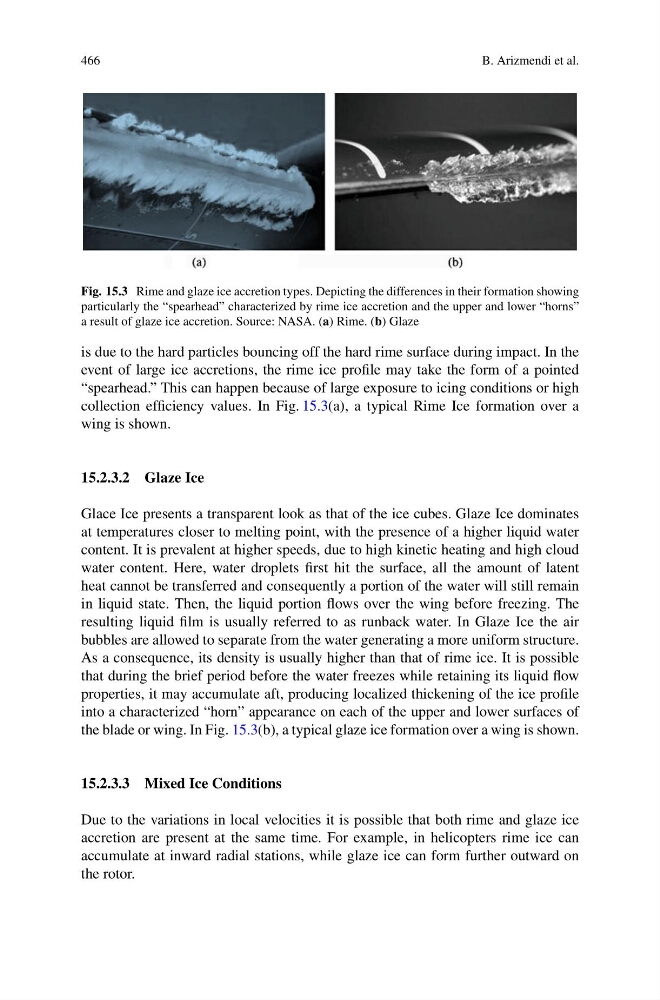
Fig. 15.3 Rime and glaze ice accretion types. Depicting the differences in their formation showing
particularly the “spearhead” characterized by rime ice accretion and the upper and lower “horns”
a result of glaze ice accretion. Source: NASA. (a) Rime. (b) Glaze
is due to the hard particles bouncing off the hard rime surface during impact. In the
event of large ice accretions, the rime ice profile may take the form of a pointed
“spearhead.” This can happen because of large exposure to icing conditions or high
collection efficiency values. In Fig. 15.3(a), a typical Rime Ice formation over a
wing is shown.
15.2.3.2 Glaze Ice
Glace Ice presents a transparent look as that of the ice cubes. Glaze Ice dominates
at temperatures closer to melting point, with the presence of a higher liquid water
content. It is prevalent at higher speeds, due to high kinetic heating and high cloud
water content. Here, water droplets first hit the surface, all the amount of latent
heat cannot be transferred and consequently a portion of the water will still remain
in liquid state. Then, the liquid portion flows over the wing before freezing. The
resulting liquid film is usually referred to as runback water. In Glaze Ice the air
bubbles are allowed to separate from the water generating a more uniform structure.
As a consequence, its density is usually higher than that of rime ice. It is possible
that during the brief period before the water freezes while retaining its liquid flow
properties, it may accumulate aft, producing localized thickening of the ice profile
into a characterized “horn” appearance on each of the upper and lower surfaces of
the blade or wing. In Fig. 15.3(b), a typical glaze ice formation over a wing is shown.
15.2.3.3 Mixed Ice Conditions
Due to the variations in local velocities it is possible that both rime and glaze ice
accretion are present at the same time. For example, in helicopters rime ice can
accumulate at inward radial stations, while glaze ice can form further outward on
the rotor.
B. Arizmendi et al.
Fig. 15.3 Rime and glaze ice accretion types. Depicting the differences in their formation showing
particularly the “spearhead” characterized by rime ice accretion and the upper and lower “horns”
a result of glaze ice accretion. Source: NASA. (a) Rime. (b) Glaze
is due to the hard particles bouncing off the hard rime surface during impact. In the
event of large ice accretions, the rime ice profile may take the form of a pointed
“spearhead.” This can happen because of large exposure to icing conditions or high
collection efficiency values. In Fig. 15.3(a), a typical Rime Ice formation over a
wing is shown.
15.2.3.2 Glaze Ice
Glace Ice presents a transparent look as that of the ice cubes. Glaze Ice dominates
at temperatures closer to melting point, with the presence of a higher liquid water
content. It is prevalent at higher speeds, due to high kinetic heating and high cloud
water content. Here, water droplets first hit the surface, all the amount of latent
heat cannot be transferred and consequently a portion of the water will still remain
in liquid state. Then, the liquid portion flows over the wing before freezing. The
resulting liquid film is usually referred to as runback water. In Glaze Ice the air
bubbles are allowed to separate from the water generating a more uniform structure.
As a consequence, its density is usually higher than that of rime ice. It is possible
that during the brief period before the water freezes while retaining its liquid flow
properties, it may accumulate aft, producing localized thickening of the ice profile
into a characterized “horn” appearance on each of the upper and lower surfaces of
the blade or wing. In Fig. 15.3(b), a typical glaze ice formation over a wing is shown.
15.2.3.3 Mixed Ice Conditions
Due to the variations in local velocities it is possible that both rime and glaze ice
accretion are present at the same time. For example, in helicopters rime ice can
accumulate at inward radial stations, while glaze ice can form further outward on
the rotor.