

15 In-flight Icing: Modeling, Prediction, and Uncertainty
467
15.2.4 Aircraft Icing Interactions
Water in solid and liquid phases interacts with the aircraft frame when it goes
through icing conditions and after the icing encounter. This section aims to describe
several interactions that present a complex physics, which have been studied in the
literature. Surface interaction describes the dependence of the surface properties
on the behavior of the droplets over it. Accordingly, ice shedding studies aim to
understand the physics and effects of the detachment of ice from the surfaces. Drop
impact studies intend to understand the process of collision and evolution of the
water droplet shape when colliding with a surface. Finally, crystal bouncing presents
the interaction of ice crystals present on clouds with the airframe.
15.2.4.1 Surface Interaction
Of particular interest for ice accretion is the study of the interaction of the
supercooled water liquid droplets-ice accreted with the surfaces to which they
collide/ adhere to. The characteristics of the interaction of liquid droplets with
a given surface depend on the wettability of the surface itself. The wettability
describes the spread of a droplet when contacting a certain surface. It can be
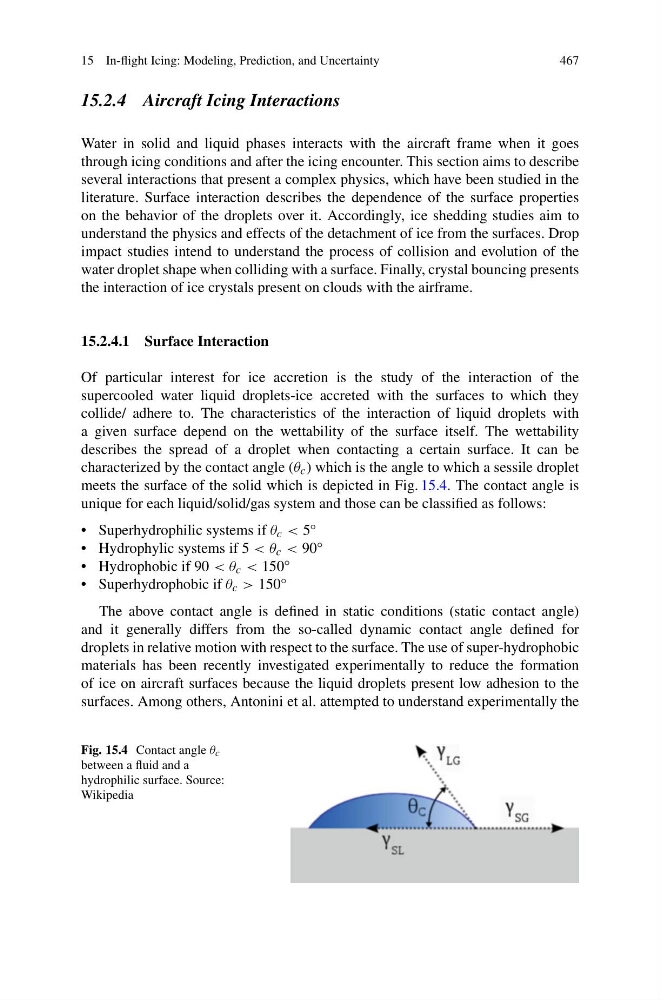
characterized by the contact angle (θ c ) which is the angle to which a sessile droplet
meets the surface of the solid which is depicted in Fig. 15.4. The contact angle is
unique for each liquid/solid/gas system and those can be classified as follows:
• Superhydrophilic systems if θ c < 5 ◦
• Hydrophylic systems if 5 < θ c < 90 ◦
• Hydrophobic if 90 < θ c < 150 ◦
• Superhydrophobic if θ c > 150 ◦
The above contact angle is defined in static conditions (static contact angle)
and it generally differs from the so-called dynamic contact angle defined for
droplets in relative motion with respect to the surface. The use of super-hydrophobic
materials has been recently investigated experimentally to reduce the formation
of ice on aircraft surfaces because the liquid droplets present low adhesion to the
surfaces. Among others, Antonini et al. attempted to understand experimentally the
Fig. 15.4 Contact angle θ c
between a fluid and a
hydrophilic surface. Source:
Wikipedia
467
15.2.4 Aircraft Icing Interactions
Water in solid and liquid phases interacts with the aircraft frame when it goes
through icing conditions and after the icing encounter. This section aims to describe
several interactions that present a complex physics, which have been studied in the
literature. Surface interaction describes the dependence of the surface properties
on the behavior of the droplets over it. Accordingly, ice shedding studies aim to
understand the physics and effects of the detachment of ice from the surfaces. Drop
impact studies intend to understand the process of collision and evolution of the
water droplet shape when colliding with a surface. Finally, crystal bouncing presents
the interaction of ice crystals present on clouds with the airframe.
15.2.4.1 Surface Interaction
Of particular interest for ice accretion is the study of the interaction of the
supercooled water liquid droplets-ice accreted with the surfaces to which they
collide/ adhere to. The characteristics of the interaction of liquid droplets with
a given surface depend on the wettability of the surface itself. The wettability
describes the spread of a droplet when contacting a certain surface. It can be
characterized by the contact angle (θ c ) which is the angle to which a sessile droplet
meets the surface of the solid which is depicted in Fig. 15.4. The contact angle is
unique for each liquid/solid/gas system and those can be classified as follows:
• Superhydrophilic systems if θ c < 5 ◦
• Hydrophylic systems if 5 < θ c < 90 ◦
• Hydrophobic if 90 < θ c < 150 ◦
• Superhydrophobic if θ c > 150 ◦
The above contact angle is defined in static conditions (static contact angle)
and it generally differs from the so-called dynamic contact angle defined for
droplets in relative motion with respect to the surface. The use of super-hydrophobic
materials has been recently investigated experimentally to reduce the formation
of ice on aircraft surfaces because the liquid droplets present low adhesion to the
surfaces. Among others, Antonini et al. attempted to understand experimentally the
Fig. 15.4 Contact angle θ c
between a fluid and a
hydrophilic surface. Source:
Wikipedia