

15 In-flight Icing: Modeling, Prediction, and Uncertainty
465
ice stagnation
point
ice
stagnation
point
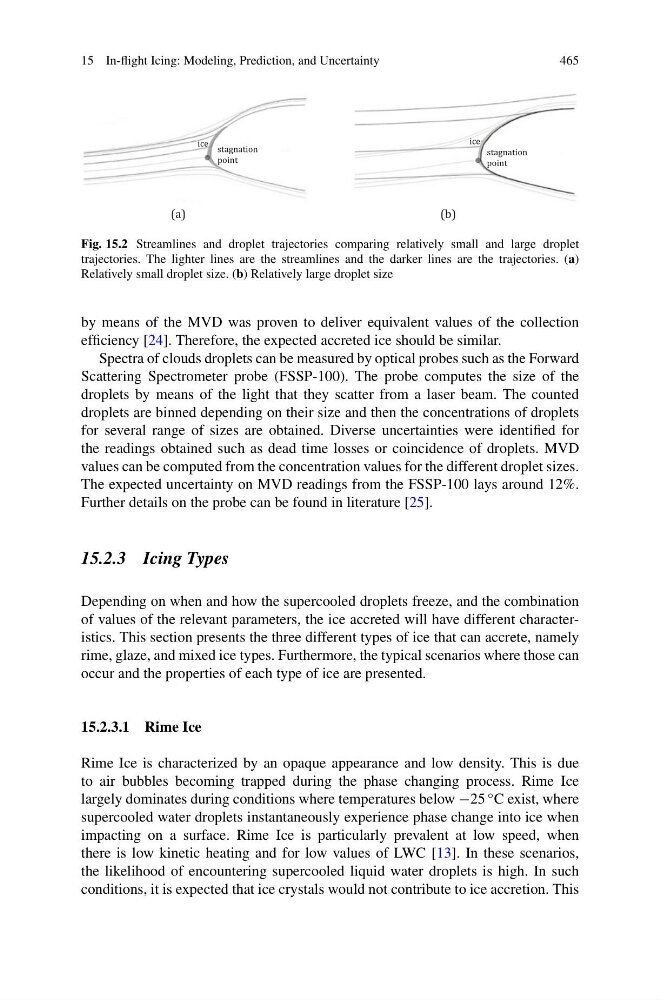
Fig. 15.2 Streamlines and droplet trajectories comparing relatively small and large droplet
trajectories. The lighter lines are the streamlines and the darker lines are the trajectories. (a)
Relatively small droplet size. (b) Relatively large droplet size
by means of the MVD was proven to deliver equivalent values of the collection
efficiency [24]. Therefore, the expected accreted ice should be similar.
Spectra of clouds droplets can be measured by optical probes such as the Forward
Scattering Spectrometer probe (FSSP-100). The probe computes the size of the
droplets by means of the light that they scatter from a laser beam. The counted
droplets are binned depending on their size and then the concentrations of droplets
for several range of sizes are obtained. Diverse uncertainties were identified for
the readings obtained such as dead time losses or coincidence of droplets. MVD
values can be computed from the concentration values for the different droplet sizes.
The expected uncertainty on MVD readings from the FSSP-100 lays around 12%.
Further details on the probe can be found in literature [25].
15.2.3 Icing Types
Depending on when and how the supercooled droplets freeze, and the combination
of values of the relevant parameters, the ice accreted will have different characteristics. This section presents the three different types of ice that can accrete, namely
rime, glaze, and mixed ice types. Furthermore, the typical scenarios where those can
occur and the properties of each type of ice are presented.
15.2.3.1 Rime Ice
Rime Ice is characterized by an opaque appearance and low density. This is due
to air bubbles becoming trapped during the phase changing process. Rime Ice
largely dominates during conditions where temperatures below −25 ◦ C exist, where
supercooled water droplets instantaneously experience phase change into ice when
impacting on a surface. Rime Ice is particularly prevalent at low speed, when
there is low kinetic heating and for low values of LWC [13]. In these scenarios,
the likelihood of encountering supercooled liquid water droplets is high. In such
conditions, it is expected that ice crystals would not contribute to ice accretion. This
465
ice stagnation
point
ice
stagnation
point
Fig. 15.2 Streamlines and droplet trajectories comparing relatively small and large droplet
trajectories. The lighter lines are the streamlines and the darker lines are the trajectories. (a)
Relatively small droplet size. (b) Relatively large droplet size
by means of the MVD was proven to deliver equivalent values of the collection
efficiency [24]. Therefore, the expected accreted ice should be similar.
Spectra of clouds droplets can be measured by optical probes such as the Forward
Scattering Spectrometer probe (FSSP-100). The probe computes the size of the
droplets by means of the light that they scatter from a laser beam. The counted
droplets are binned depending on their size and then the concentrations of droplets
for several range of sizes are obtained. Diverse uncertainties were identified for
the readings obtained such as dead time losses or coincidence of droplets. MVD
values can be computed from the concentration values for the different droplet sizes.
The expected uncertainty on MVD readings from the FSSP-100 lays around 12%.
Further details on the probe can be found in literature [25].
15.2.3 Icing Types
Depending on when and how the supercooled droplets freeze, and the combination
of values of the relevant parameters, the ice accreted will have different characteristics. This section presents the three different types of ice that can accrete, namely
rime, glaze, and mixed ice types. Furthermore, the typical scenarios where those can
occur and the properties of each type of ice are presented.
15.2.3.1 Rime Ice
Rime Ice is characterized by an opaque appearance and low density. This is due
to air bubbles becoming trapped during the phase changing process. Rime Ice
largely dominates during conditions where temperatures below −25 ◦ C exist, where
supercooled water droplets instantaneously experience phase change into ice when
impacting on a surface. Rime Ice is particularly prevalent at low speed, when
there is low kinetic heating and for low values of LWC [13]. In these scenarios,
the likelihood of encountering supercooled liquid water droplets is high. In such
conditions, it is expected that ice crystals would not contribute to ice accretion. This