

464
B. Arizmendi et al.
˙
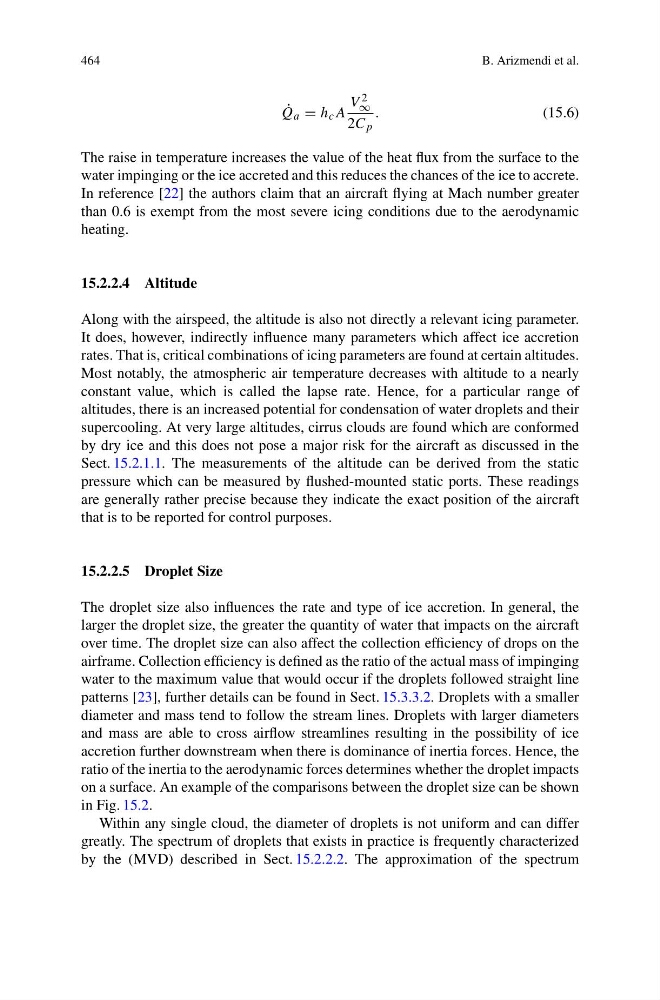
Q a = h c A
V 2
∞
2C p
.
(15.6)
The raise in temperature increases the value of the heat flux from the surface to the
water impinging or the ice accreted and this reduces the chances of the ice to accrete.
In reference [22] the authors claim that an aircraft flying at Mach number greater
than 0.6 is exempt from the most severe icing conditions due to the aerodynamic
heating.
15.2.2.4 Altitude
Along with the airspeed, the altitude is also not directly a relevant icing parameter.
It does, however, indirectly influence many parameters which affect ice accretion
rates. That is, critical combinations of icing parameters are found at certain altitudes.
Most notably, the atmospheric air temperature decreases with altitude to a nearly
constant value, which is called the lapse rate. Hence, for a particular range of
altitudes, there is an increased potential for condensation of water droplets and their
supercooling. At very large altitudes, cirrus clouds are found which are conformed
by dry ice and this does not pose a major risk for the aircraft as discussed in the
Sect. 15.2.1.1. The measurements of the altitude can be derived from the static
pressure which can be measured by flushed-mounted static ports. These readings
are generally rather precise because they indicate the exact position of the aircraft
that is to be reported for control purposes.
15.2.2.5 Droplet Size
The droplet size also influences the rate and type of ice accretion. In general, the
larger the droplet size, the greater the quantity of water that impacts on the aircraft
over time. The droplet size can also affect the collection efficiency of drops on the
airframe. Collection efficiency is defined as the ratio of the actual mass of impinging
water to the maximum value that would occur if the droplets followed straight line
patterns [23], further details can be found in Sect. 15.3.3.2. Droplets with a smaller
diameter and mass tend to follow the stream lines. Droplets with larger diameters
and mass are able to cross airflow streamlines resulting in the possibility of ice
accretion further downstream when there is dominance of inertia forces. Hence, the
ratio of the inertia to the aerodynamic forces determines whether the droplet impacts
on a surface. An example of the comparisons between the droplet size can be shown
in Fig. 15.2.
Within any single cloud, the diameter of droplets is not uniform and can differ
greatly. The spectrum of droplets that exists in practice is frequently characterized
by the (MVD) described in Sect. 15.2.2.2. The approximation of the spectrum
B. Arizmendi et al.
˙
Q a = h c A
V 2
∞
2C p
.
(15.6)
The raise in temperature increases the value of the heat flux from the surface to the
water impinging or the ice accreted and this reduces the chances of the ice to accrete.
In reference [22] the authors claim that an aircraft flying at Mach number greater
than 0.6 is exempt from the most severe icing conditions due to the aerodynamic
heating.
15.2.2.4 Altitude
Along with the airspeed, the altitude is also not directly a relevant icing parameter.
It does, however, indirectly influence many parameters which affect ice accretion
rates. That is, critical combinations of icing parameters are found at certain altitudes.
Most notably, the atmospheric air temperature decreases with altitude to a nearly
constant value, which is called the lapse rate. Hence, for a particular range of
altitudes, there is an increased potential for condensation of water droplets and their
supercooling. At very large altitudes, cirrus clouds are found which are conformed
by dry ice and this does not pose a major risk for the aircraft as discussed in the
Sect. 15.2.1.1. The measurements of the altitude can be derived from the static
pressure which can be measured by flushed-mounted static ports. These readings
are generally rather precise because they indicate the exact position of the aircraft
that is to be reported for control purposes.
15.2.2.5 Droplet Size
The droplet size also influences the rate and type of ice accretion. In general, the
larger the droplet size, the greater the quantity of water that impacts on the aircraft
over time. The droplet size can also affect the collection efficiency of drops on the
airframe. Collection efficiency is defined as the ratio of the actual mass of impinging
water to the maximum value that would occur if the droplets followed straight line
patterns [23], further details can be found in Sect. 15.3.3.2. Droplets with a smaller
diameter and mass tend to follow the stream lines. Droplets with larger diameters
and mass are able to cross airflow streamlines resulting in the possibility of ice
accretion further downstream when there is dominance of inertia forces. Hence, the
ratio of the inertia to the aerodynamic forces determines whether the droplet impacts
on a surface. An example of the comparisons between the droplet size can be shown
in Fig. 15.2.
Within any single cloud, the diameter of droplets is not uniform and can differ
greatly. The spectrum of droplets that exists in practice is frequently characterized
by the (MVD) described in Sect. 15.2.2.2. The approximation of the spectrum