

15 In-flight Icing: Modeling, Prediction, and Uncertainty
463
where ˙
m f r is the mass of freezing water and L f is the latent heat of fusion. The
mass of freezing water is dependent on the LWC of the cloud and so does the type
of ice accreted. Consequently, the larger the value of LWC, the greater the amount of
latent heat which must be removed from the impinging droplets to freeze on impact.
If part of the water remains in liquid state, this will run downstream by aerodynamic
forces.
Higher rates of ice accretion can occur when the clouds present higher values
of LWC. Typical values are in the range of 0.3–0.5 g/m 3 for the 90% of the
stratiform clouds and between 0.5 and 0.7 g/m 3 for convective clouds [13]. The
maximum LWC value the authors found was of 1.3 g/m 3 . It was also noted from
icing encounter reports that at very low temperatures, large droplets were rarely
encountered.
Hot wire probes are widely used to measure LWC in-flight. The hot wire is kept at
100 ◦ C and the LWC is proportional to the amount of heat needed to fully evaporate
the impinging droplets. The uncertainty of these measurements ranges 20–30%,
increasing the larger the LWC and the MVD. This is caused by partial evaporation
of large droplets or high values of LWC. Further details can be found in [21].
15.2.2.3 Airspeed
Although not strictly itself an icing parameter, the airspeed has a significant
influence in determining the rate of accretion. The higher the airspeed, the greater
the intercepted volume of air per unit time and hence the larger the amount of mass
of water available to accumulate on the body [12]. In addition, the heat transfer
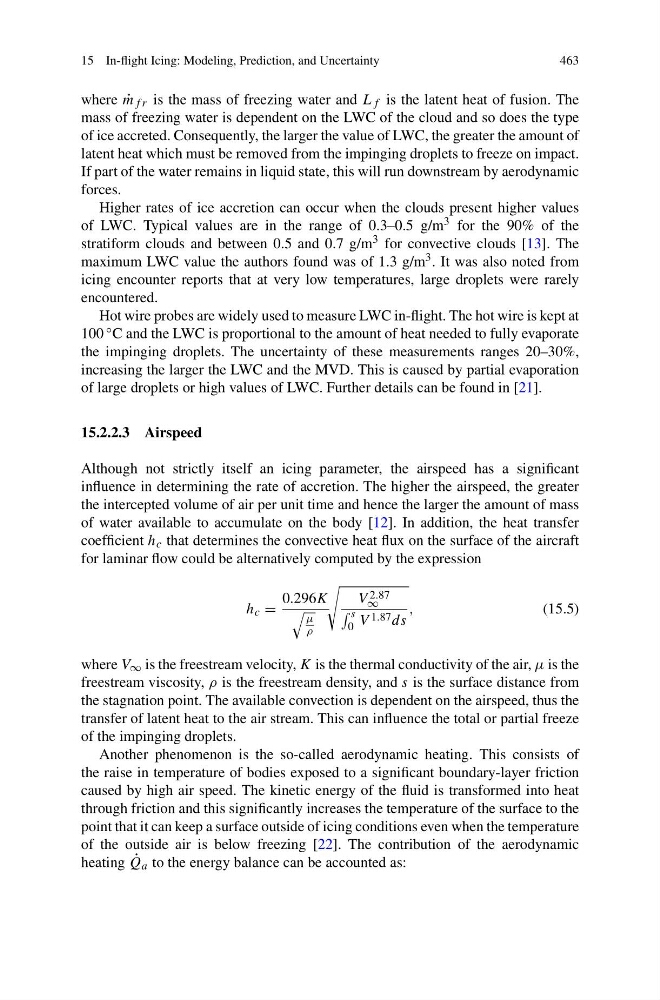
coefficient h c that determines the convective heat flux on the surface of the aircraft
for laminar flow could be alternatively computed by the expression
h c =
0.296K
μ
ρ
V 2.87
∞
s
0 V 1.87 ds
,
(15.5)
where V ∞ is the freestream velocity, K is the thermal conductivity of the air, μ is the
freestream viscosity, ρ is the freestream density, and s is the surface distance from
the stagnation point. The available convection is dependent on the airspeed, thus the
transfer of latent heat to the air stream. This can influence the total or partial freeze
of the impinging droplets.
Another phenomenon is the so-called aerodynamic heating. This consists of
the raise in temperature of bodies exposed to a significant boundary-layer friction
caused by high air speed. The kinetic energy of the fluid is transformed into heat
through friction and this significantly increases the temperature of the surface to the
point that it can keep a surface outside of icing conditions even when the temperature
of the outside air is below freezing [22]. The contribution of the aerodynamic
heating ˙
Q a to the energy balance can be accounted as:
463
where ˙
m f r is the mass of freezing water and L f is the latent heat of fusion. The
mass of freezing water is dependent on the LWC of the cloud and so does the type
of ice accreted. Consequently, the larger the value of LWC, the greater the amount of
latent heat which must be removed from the impinging droplets to freeze on impact.
If part of the water remains in liquid state, this will run downstream by aerodynamic
forces.
Higher rates of ice accretion can occur when the clouds present higher values
of LWC. Typical values are in the range of 0.3–0.5 g/m 3 for the 90% of the
stratiform clouds and between 0.5 and 0.7 g/m 3 for convective clouds [13]. The
maximum LWC value the authors found was of 1.3 g/m 3 . It was also noted from
icing encounter reports that at very low temperatures, large droplets were rarely
encountered.
Hot wire probes are widely used to measure LWC in-flight. The hot wire is kept at
100 ◦ C and the LWC is proportional to the amount of heat needed to fully evaporate
the impinging droplets. The uncertainty of these measurements ranges 20–30%,
increasing the larger the LWC and the MVD. This is caused by partial evaporation
of large droplets or high values of LWC. Further details can be found in [21].
15.2.2.3 Airspeed
Although not strictly itself an icing parameter, the airspeed has a significant
influence in determining the rate of accretion. The higher the airspeed, the greater
the intercepted volume of air per unit time and hence the larger the amount of mass
of water available to accumulate on the body [12]. In addition, the heat transfer
coefficient h c that determines the convective heat flux on the surface of the aircraft
for laminar flow could be alternatively computed by the expression
h c =
0.296K
μ
ρ
V 2.87
∞
s
0 V 1.87 ds
,
(15.5)
where V ∞ is the freestream velocity, K is the thermal conductivity of the air, μ is the
freestream viscosity, ρ is the freestream density, and s is the surface distance from
the stagnation point. The available convection is dependent on the airspeed, thus the
transfer of latent heat to the air stream. This can influence the total or partial freeze
of the impinging droplets.
Another phenomenon is the so-called aerodynamic heating. This consists of
the raise in temperature of bodies exposed to a significant boundary-layer friction
caused by high air speed. The kinetic energy of the fluid is transformed into heat
through friction and this significantly increases the temperature of the surface to the
point that it can keep a surface outside of icing conditions even when the temperature
of the outside air is below freezing [22]. The contribution of the aerodynamic
heating ˙
Q a to the energy balance can be accounted as: