

14 Best Practices for Surrogate Based Uncertainty Quantification in. . .
443
Table 14.2 Characterization
of operational uncertainties
Mach number Lift coefficient
Mean
0.76
0.5
Standard deviation 0.0033
0.00333
0 and 1, corresponding to its minimum and maximum value, respectively. They
control the amplitude (positive or negative) of the deformation.
14.4.5 Parametrization of Uncertainties
The operational uncertainties (the freestream Mach number and lift coefficient)
present in the day to day of the airfoil operations are considered. These are
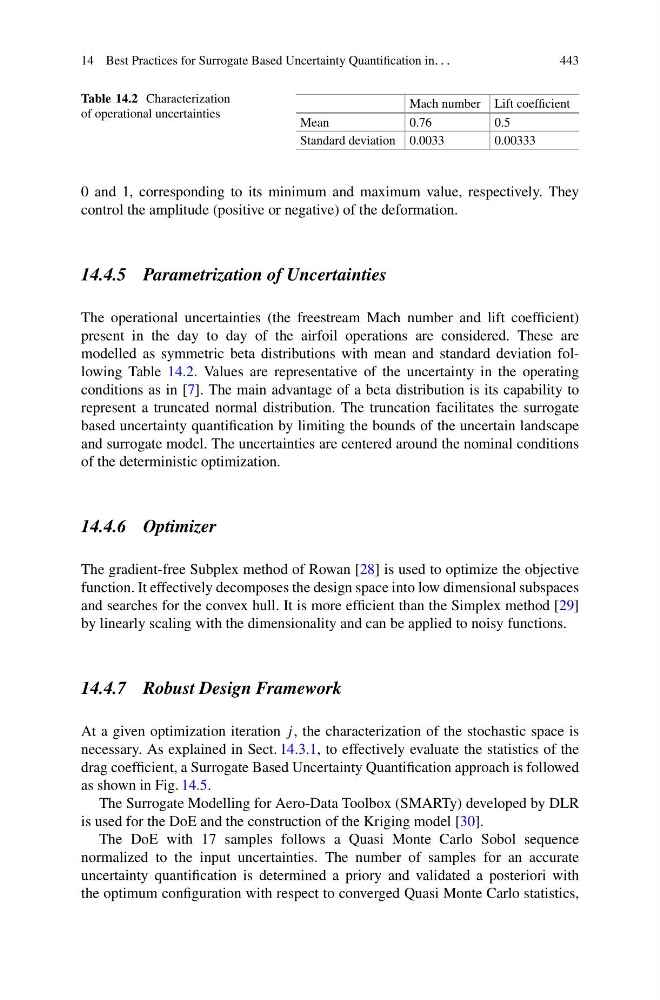
modelled as symmetric beta distributions with mean and standard deviation following Table 14.2. Values are representative of the uncertainty in the operating
conditions as in [7]. The main advantage of a beta distribution is its capability to
represent a truncated normal distribution. The truncation facilitates the surrogate
based uncertainty quantification by limiting the bounds of the uncertain landscape
and surrogate model. The uncertainties are centered around the nominal conditions
of the deterministic optimization.
14.4.6 Optimizer
The gradient-free Subplex method of Rowan [28] is used to optimize the objective
function. It effectively decomposes the design space into low dimensional subspaces
and searches for the convex hull. It is more efficient than the Simplex method [29]
by linearly scaling with the dimensionality and can be applied to noisy functions.
14.4.7 Robust Design Framework
At a given optimization iteration j , the characterization of the stochastic space is
necessary. As explained in Sect. 14.3.1, to effectively evaluate the statistics of the
drag coefficient, a Surrogate Based Uncertainty Quantification approach is followed
as shown in Fig. 14.5.
The Surrogate Modelling for Aero-Data Toolbox (SMARTy) developed by DLR
is used for the DoE and the construction of the Kriging model [30].
The DoE with 17 samples follows a Quasi Monte Carlo Sobol sequence
normalized to the input uncertainties. The number of samples for an accurate
uncertainty quantification is determined a priory and validated a posteriori with
the optimum configuration with respect to converged Quasi Monte Carlo statistics,
443
Table 14.2 Characterization
of operational uncertainties
Mach number Lift coefficient
Mean
0.76
0.5
Standard deviation 0.0033
0.00333
0 and 1, corresponding to its minimum and maximum value, respectively. They
control the amplitude (positive or negative) of the deformation.
14.4.5 Parametrization of Uncertainties
The operational uncertainties (the freestream Mach number and lift coefficient)
present in the day to day of the airfoil operations are considered. These are
modelled as symmetric beta distributions with mean and standard deviation following Table 14.2. Values are representative of the uncertainty in the operating
conditions as in [7]. The main advantage of a beta distribution is its capability to
represent a truncated normal distribution. The truncation facilitates the surrogate
based uncertainty quantification by limiting the bounds of the uncertain landscape
and surrogate model. The uncertainties are centered around the nominal conditions
of the deterministic optimization.
14.4.6 Optimizer
The gradient-free Subplex method of Rowan [28] is used to optimize the objective
function. It effectively decomposes the design space into low dimensional subspaces
and searches for the convex hull. It is more efficient than the Simplex method [29]
by linearly scaling with the dimensionality and can be applied to noisy functions.
14.4.7 Robust Design Framework
At a given optimization iteration j , the characterization of the stochastic space is
necessary. As explained in Sect. 14.3.1, to effectively evaluate the statistics of the
drag coefficient, a Surrogate Based Uncertainty Quantification approach is followed
as shown in Fig. 14.5.
The Surrogate Modelling for Aero-Data Toolbox (SMARTy) developed by DLR
is used for the DoE and the construction of the Kriging model [30].
The DoE with 17 samples follows a Quasi Monte Carlo Sobol sequence
normalized to the input uncertainties. The number of samples for an accurate
uncertainty quantification is determined a priory and validated a posteriori with
the optimum configuration with respect to converged Quasi Monte Carlo statistics,