

432
C. Sabater
operational uncertainties. It only focuses on the operating condition with larger
drag (usually at high Mach and/or lift coefficients). As a result of not taking into
consideration the global behavior but the worst-case scenario, it is more appropriate
for Structural Optimization field rather than for Aerodynamic Shape Optimization
problems. In this case, a very conservative design will be obtained. For example, the
solution can be optimal with respect to very high Mach numbers, while during the
rest of the flight envelope the opportunity of further reducing drag is lost, leading
towards an increase in fuel consumption. In addition, this approach is dependent on
the choice of operating condition A i .
14.2.3 Interval Analysis
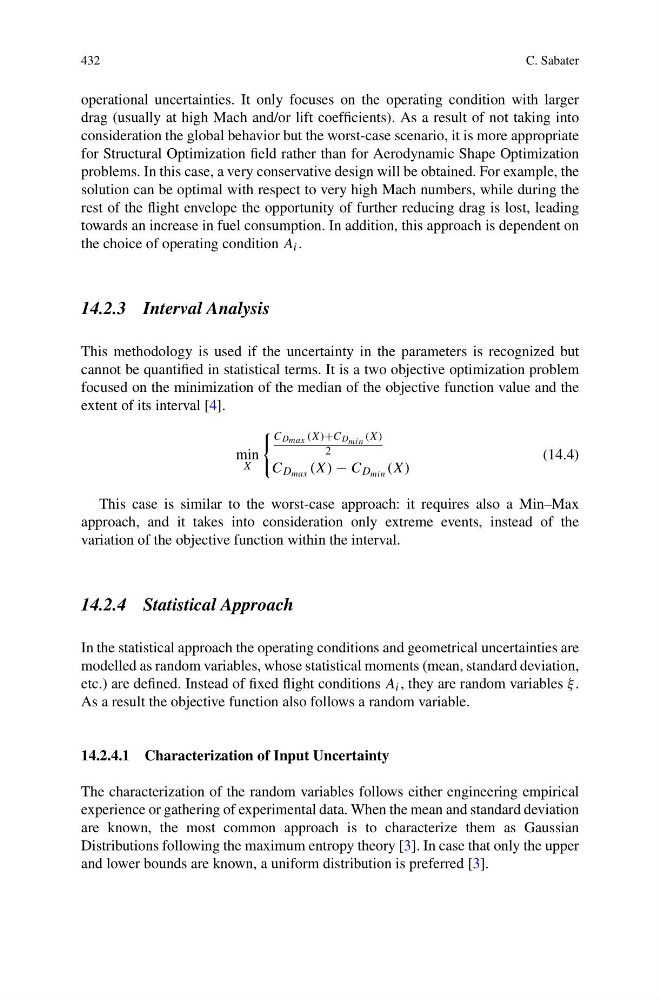
This methodology is used if the uncertainty in the parameters is recognized but
cannot be quantified in statistical terms. It is a two objective optimization problem
focused on the minimization of the median of the objective function value and the
extent of its interval [4].
min
X
C Dmax (X)+C D min (X)
2
C D max (X) − C D min (X)
(14.4)
This case is similar to the worst-case approach: it requires also a Min–Max
approach, and it takes into consideration only extreme events, instead of the
variation of the objective function within the interval.
14.2.4 Statistical Approach
In the statistical approach the operating conditions and geometrical uncertainties are
modelled as random variables, whose statistical moments (mean, standard deviation,
etc.) are defined. Instead of fixed flight conditions A i , they are random variables ξ .
As a result the objective function also follows a random variable.
14.2.4.1 Characterization of Input Uncertainty
The characterization of the random variables follows either engineering empirical
experience or gathering of experimental data. When the mean and standard deviation
are known, the most common approach is to characterize them as Gaussian
Distributions following the maximum entropy theory [3]. In case that only the upper
and lower bounds are known, a uniform distribution is preferred [3].
C. Sabater
operational uncertainties. It only focuses on the operating condition with larger
drag (usually at high Mach and/or lift coefficients). As a result of not taking into
consideration the global behavior but the worst-case scenario, it is more appropriate
for Structural Optimization field rather than for Aerodynamic Shape Optimization
problems. In this case, a very conservative design will be obtained. For example, the
solution can be optimal with respect to very high Mach numbers, while during the
rest of the flight envelope the opportunity of further reducing drag is lost, leading
towards an increase in fuel consumption. In addition, this approach is dependent on
the choice of operating condition A i .
14.2.3 Interval Analysis
This methodology is used if the uncertainty in the parameters is recognized but
cannot be quantified in statistical terms. It is a two objective optimization problem
focused on the minimization of the median of the objective function value and the
extent of its interval [4].
min
X
C Dmax (X)+C D min (X)
2
C D max (X) − C D min (X)
(14.4)
This case is similar to the worst-case approach: it requires also a Min–Max
approach, and it takes into consideration only extreme events, instead of the
variation of the objective function within the interval.
14.2.4 Statistical Approach
In the statistical approach the operating conditions and geometrical uncertainties are
modelled as random variables, whose statistical moments (mean, standard deviation,
etc.) are defined. Instead of fixed flight conditions A i , they are random variables ξ .
As a result the objective function also follows a random variable.
14.2.4.1 Characterization of Input Uncertainty
The characterization of the random variables follows either engineering empirical
experience or gathering of experimental data. When the mean and standard deviation
are known, the most common approach is to characterize them as Gaussian
Distributions following the maximum entropy theory [3]. In case that only the upper
and lower bounds are known, a uniform distribution is preferred [3].