

14 Best Practices for Surrogate Based Uncertainty Quantification in. . .
431
14.2 Robust Design Approaches for Aerodynamic Shape
Optimization
Historically, several approaches have been available for robust aerodynamic shape
optimization. In this section, they are briefly introduced.
14.2.1 Multi-Point Optimization
Multi-point optimization is the most widely used approach in aerodynamic shape
optimization to reduce the sensitivity to the operating conditions. The optimization
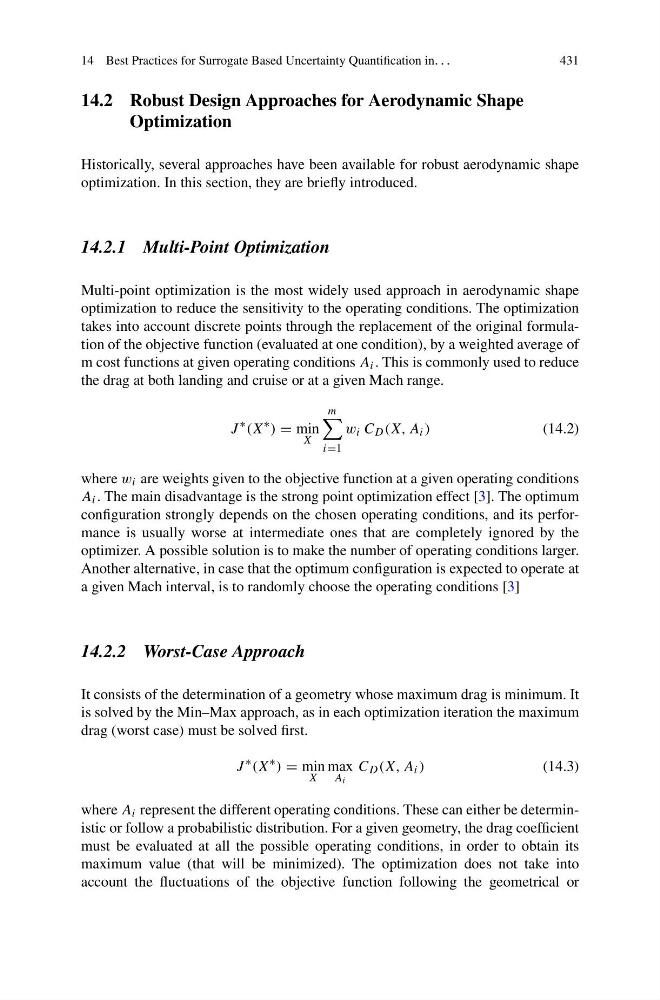
takes into account discrete points through the replacement of the original formulation of the objective function (evaluated at one condition), by a weighted average of
m cost functions at given operating conditions A i . This is commonly used to reduce
the drag at both landing and cruise or at a given Mach range.
J
∗ (X
∗ ) = min
X
m
i=1
w i C D (X, A i )
(14.2)
where w i are weights given to the objective function at a given operating conditions
A i . The main disadvantage is the strong point optimization effect [3]. The optimum
configuration strongly depends on the chosen operating conditions, and its performance is usually worse at intermediate ones that are completely ignored by the
optimizer. A possible solution is to make the number of operating conditions larger.
Another alternative, in case that the optimum configuration is expected to operate at
a given Mach interval, is to randomly choose the operating conditions [3]
14.2.2 Worst-Case Approach
It consists of the determination of a geometry whose maximum drag is minimum. It
is solved by the Min–Max approach, as in each optimization iteration the maximum
drag (worst case) must be solved first.
J
∗ (X
∗ ) = min
X
max
A i
C D (X, A i )
(14.3)
where A i represent the different operating conditions. These can either be deterministic or follow a probabilistic distribution. For a given geometry, the drag coefficient
must be evaluated at all the possible operating conditions, in order to obtain its
maximum value (that will be minimized). The optimization does not take into
account the fluctuations of the objective function following the geometrical or
431
14.2 Robust Design Approaches for Aerodynamic Shape
Optimization
Historically, several approaches have been available for robust aerodynamic shape
optimization. In this section, they are briefly introduced.
14.2.1 Multi-Point Optimization
Multi-point optimization is the most widely used approach in aerodynamic shape
optimization to reduce the sensitivity to the operating conditions. The optimization
takes into account discrete points through the replacement of the original formulation of the objective function (evaluated at one condition), by a weighted average of
m cost functions at given operating conditions A i . This is commonly used to reduce
the drag at both landing and cruise or at a given Mach range.
J
∗ (X
∗ ) = min
X
m
i=1
w i C D (X, A i )
(14.2)
where w i are weights given to the objective function at a given operating conditions
A i . The main disadvantage is the strong point optimization effect [3]. The optimum
configuration strongly depends on the chosen operating conditions, and its performance is usually worse at intermediate ones that are completely ignored by the
optimizer. A possible solution is to make the number of operating conditions larger.
Another alternative, in case that the optimum configuration is expected to operate at
a given Mach interval, is to randomly choose the operating conditions [3]
14.2.2 Worst-Case Approach
It consists of the determination of a geometry whose maximum drag is minimum. It
is solved by the Min–Max approach, as in each optimization iteration the maximum
drag (worst case) must be solved first.
J
∗ (X
∗ ) = min
X
max
A i
C D (X, A i )
(14.3)
where A i represent the different operating conditions. These can either be deterministic or follow a probabilistic distribution. For a given geometry, the drag coefficient
must be evaluated at all the possible operating conditions, in order to obtain its
maximum value (that will be minimized). The optimization does not take into
account the fluctuations of the objective function following the geometrical or