

430
C. Sabater
14.1.1 Deterministic Optimization
A typical optimization setup aims to obtain the “best” solution to a given problem.
This “best” solution does not need to be the global optimum of the problem,
but is most cases it being sufficiently superior is enough, a local optimum that
satisfies the design requirements and constraints. In the case of aerodynamic shape
optimization problems, due to the complex nature of computational fluid dynamics,
the optimization must be performed within realistic run times according to the
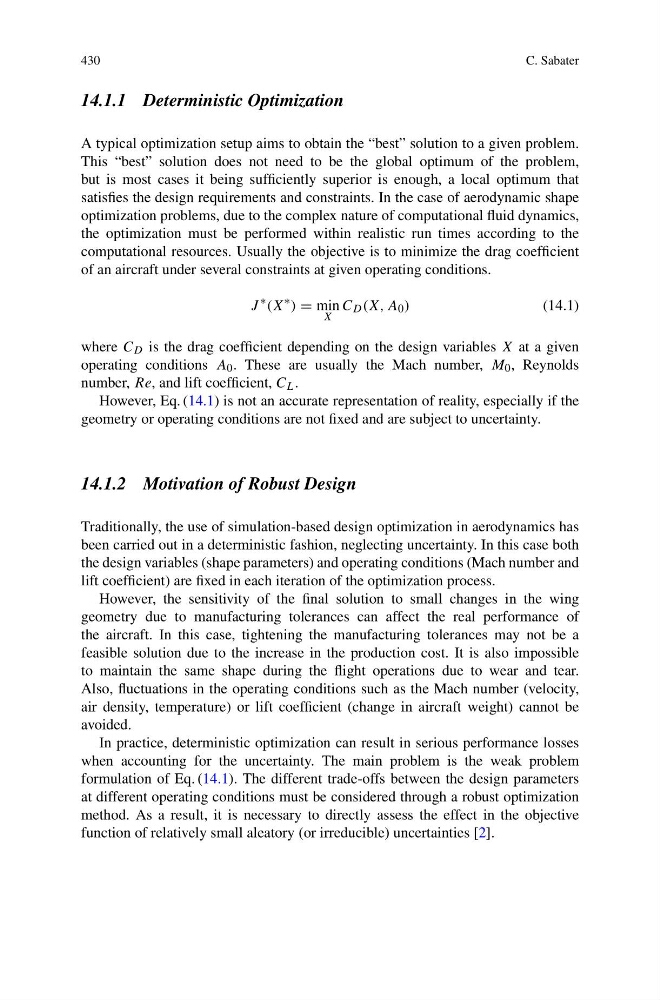
computational resources. Usually the objective is to minimize the drag coefficient
of an aircraft under several constraints at given operating conditions.
J
∗ (X
∗ ) = min
X
C D (X, A 0 )
(14.1)
where C D is the drag coefficient depending on the design variables X at a given
operating conditions A 0 . These are usually the Mach number, M 0 , Reynolds
number, Re, and lift coefficient, C L .
However, Eq. (14.1) is not an accurate representation of reality, especially if the
geometry or operating conditions are not fixed and are subject to uncertainty.
14.1.2 Motivation of Robust Design
Traditionally, the use of simulation-based design optimization in aerodynamics has
been carried out in a deterministic fashion, neglecting uncertainty. In this case both
the design variables (shape parameters) and operating conditions (Mach number and
lift coefficient) are fixed in each iteration of the optimization process.
However, the sensitivity of the final solution to small changes in the wing
geometry due to manufacturing tolerances can affect the real performance of
the aircraft. In this case, tightening the manufacturing tolerances may not be a
feasible solution due to the increase in the production cost. It is also impossible
to maintain the same shape during the flight operations due to wear and tear.
Also, fluctuations in the operating conditions such as the Mach number (velocity,
air density, temperature) or lift coefficient (change in aircraft weight) cannot be
avoided.
In practice, deterministic optimization can result in serious performance losses
when accounting for the uncertainty. The main problem is the weak problem
formulation of Eq. (14.1). The different trade-offs between the design parameters
at different operating conditions must be considered through a robust optimization
method. As a result, it is necessary to directly assess the effect in the objective
function of relatively small aleatory (or irreducible) uncertainties [2].
C. Sabater
14.1.1 Deterministic Optimization
A typical optimization setup aims to obtain the “best” solution to a given problem.
This “best” solution does not need to be the global optimum of the problem,
but is most cases it being sufficiently superior is enough, a local optimum that
satisfies the design requirements and constraints. In the case of aerodynamic shape
optimization problems, due to the complex nature of computational fluid dynamics,
the optimization must be performed within realistic run times according to the
computational resources. Usually the objective is to minimize the drag coefficient
of an aircraft under several constraints at given operating conditions.
J
∗ (X
∗ ) = min
X
C D (X, A 0 )
(14.1)
where C D is the drag coefficient depending on the design variables X at a given
operating conditions A 0 . These are usually the Mach number, M 0 , Reynolds
number, Re, and lift coefficient, C L .
However, Eq. (14.1) is not an accurate representation of reality, especially if the
geometry or operating conditions are not fixed and are subject to uncertainty.
14.1.2 Motivation of Robust Design
Traditionally, the use of simulation-based design optimization in aerodynamics has
been carried out in a deterministic fashion, neglecting uncertainty. In this case both
the design variables (shape parameters) and operating conditions (Mach number and
lift coefficient) are fixed in each iteration of the optimization process.
However, the sensitivity of the final solution to small changes in the wing
geometry due to manufacturing tolerances can affect the real performance of
the aircraft. In this case, tightening the manufacturing tolerances may not be a
feasible solution due to the increase in the production cost. It is also impossible
to maintain the same shape during the flight operations due to wear and tear.
Also, fluctuations in the operating conditions such as the Mach number (velocity,
air density, temperature) or lift coefficient (change in aircraft weight) cannot be
avoided.
In practice, deterministic optimization can result in serious performance losses
when accounting for the uncertainty. The main problem is the weak problem
formulation of Eq. (14.1). The different trade-offs between the design parameters
at different operating conditions must be considered through a robust optimization
method. As a result, it is necessary to directly assess the effect in the objective
function of relatively small aleatory (or irreducible) uncertainties [2].