

13 Risk Measures in the Context of Robust and Reliability Based Optimization
417
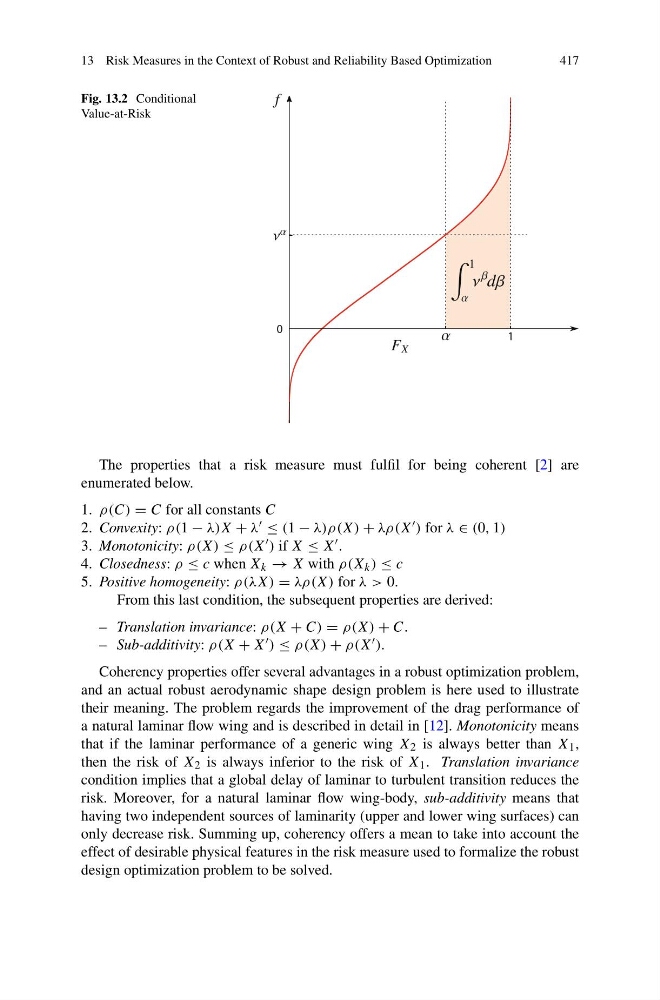
Fig. 13.2 Conditional
Value-at-Risk
1
0
The properties that a risk measure must fulfil for being coherent [2] are
enumerated below.
1. ρ(C) = C for all constants C
2. Convexity: ρ(1 − λ)X + λ ≤ (1 − λ)ρ(X) + λρ(X ) for λ ∈ (0, 1)
3. Monotonicity: ρ(X) ≤ ρ(X ) if X ≤ X .
4. Closedness: ρ ≤ c when X k → X with ρ(X k ) ≤ c
5. Positive homogeneity: ρ(λX) = λρ(X) for λ > 0.
From this last condition, the subsequent properties are derived:
– Translation invariance: ρ(X + C) = ρ(X) + C.
– Sub-additivity: ρ(X + X ) ≤ ρ(X) + ρ(X ).
Coherency properties offer several advantages in a robust optimization problem,
and an actual robust aerodynamic shape design problem is here used to illustrate
their meaning. The problem regards the improvement of the drag performance of
a natural laminar flow wing and is described in detail in [12]. Monotonicity means
that if the laminar performance of a generic wing X 2 is always better than X 1 ,
then the risk of X 2 is always inferior to the risk of X 1 . Translation invariance
condition implies that a global delay of laminar to turbulent transition reduces the
risk. Moreover, for a natural laminar flow wing-body, sub-additivity means that
having two independent sources of laminarity (upper and lower wing surfaces) can
only decrease risk. Summing up, coherency offers a mean to take into account the
effect of desirable physical features in the risk measure used to formalize the robust
design optimization problem to be solved.
417
Fig. 13.2 Conditional
Value-at-Risk
1
0
The properties that a risk measure must fulfil for being coherent [2] are
enumerated below.
1. ρ(C) = C for all constants C
2. Convexity: ρ(1 − λ)X + λ ≤ (1 − λ)ρ(X) + λρ(X ) for λ ∈ (0, 1)
3. Monotonicity: ρ(X) ≤ ρ(X ) if X ≤ X .
4. Closedness: ρ ≤ c when X k → X with ρ(X k ) ≤ c
5. Positive homogeneity: ρ(λX) = λρ(X) for λ > 0.
From this last condition, the subsequent properties are derived:
– Translation invariance: ρ(X + C) = ρ(X) + C.
– Sub-additivity: ρ(X + X ) ≤ ρ(X) + ρ(X ).
Coherency properties offer several advantages in a robust optimization problem,
and an actual robust aerodynamic shape design problem is here used to illustrate
their meaning. The problem regards the improvement of the drag performance of
a natural laminar flow wing and is described in detail in [12]. Monotonicity means
that if the laminar performance of a generic wing X 2 is always better than X 1 ,
then the risk of X 2 is always inferior to the risk of X 1 . Translation invariance
condition implies that a global delay of laminar to turbulent transition reduces the
risk. Moreover, for a natural laminar flow wing-body, sub-additivity means that
having two independent sources of laminarity (upper and lower wing surfaces) can
only decrease risk. Summing up, coherency offers a mean to take into account the
effect of desirable physical features in the risk measure used to formalize the robust
design optimization problem to be solved.