

404
P. Z. Korondi et al.
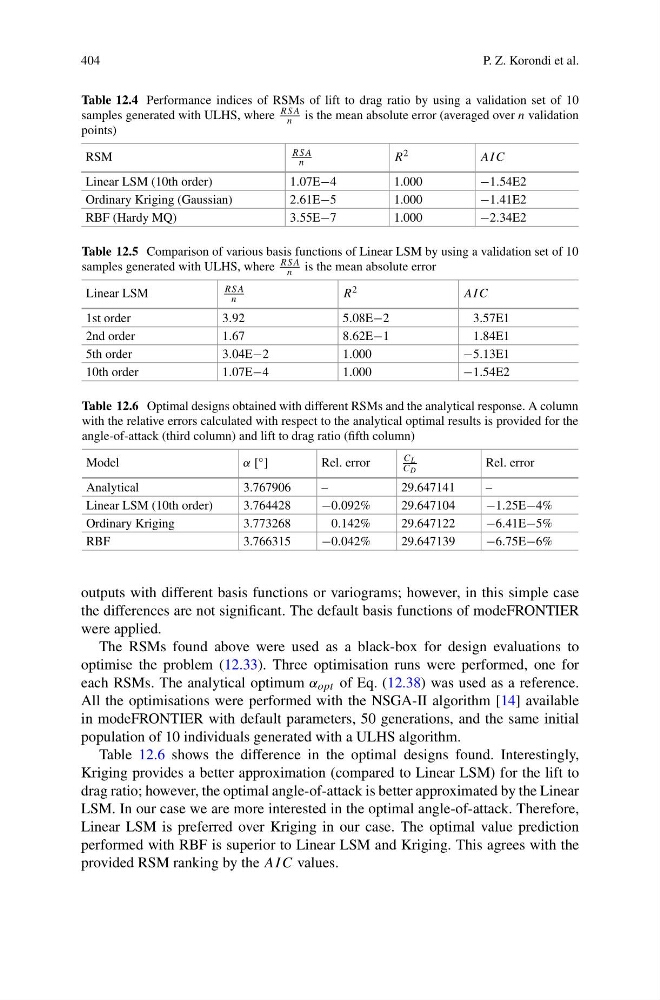
Table 12.4 Performance indices of RSMs of lift to drag ratio by using a validation set of 10
samples generated with ULHS, where
RSA
n is the mean absolute error (averaged over n validation
points)
RSM
RSA
n
R 2
AI C
Linear LSM (10th order)
1.07E−4
1.000
−1.54E2
Ordinary Kriging (Gaussian)
2.61E−5
1.000
−1.41E2
RBF (Hardy MQ)
3.55E−7
1.000
−2.34E2
Table 12.5 Comparison of various basis functions of Linear LSM by using a validation set of 10
samples generated with ULHS, where
RSA
n is the mean absolute error
Linear LSM
RSA
n
R 2
AI C
1st order
3.92
5.08E−2
3.57E1
2nd order
1.67
8.62E−1
1.84E1
5th order
3.04E−2
1.000
−5.13E1
10th order
1.07E−4
1.000
−1.54E2
Table 12.6 Optimal designs obtained with different RSMs and the analytical response. A column
with the relative errors calculated with respect to the analytical optimal results is provided for the
angle-of-attack (third column) and lift to drag ratio (fifth column)
Model
α [ ◦ ]
Rel. error
C L
C D
Rel. error
Analytical
3.767906
–
29.647141
–
Linear LSM (10th order)
3.764428
−0.092%
29.647104
−1.25E−4%
Ordinary Kriging
3.773268
0.142%
29.647122
−6.41E−5%
RBF
3.766315
−0.042%
29.647139
−6.75E−6%
outputs with different basis functions or variograms; however, in this simple case
the differences are not significant. The default basis functions of modeFRONTIER
were applied.
The RSMs found above were used as a black-box for design evaluations to
optimise the problem (12.33). Three optimisation runs were performed, one for
each RSMs. The analytical optimum α opt of Eq. (12.38) was used as a reference.
All the optimisations were performed with the NSGA-II algorithm [14] available
in modeFRONTIER with default parameters, 50 generations, and the same initial
population of 10 individuals generated with a ULHS algorithm.
Table 12.6 shows the difference in the optimal designs found. Interestingly,
Kriging provides a better approximation (compared to Linear LSM) for the lift to
drag ratio; however, the optimal angle-of-attack is better approximated by the Linear
LSM. In our case we are more interested in the optimal angle-of-attack. Therefore,
Linear LSM is preferred over Kriging in our case. The optimal value prediction
performed with RBF is superior to Linear LSM and Kriging. This agrees with the
provided RSM ranking by the AI C values.
P. Z. Korondi et al.
Table 12.4 Performance indices of RSMs of lift to drag ratio by using a validation set of 10
samples generated with ULHS, where
RSA
n is the mean absolute error (averaged over n validation
points)
RSM
RSA
n
R 2
AI C
Linear LSM (10th order)
1.07E−4
1.000
−1.54E2
Ordinary Kriging (Gaussian)
2.61E−5
1.000
−1.41E2
RBF (Hardy MQ)
3.55E−7
1.000
−2.34E2
Table 12.5 Comparison of various basis functions of Linear LSM by using a validation set of 10
samples generated with ULHS, where
RSA
n is the mean absolute error
Linear LSM
RSA
n
R 2
AI C
1st order
3.92
5.08E−2
3.57E1
2nd order
1.67
8.62E−1
1.84E1
5th order
3.04E−2
1.000
−5.13E1
10th order
1.07E−4
1.000
−1.54E2
Table 12.6 Optimal designs obtained with different RSMs and the analytical response. A column
with the relative errors calculated with respect to the analytical optimal results is provided for the
angle-of-attack (third column) and lift to drag ratio (fifth column)
Model
α [ ◦ ]
Rel. error
C L
C D
Rel. error
Analytical
3.767906
–
29.647141
–
Linear LSM (10th order)
3.764428
−0.092%
29.647104
−1.25E−4%
Ordinary Kriging
3.773268
0.142%
29.647122
−6.41E−5%
RBF
3.766315
−0.042%
29.647139
−6.75E−6%
outputs with different basis functions or variograms; however, in this simple case
the differences are not significant. The default basis functions of modeFRONTIER
were applied.
The RSMs found above were used as a black-box for design evaluations to
optimise the problem (12.33). Three optimisation runs were performed, one for
each RSMs. The analytical optimum α opt of Eq. (12.38) was used as a reference.
All the optimisations were performed with the NSGA-II algorithm [14] available
in modeFRONTIER with default parameters, 50 generations, and the same initial
population of 10 individuals generated with a ULHS algorithm.
Table 12.6 shows the difference in the optimal designs found. Interestingly,
Kriging provides a better approximation (compared to Linear LSM) for the lift to
drag ratio; however, the optimal angle-of-attack is better approximated by the Linear
LSM. In our case we are more interested in the optimal angle-of-attack. Therefore,
Linear LSM is preferred over Kriging in our case. The optimal value prediction
performed with RBF is superior to Linear LSM and Kriging. This agrees with the
provided RSM ranking by the AI C values.