

396
P. Z. Korondi et al.
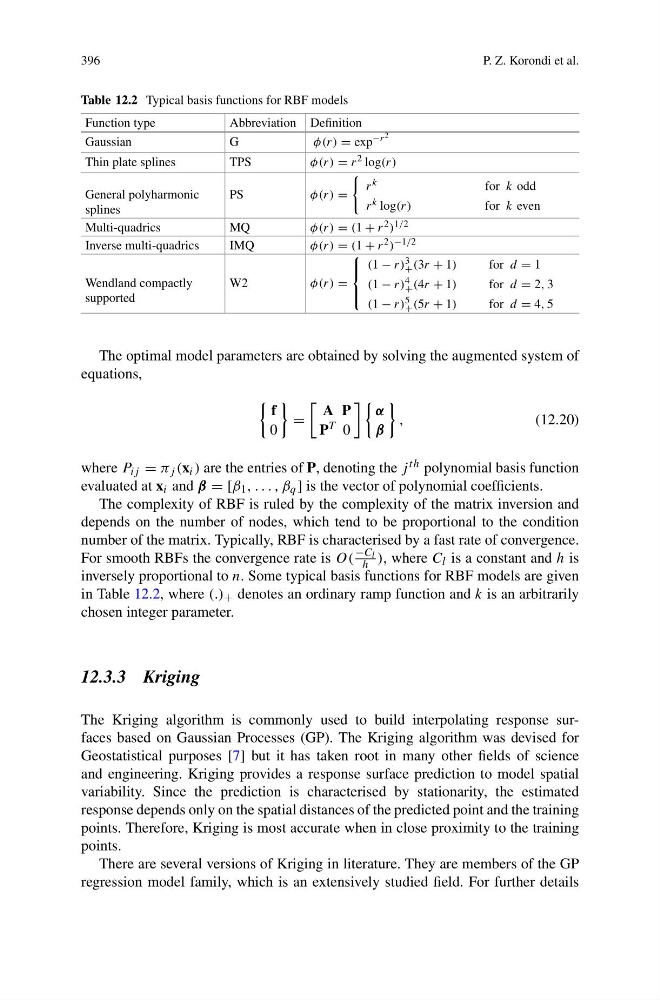
Table 12.2 Typical basis functions for RBF models
Function type
Abbreviation Definition
Gaussian
G
φ(r) = exp −r 2
Thin plate splines
TPS
φ(r) = r 2 log(r)
General polyharmonic
splines
PS
φ(r) =
r k
for k odd
r k log(r)
for k even
Multi-quadrics
MQ
φ(r) = (1 + r 2 ) 1/2
Inverse multi-quadrics
IMQ
φ(r) = (1 + r 2 ) −1/2
Wendland compactly
supported
W2
φ(r) =
⎧
⎪ ⎨
⎪ ⎩
(1 − r) 3
+ (3r + 1)
for d = 1
(1 − r) 4
+ (4r + 1)
for d = 2, 3
(1 − r) 5
+ (5r + 1)
for d = 4, 5
The optimal model parameters are obtained by solving the augmented system of
equations,
f
0
=
A P
P T 0
α
β
,
(12.20)
where P ij = π j (x i ) are the entries of P, denoting the j th polynomial basis function
evaluated at x i and β = [β 1 , . . . , β q ] is the vector of polynomial coefficients.
The complexity of RBF is ruled by the complexity of the matrix inversion and
depends on the number of nodes, which tend to be proportional to the condition
number of the matrix. Typically, RBF is characterised by a fast rate of convergence.
For smooth RBFs the convergence rate is O(
−C l
h ), where C l is a constant and h is
inversely proportional to n. Some typical basis functions for RBF models are given
in Table 12.2, where (.) + denotes an ordinary ramp function and k is an arbitrarily
chosen integer parameter.
12.3.3 Kriging
The Kriging algorithm is commonly used to build interpolating response surfaces based on Gaussian Processes (GP). The Kriging algorithm was devised for
Geostatistical purposes [7] but it has taken root in many other fields of science
and engineering. Kriging provides a response surface prediction to model spatial
variability. Since the prediction is characterised by stationarity, the estimated
response depends only on the spatial distances of the predicted point and the training
points. Therefore, Kriging is most accurate when in close proximity to the training
points.
There are several versions of Kriging in literature. They are members of the GP
regression model family, which is an extensively studied field. For further details
P. Z. Korondi et al.
Table 12.2 Typical basis functions for RBF models
Function type
Abbreviation Definition
Gaussian
G
φ(r) = exp −r 2
Thin plate splines
TPS
φ(r) = r 2 log(r)
General polyharmonic
splines
PS
φ(r) =
r k
for k odd
r k log(r)
for k even
Multi-quadrics
MQ
φ(r) = (1 + r 2 ) 1/2
Inverse multi-quadrics
IMQ
φ(r) = (1 + r 2 ) −1/2
Wendland compactly
supported
W2
φ(r) =
⎧
⎪ ⎨
⎪ ⎩
(1 − r) 3
+ (3r + 1)
for d = 1
(1 − r) 4
+ (4r + 1)
for d = 2, 3
(1 − r) 5
+ (5r + 1)
for d = 4, 5
The optimal model parameters are obtained by solving the augmented system of
equations,
f
0
=
A P
P T 0
α
β
,
(12.20)
where P ij = π j (x i ) are the entries of P, denoting the j th polynomial basis function
evaluated at x i and β = [β 1 , . . . , β q ] is the vector of polynomial coefficients.
The complexity of RBF is ruled by the complexity of the matrix inversion and
depends on the number of nodes, which tend to be proportional to the condition
number of the matrix. Typically, RBF is characterised by a fast rate of convergence.
For smooth RBFs the convergence rate is O(
−C l
h ), where C l is a constant and h is
inversely proportional to n. Some typical basis functions for RBF models are given
in Table 12.2, where (.) + denotes an ordinary ramp function and k is an arbitrarily
chosen integer parameter.
12.3.3 Kriging
The Kriging algorithm is commonly used to build interpolating response surfaces based on Gaussian Processes (GP). The Kriging algorithm was devised for
Geostatistical purposes [7] but it has taken root in many other fields of science
and engineering. Kriging provides a response surface prediction to model spatial
variability. Since the prediction is characterised by stationarity, the estimated
response depends only on the spatial distances of the predicted point and the training
points. Therefore, Kriging is most accurate when in close proximity to the training
points.
There are several versions of Kriging in literature. They are members of the GP
regression model family, which is an extensively studied field. For further details