

392
P. Z. Korondi et al.
In interpolation, the model parameters are typically found by solving a linear
system of equations defined by the interpolation condition.
For regression models, parameter tuning is typically carried out by minimising
an error measure calculated with respect to the deviation of the predicted surface
from the true response. From a statistical point of view, the parameters can be set by
maximising the probability that the response values of the observation data set are
generated by the RSM, see [1].
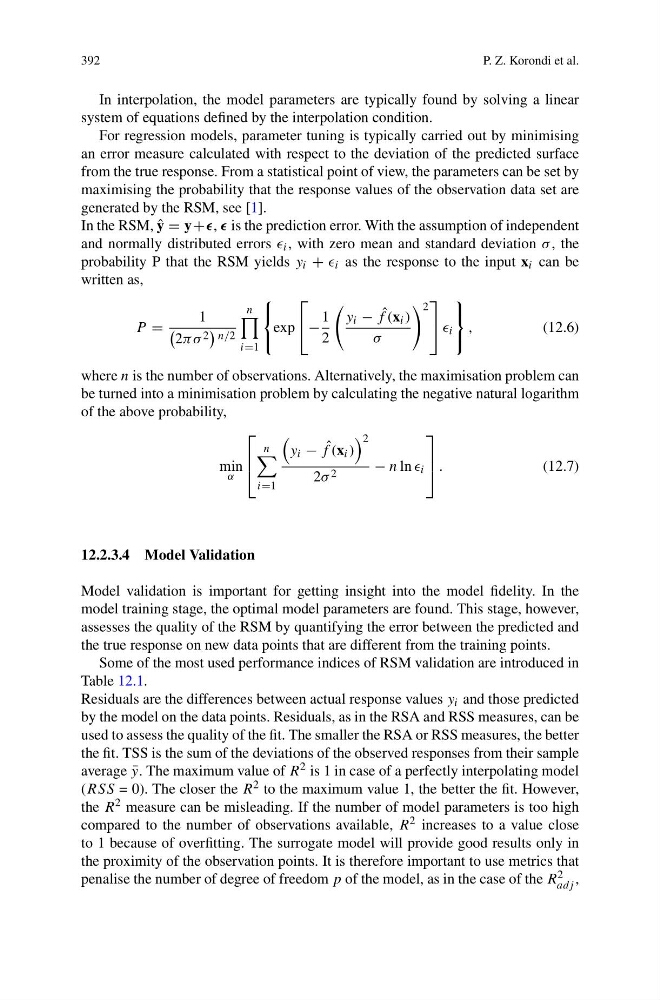
In the RSM, ˆ
y = y+, is the prediction error. With the assumption of independent
and normally distributed errors i , with zero mean and standard deviation σ , the
probability P that the RSM yields y i + i as the response to the input x i can be
written as,
P =
1
2πσ 2
n/2
n
i=1
⎧
⎨
⎩
exp
⎡
⎣ −
1
2
y i − ˆ
f (x i )
σ
2
⎤
⎦ i
⎫
⎬
⎭
,
(12.6)
where n is the number of observations. Alternatively, the maximisation problem can
be turned into a minimisation problem by calculating the negative natural logarithm
of the above probability,
min
α
⎡
⎢
⎣
n
i=1
y i − ˆ
f (x i )
2
2σ 2
− n ln i
⎤
⎥
⎦ .
(12.7)
12.2.3.4 Model Validation
Model validation is important for getting insight into the model fidelity. In the
model training stage, the optimal model parameters are found. This stage, however,
assesses the quality of the RSM by quantifying the error between the predicted and
the true response on new data points that are different from the training points.
Some of the most used performance indices of RSM validation are introduced in
Table 12.1.
Residuals are the differences between actual response values y i and those predicted
by the model on the data points. Residuals, as in the RSA and RSS measures, can be
used to assess the quality of the fit. The smaller the RSA or RSS measures, the better
the fit. TSS is the sum of the deviations of the observed responses from their sample
average ¯
y. The maximum value of R 2 is 1 in case of a perfectly interpolating model
(RSS = 0). The closer the R 2 to the maximum value 1, the better the fit. However,
the R 2 measure can be misleading. If the number of model parameters is too high
compared to the number of observations available, R 2 increases to a value close
to 1 because of overfitting. The surrogate model will provide good results only in
the proximity of the observation points. It is therefore important to use metrics that
penalise the number of degree of freedom p of the model, as in the case of the R 2
adj ,
P. Z. Korondi et al.
In interpolation, the model parameters are typically found by solving a linear
system of equations defined by the interpolation condition.
For regression models, parameter tuning is typically carried out by minimising
an error measure calculated with respect to the deviation of the predicted surface
from the true response. From a statistical point of view, the parameters can be set by
maximising the probability that the response values of the observation data set are
generated by the RSM, see [1].
In the RSM, ˆ
y = y+, is the prediction error. With the assumption of independent
and normally distributed errors i , with zero mean and standard deviation σ , the
probability P that the RSM yields y i + i as the response to the input x i can be
written as,
P =
1
2πσ 2
n/2
n
i=1
⎧
⎨
⎩
exp
⎡
⎣ −
1
2
y i − ˆ
f (x i )
σ
2
⎤
⎦ i
⎫
⎬
⎭
,
(12.6)
where n is the number of observations. Alternatively, the maximisation problem can
be turned into a minimisation problem by calculating the negative natural logarithm
of the above probability,
min
α
⎡
⎢
⎣
n
i=1
y i − ˆ
f (x i )
2
2σ 2
− n ln i
⎤
⎥
⎦ .
(12.7)
12.2.3.4 Model Validation
Model validation is important for getting insight into the model fidelity. In the
model training stage, the optimal model parameters are found. This stage, however,
assesses the quality of the RSM by quantifying the error between the predicted and
the true response on new data points that are different from the training points.
Some of the most used performance indices of RSM validation are introduced in
Table 12.1.
Residuals are the differences between actual response values y i and those predicted
by the model on the data points. Residuals, as in the RSA and RSS measures, can be
used to assess the quality of the fit. The smaller the RSA or RSS measures, the better
the fit. TSS is the sum of the deviations of the observed responses from their sample
average ¯
y. The maximum value of R 2 is 1 in case of a perfectly interpolating model
(RSS = 0). The closer the R 2 to the maximum value 1, the better the fit. However,
the R 2 measure can be misleading. If the number of model parameters is too high
compared to the number of observations available, R 2 increases to a value close
to 1 because of overfitting. The surrogate model will provide good results only in
the proximity of the observation points. It is therefore important to use metrics that
penalise the number of degree of freedom p of the model, as in the case of the R 2
adj ,