

370
M. Antoniou et al.
optimisation process that changes the parameters according to some pre-described
rule.
The following list presents some of the adaptive algorithms:
• (1+1) EA α —a multiplicative, comparison-based update rule to adjust the mutation probability of a (1+1) Evolutionary Algorithm [24].
• PLES—the control parameters (population size, recombination, mutation) are
calculated during the optimisation process according to the progress (best value
and standard deviation) of the search [12].
• CMA-ES—the shape of mutation distribution is generated according to a
covariance matrix C, which is adapted during evolution [25].
• SHADE—the control parameters for are drawn from a distribution, shape of
which is guided by the values of control parameters that previously produced
high-quality candidates [44].
Model of Adaptive Parameter Control
Parameter control requires searching for optimal control parameter values during
the run. The optimisation starts with suboptimal control parameter values that are
adapted during the progress of the algorithm. The parameter control derives the
best next control parameter value such that the influence on the performance of the
algorithm is optimised.
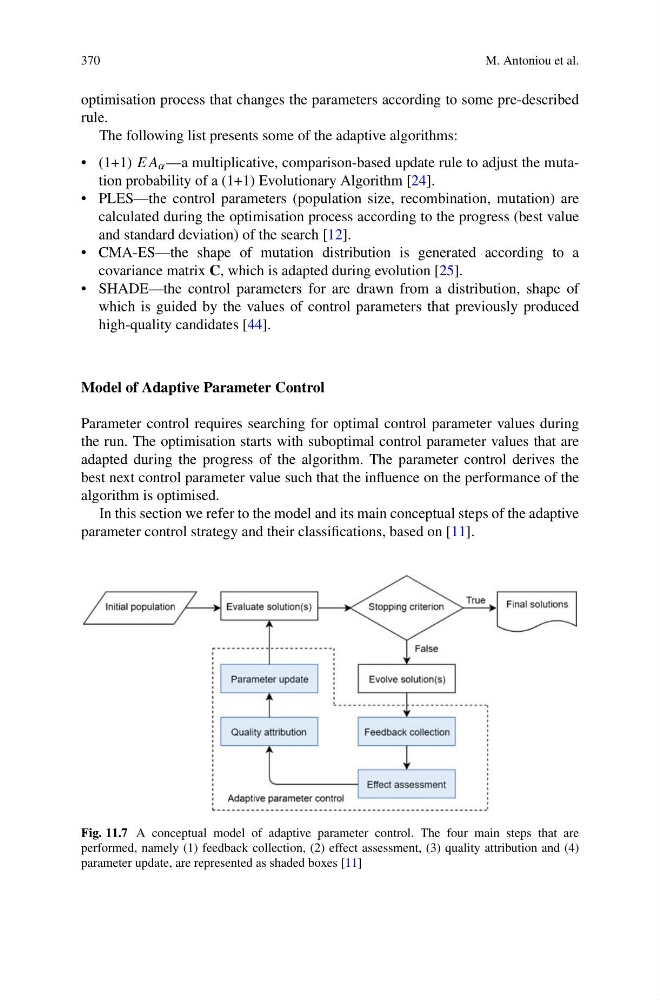
In this section we refer to the model and its main conceptual steps of the adaptive
parameter control strategy and their classifications, based on [11].
Fig. 11.7 A conceptual model of adaptive parameter control. The four main steps that are
performed, namely (1) feedback collection, (2) effect assessment, (3) quality attribution and (4)
parameter update, are represented as shaded boxes [11]
M. Antoniou et al.
optimisation process that changes the parameters according to some pre-described
rule.
The following list presents some of the adaptive algorithms:
• (1+1) EA α —a multiplicative, comparison-based update rule to adjust the mutation probability of a (1+1) Evolutionary Algorithm [24].
• PLES—the control parameters (population size, recombination, mutation) are
calculated during the optimisation process according to the progress (best value
and standard deviation) of the search [12].
• CMA-ES—the shape of mutation distribution is generated according to a
covariance matrix C, which is adapted during evolution [25].
• SHADE—the control parameters for are drawn from a distribution, shape of
which is guided by the values of control parameters that previously produced
high-quality candidates [44].
Model of Adaptive Parameter Control
Parameter control requires searching for optimal control parameter values during
the run. The optimisation starts with suboptimal control parameter values that are
adapted during the progress of the algorithm. The parameter control derives the
best next control parameter value such that the influence on the performance of the
algorithm is optimised.
In this section we refer to the model and its main conceptual steps of the adaptive
parameter control strategy and their classifications, based on [11].
Fig. 11.7 A conceptual model of adaptive parameter control. The four main steps that are
performed, namely (1) feedback collection, (2) effect assessment, (3) quality attribution and (4)
parameter update, are represented as shaded boxes [11]