

11 Parameter Control in Evolutionary Optimisation
371
In Fig. 11.7 the conceptual model of this procedure is shown. During the
optimisation, another iterative process is taking place that refers to the control
parameters. The main steps of this process are (1) feedback collection, (2) effect
assessment, (3) quality attribution and (4) parameter update. The success of each
step depends on the others.
• Feedback collection: This is the starting step of the adaptive parameter control. This feedback measures certain properties of an EA, which indicate the
algorithm’s behaviour. According to [11], there are five different feedback
categories:
– Phenotype feedback: Feedback referring to the observed behaviour or quality
of a solution. Most of the times, the fitness improvement of the solutions as an
indication for the performance of the algorithm is used.
– Relative phenotype feedback: Feedback referring to the relative quality of the
solutions, most commonly using entropy as a measure.
– Genotype feedback: This kind of feedback relates to the components of a
single solution.
– Genotype diversity feedback: Feedback as to how much population diversity
is maintained for increasing search coverage and for dealing with fitness
landscape change.
– Feasibility feedback: Feedback about the amount of violation of constraints.
• Effect assessment: based on the feedback collection strategy, the effect of the
parameter values on the performance of the algorithm is estimated. The distinction of current available parameter effect assessment methods is how the progress
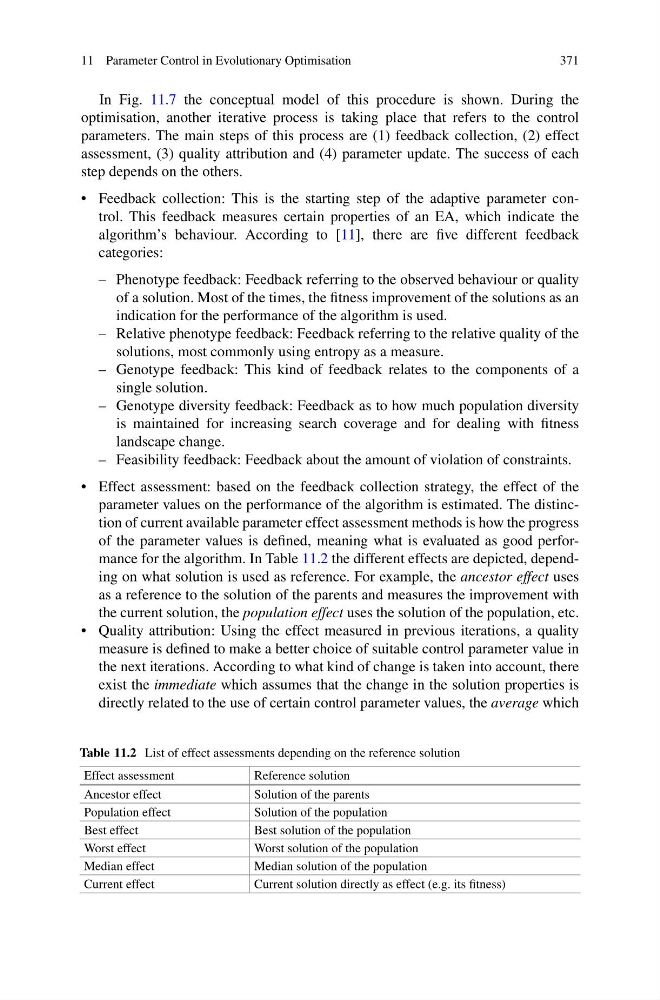
of the parameter values is defined, meaning what is evaluated as good performance for the algorithm. In Table 11.2 the different effects are depicted, depending on what solution is used as reference. For example, the ancestor effect uses
as a reference to the solution of the parents and measures the improvement with
the current solution, the population effect uses the solution of the population, etc.
• Quality attribution: Using the effect measured in previous iterations, a quality
measure is defined to make a better choice of suitable control parameter value in
the next iterations. According to what kind of change is taken into account, there
exist the immediate which assumes that the change in the solution properties is
directly related to the use of certain control parameter values, the average which
Table 11.2 List of effect assessments depending on the reference solution
Effect assessment
Reference solution
Ancestor effect
Solution of the parents
Population effect
Solution of the population
Best effect
Best solution of the population
Worst effect
Worst solution of the population
Median effect
Median solution of the population
Current effect
Current solution directly as effect (e.g. its fitness)
371
In Fig. 11.7 the conceptual model of this procedure is shown. During the
optimisation, another iterative process is taking place that refers to the control
parameters. The main steps of this process are (1) feedback collection, (2) effect
assessment, (3) quality attribution and (4) parameter update. The success of each
step depends on the others.
• Feedback collection: This is the starting step of the adaptive parameter control. This feedback measures certain properties of an EA, which indicate the
algorithm’s behaviour. According to [11], there are five different feedback
categories:
– Phenotype feedback: Feedback referring to the observed behaviour or quality
of a solution. Most of the times, the fitness improvement of the solutions as an
indication for the performance of the algorithm is used.
– Relative phenotype feedback: Feedback referring to the relative quality of the
solutions, most commonly using entropy as a measure.
– Genotype feedback: This kind of feedback relates to the components of a
single solution.
– Genotype diversity feedback: Feedback as to how much population diversity
is maintained for increasing search coverage and for dealing with fitness
landscape change.
– Feasibility feedback: Feedback about the amount of violation of constraints.
• Effect assessment: based on the feedback collection strategy, the effect of the
parameter values on the performance of the algorithm is estimated. The distinction of current available parameter effect assessment methods is how the progress
of the parameter values is defined, meaning what is evaluated as good performance for the algorithm. In Table 11.2 the different effects are depicted, depending on what solution is used as reference. For example, the ancestor effect uses
as a reference to the solution of the parents and measures the improvement with
the current solution, the population effect uses the solution of the population, etc.
• Quality attribution: Using the effect measured in previous iterations, a quality
measure is defined to make a better choice of suitable control parameter value in
the next iterations. According to what kind of change is taken into account, there
exist the immediate which assumes that the change in the solution properties is
directly related to the use of certain control parameter values, the average which
Table 11.2 List of effect assessments depending on the reference solution
Effect assessment
Reference solution
Ancestor effect
Solution of the parents
Population effect
Solution of the population
Best effect
Best solution of the population
Worst effect
Worst solution of the population
Median effect
Median solution of the population
Current effect
Current solution directly as effect (e.g. its fitness)