

10 Sequential Parameter Optimization for Mixed-Discrete Problems
349
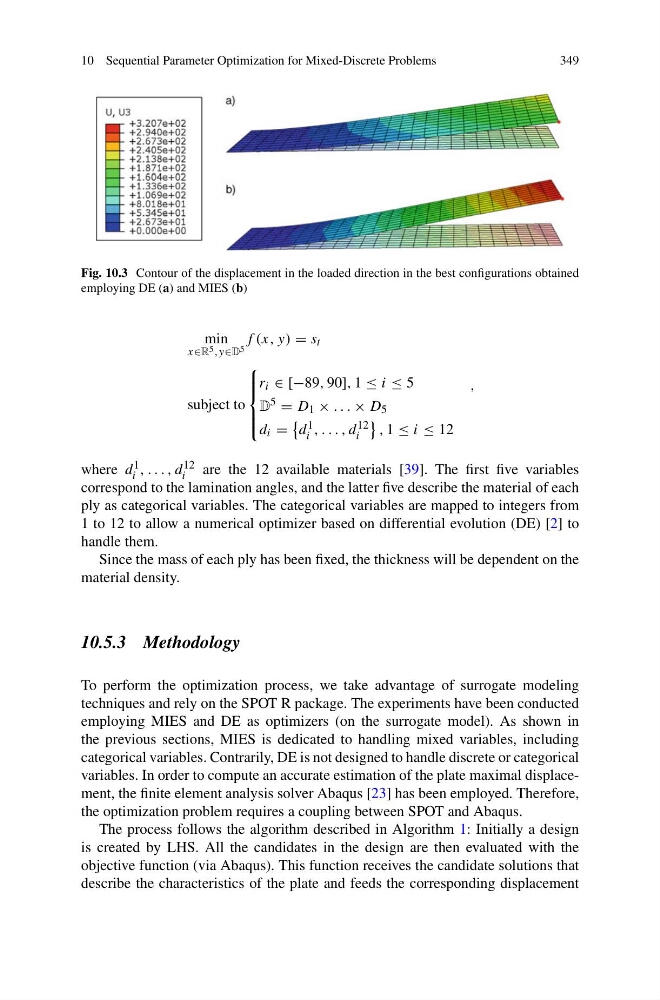
Fig. 10.3 Contour of the displacement in the loaded direction in the best configurations obtained
employing DE (a) and MIES (b)
min
x∈R 5 ,y∈D 5
f (x, y) = s t
subject to
⎧
⎪ ⎪ ⎨
⎪ ⎪ ⎩
r i ∈ [−89, 90], 1 ≤ i ≤ 5
D 5 = D 1 × . . . × D 5
d i =
d 1
i , . . . , d 12
i
, 1 ≤ i ≤ 12
,
where d 1
i , . . . , d 12
i
are the 12 available materials [39]. The first five variables
correspond to the lamination angles, and the latter five describe the material of each
ply as categorical variables. The categorical variables are mapped to integers from
1 to 12 to allow a numerical optimizer based on differential evolution (DE) [2] to
handle them.
Since the mass of each ply has been fixed, the thickness will be dependent on the
material density.
10.5.3 Methodology
To perform the optimization process, we take advantage of surrogate modeling
techniques and rely on the SPOT R package. The experiments have been conducted
employing MIES and DE as optimizers (on the surrogate model). As shown in
the previous sections, MIES is dedicated to handling mixed variables, including
categorical variables. Contrarily, DE is not designed to handle discrete or categorical
variables. In order to compute an accurate estimation of the plate maximal displacement, the finite element analysis solver Abaqus [23] has been employed. Therefore,
the optimization problem requires a coupling between SPOT and Abaqus.
The process follows the algorithm described in Algorithm 1: Initially a design
is created by LHS. All the candidates in the design are then evaluated with the
objective function (via Abaqus). This function receives the candidate solutions that
describe the characteristics of the plate and feeds the corresponding displacement
349
Fig. 10.3 Contour of the displacement in the loaded direction in the best configurations obtained
employing DE (a) and MIES (b)
min
x∈R 5 ,y∈D 5
f (x, y) = s t
subject to
⎧
⎪ ⎪ ⎨
⎪ ⎪ ⎩
r i ∈ [−89, 90], 1 ≤ i ≤ 5
D 5 = D 1 × . . . × D 5
d i =
d 1
i , . . . , d 12
i
, 1 ≤ i ≤ 12
,
where d 1
i , . . . , d 12
i
are the 12 available materials [39]. The first five variables
correspond to the lamination angles, and the latter five describe the material of each
ply as categorical variables. The categorical variables are mapped to integers from
1 to 12 to allow a numerical optimizer based on differential evolution (DE) [2] to
handle them.
Since the mass of each ply has been fixed, the thickness will be dependent on the
material density.
10.5.3 Methodology
To perform the optimization process, we take advantage of surrogate modeling
techniques and rely on the SPOT R package. The experiments have been conducted
employing MIES and DE as optimizers (on the surrogate model). As shown in
the previous sections, MIES is dedicated to handling mixed variables, including
categorical variables. Contrarily, DE is not designed to handle discrete or categorical
variables. In order to compute an accurate estimation of the plate maximal displacement, the finite element analysis solver Abaqus [23] has been employed. Therefore,
the optimization problem requires a coupling between SPOT and Abaqus.
The process follows the algorithm described in Algorithm 1: Initially a design
is created by LHS. All the candidates in the design are then evaluated with the
objective function (via Abaqus). This function receives the candidate solutions that
describe the characteristics of the plate and feeds the corresponding displacement