

348
L. Gentile et al.
Table 10.1 Properties of the material used in this study
Young’s
Young’s
In-plane
Poisson’s
Properties
Modulus 0 Modulus 90 Shear modulus ratio
Symbols
E1
E2
G12
v12
Density
Units
GPa
GPa
GPa
g/cc
CF
Vf 50%
70
70
5
0.10
1.60
HMCF
Vf 50%
85
85
5
0.10
1.60
E glass
Vf 50%
25
25
4
0.20
1.90
Kevlar
Vf 50%
30
30
5
0.20
1.40
Std CF
Vf 60% 135
10
5
0.30
1.60
HMCF
Vf 60% 175
8
5
0.30
1.60
M55**
Vf 60% 300
12
5
0.30
1.65
E glass
Vf 60%
40
8
4
0.25
1.90
Kevlar
Vf 60%
75
6
2
0.34
1.40
Boron
Vf 60% 200
15
5
0.23
2.00
Steel
S97
207
207
80
0.3
7.85
AL
L65
72
72
25
0.3
2.7
** Calculated figures
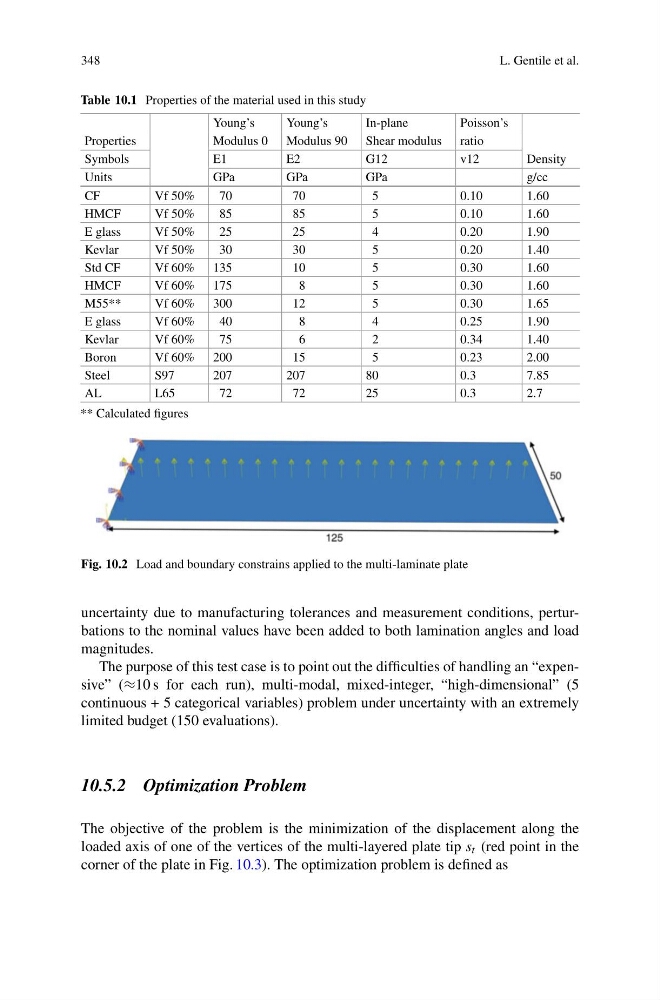
Fig. 10.2 Load and boundary constrains applied to the multi-laminate plate
uncertainty due to manufacturing tolerances and measurement conditions, perturbations to the nominal values have been added to both lamination angles and load
magnitudes.
The purpose of this test case is to point out the difficulties of handling an “expensive” (≈10 s for each run), multi-modal, mixed-integer, “high-dimensional” (5
continuous + 5 categorical variables) problem under uncertainty with an extremely
limited budget (150 evaluations).
10.5.2 Optimization Problem
The objective of the problem is the minimization of the displacement along the
loaded axis of one of the vertices of the multi-layered plate tip s t (red point in the
corner of the plate in Fig. 10.3). The optimization problem is defined as
L. Gentile et al.
Table 10.1 Properties of the material used in this study
Young’s
Young’s
In-plane
Poisson’s
Properties
Modulus 0 Modulus 90 Shear modulus ratio
Symbols
E1
E2
G12
v12
Density
Units
GPa
GPa
GPa
g/cc
CF
Vf 50%
70
70
5
0.10
1.60
HMCF
Vf 50%
85
85
5
0.10
1.60
E glass
Vf 50%
25
25
4
0.20
1.90
Kevlar
Vf 50%
30
30
5
0.20
1.40
Std CF
Vf 60% 135
10
5
0.30
1.60
HMCF
Vf 60% 175
8
5
0.30
1.60
M55**
Vf 60% 300
12
5
0.30
1.65
E glass
Vf 60%
40
8
4
0.25
1.90
Kevlar
Vf 60%
75
6
2
0.34
1.40
Boron
Vf 60% 200
15
5
0.23
2.00
Steel
S97
207
207
80
0.3
7.85
AL
L65
72
72
25
0.3
2.7
** Calculated figures
Fig. 10.2 Load and boundary constrains applied to the multi-laminate plate
uncertainty due to manufacturing tolerances and measurement conditions, perturbations to the nominal values have been added to both lamination angles and load
magnitudes.
The purpose of this test case is to point out the difficulties of handling an “expensive” (≈10 s for each run), multi-modal, mixed-integer, “high-dimensional” (5
continuous + 5 categorical variables) problem under uncertainty with an extremely
limited budget (150 evaluations).
10.5.2 Optimization Problem
The objective of the problem is the minimization of the displacement along the
loaded axis of one of the vertices of the multi-layered plate tip s t (red point in the
corner of the plate in Fig. 10.3). The optimization problem is defined as