

8 An Introduction to Many-Objective Evolutionary Optimization
299
8.6.1.1 ZDT
ZDT is proposed by Zitzler, Deb, and Thiele [47] hence its name. It consists of
six test functions with same structures but different shapes and difficulties. The
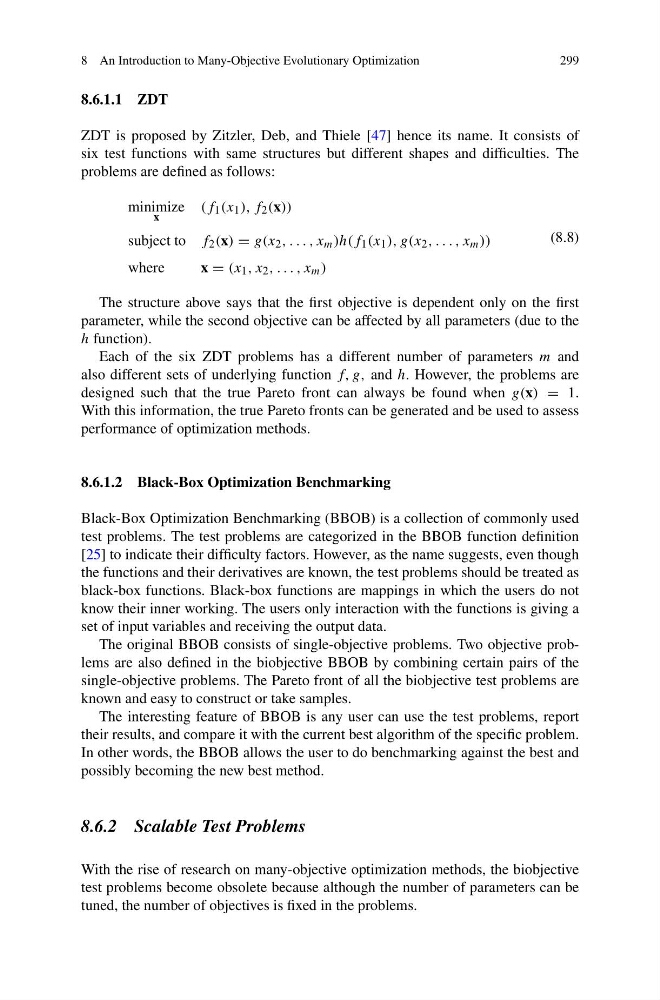
problems are defined as follows:
minimize
x
(f 1 (x 1 ), f 2 (x))
subject to f 2 (x) = g(x 2 , . . . , x m )h(f 1 (x 1 ), g(x 2 , . . . , x m ))
where
x = (x 1 , x 2 , . . . , x m )
(8.8)
The structure above says that the first objective is dependent only on the first
parameter, while the second objective can be affected by all parameters (due to the
h function).
Each of the six ZDT problems has a different number of parameters m and
also different sets of underlying function f, g, and h. However, the problems are
designed such that the true Pareto front can always be found when g(x) = 1.
With this information, the true Pareto fronts can be generated and be used to assess
performance of optimization methods.
8.6.1.2 Black-Box Optimization Benchmarking
Black-Box Optimization Benchmarking (BBOB) is a collection of commonly used
test problems. The test problems are categorized in the BBOB function definition
[25] to indicate their difficulty factors. However, as the name suggests, even though
the functions and their derivatives are known, the test problems should be treated as
black-box functions. Black-box functions are mappings in which the users do not
know their inner working. The users only interaction with the functions is giving a
set of input variables and receiving the output data.
The original BBOB consists of single-objective problems. Two objective problems are also defined in the biobjective BBOB by combining certain pairs of the
single-objective problems. The Pareto front of all the biobjective test problems are
known and easy to construct or take samples.
The interesting feature of BBOB is any user can use the test problems, report
their results, and compare it with the current best algorithm of the specific problem.
In other words, the BBOB allows the user to do benchmarking against the best and
possibly becoming the new best method.
8.6.2 Scalable Test Problems
With the rise of research on many-objective optimization methods, the biobjective
test problems become obsolete because although the number of parameters can be
tuned, the number of objectives is fixed in the problems.
299
8.6.1.1 ZDT
ZDT is proposed by Zitzler, Deb, and Thiele [47] hence its name. It consists of
six test functions with same structures but different shapes and difficulties. The
problems are defined as follows:
minimize
x
(f 1 (x 1 ), f 2 (x))
subject to f 2 (x) = g(x 2 , . . . , x m )h(f 1 (x 1 ), g(x 2 , . . . , x m ))
where
x = (x 1 , x 2 , . . . , x m )
(8.8)
The structure above says that the first objective is dependent only on the first
parameter, while the second objective can be affected by all parameters (due to the
h function).
Each of the six ZDT problems has a different number of parameters m and
also different sets of underlying function f, g, and h. However, the problems are
designed such that the true Pareto front can always be found when g(x) = 1.
With this information, the true Pareto fronts can be generated and be used to assess
performance of optimization methods.
8.6.1.2 Black-Box Optimization Benchmarking
Black-Box Optimization Benchmarking (BBOB) is a collection of commonly used
test problems. The test problems are categorized in the BBOB function definition
[25] to indicate their difficulty factors. However, as the name suggests, even though
the functions and their derivatives are known, the test problems should be treated as
black-box functions. Black-box functions are mappings in which the users do not
know their inner working. The users only interaction with the functions is giving a
set of input variables and receiving the output data.
The original BBOB consists of single-objective problems. Two objective problems are also defined in the biobjective BBOB by combining certain pairs of the
single-objective problems. The Pareto front of all the biobjective test problems are
known and easy to construct or take samples.
The interesting feature of BBOB is any user can use the test problems, report
their results, and compare it with the current best algorithm of the specific problem.
In other words, the BBOB allows the user to do benchmarking against the best and
possibly becoming the new best method.
8.6.2 Scalable Test Problems
With the rise of research on many-objective optimization methods, the biobjective
test problems become obsolete because although the number of parameters can be
tuned, the number of objectives is fixed in the problems.