

300
D. Irawan and B. Naujoks
Deb et al. [13] proposed that test problems should have scalability in both
objective and design spaces and be easy to implement and the real Pareto front
must be easy to comprehend. Scalability means that the test problems should have
both their number of objectives and number of variables easily tunable. If the test
problems are scalable, algorithms can be tested on standard/test cases with varying
dimensionality easily.
8.6.2.1 DTLZ
As a trivia, DTLZ is developed by the same group who suggested the ZDT test
functions. It is also an acronym of their name with the addition of Laumanns.
The DTLZ [13] test suite consists of seven test problems. Each of the test
problems is designed to be able to take the number of objectives and number of
variables as an input to construct the complete problem, making it scalable. Each
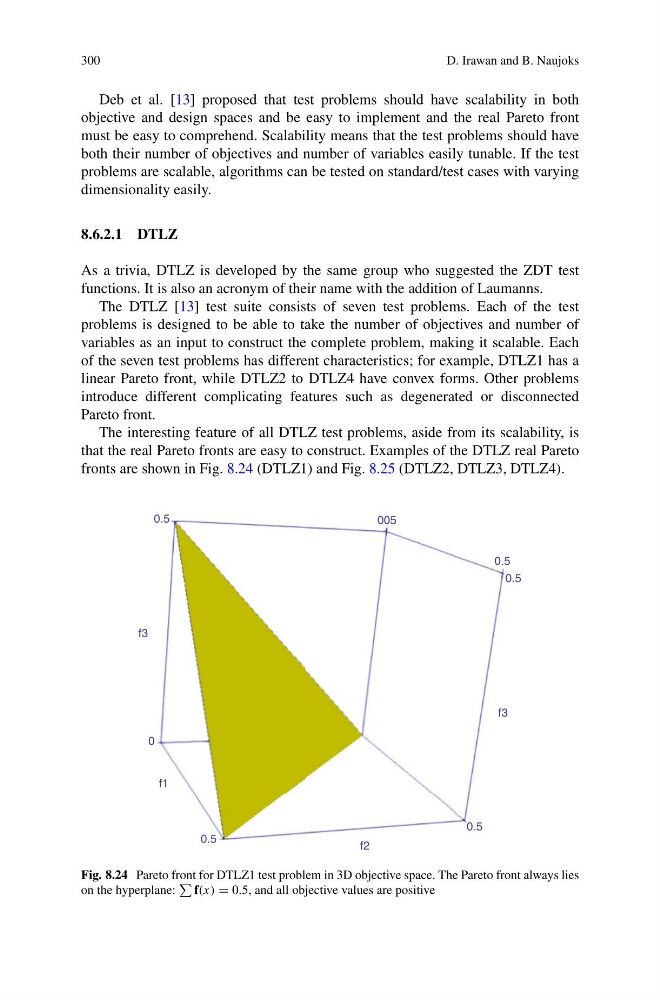
of the seven test problems has different characteristics; for example, DTLZ1 has a
linear Pareto front, while DTLZ2 to DTLZ4 have convex forms. Other problems
introduce different complicating features such as degenerated or disconnected
Pareto front.
The interesting feature of all DTLZ test problems, aside from its scalability, is
that the real Pareto fronts are easy to construct. Examples of the DTLZ real Pareto
fronts are shown in Fig. 8.24 (DTLZ1) and Fig. 8.25 (DTLZ2, DTLZ3, DTLZ4).
0.5
005
0.5
0.5
0.5
0.5
0
f3
f1
f2
f3
Fig. 8.24 Pareto front for DTLZ1 test problem in 3D objective space. The Pareto front always lies
on the hyperplane:
f(x) = 0.5, and all objective values are positive
D. Irawan and B. Naujoks
Deb et al. [13] proposed that test problems should have scalability in both
objective and design spaces and be easy to implement and the real Pareto front
must be easy to comprehend. Scalability means that the test problems should have
both their number of objectives and number of variables easily tunable. If the test
problems are scalable, algorithms can be tested on standard/test cases with varying
dimensionality easily.
8.6.2.1 DTLZ
As a trivia, DTLZ is developed by the same group who suggested the ZDT test
functions. It is also an acronym of their name with the addition of Laumanns.
The DTLZ [13] test suite consists of seven test problems. Each of the test
problems is designed to be able to take the number of objectives and number of
variables as an input to construct the complete problem, making it scalable. Each
of the seven test problems has different characteristics; for example, DTLZ1 has a
linear Pareto front, while DTLZ2 to DTLZ4 have convex forms. Other problems
introduce different complicating features such as degenerated or disconnected
Pareto front.
The interesting feature of all DTLZ test problems, aside from its scalability, is
that the real Pareto fronts are easy to construct. Examples of the DTLZ real Pareto
fronts are shown in Fig. 8.24 (DTLZ1) and Fig. 8.25 (DTLZ2, DTLZ3, DTLZ4).
0.5
005
0.5
0.5
0.5
0.5
0
f3
f1
f2
f3
Fig. 8.24 Pareto front for DTLZ1 test problem in 3D objective space. The Pareto front always lies
on the hyperplane:
f(x) = 0.5, and all objective values are positive