

298
D. Irawan and B. Naujoks
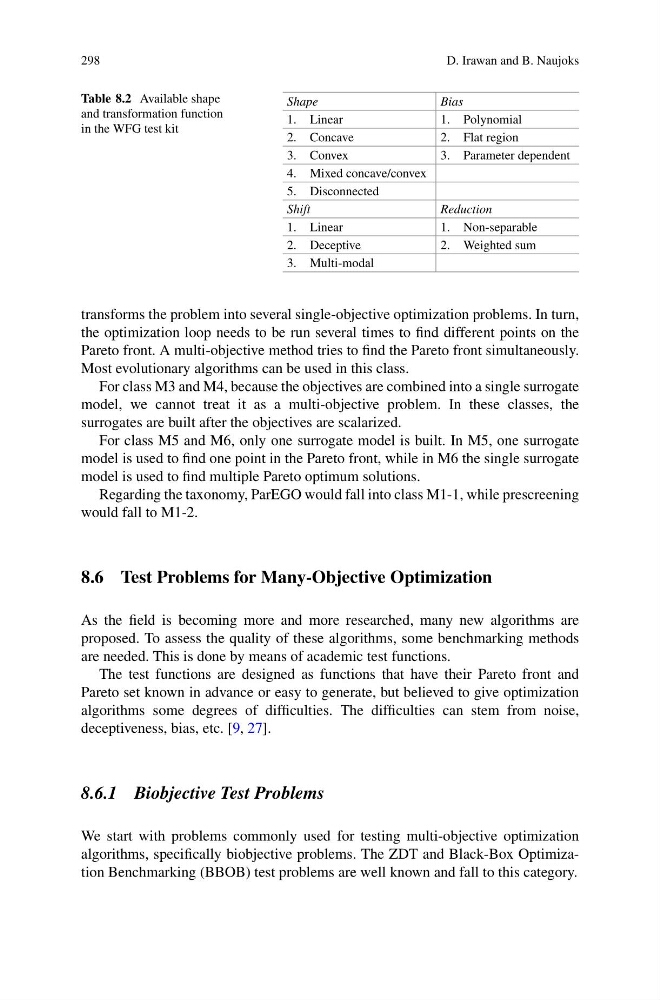
Table 8.2 Available shape
and transformation function
in the WFG test kit
Shape
Bias
1. Linear
1. Polynomial
2. Concave
2. Flat region
3. Convex
3. Parameter dependent
4. Mixed concave/convex
5. Disconnected
Shift
Reduction
1. Linear
1. Non-separable
2. Deceptive
2. Weighted sum
3. Multi-modal
transforms the problem into several single-objective optimization problems. In turn,
the optimization loop needs to be run several times to find different points on the
Pareto front. A multi-objective method tries to find the Pareto front simultaneously.
Most evolutionary algorithms can be used in this class.
For class M3 and M4, because the objectives are combined into a single surrogate
model, we cannot treat it as a multi-objective problem. In these classes, the
surrogates are built after the objectives are scalarized.
For class M5 and M6, only one surrogate model is built. In M5, one surrogate
model is used to find one point in the Pareto front, while in M6 the single surrogate
model is used to find multiple Pareto optimum solutions.
Regarding the taxonomy, ParEGO would fall into class M1-1, while prescreening
would fall to M1-2.
8.6 Test Problems for Many-Objective Optimization
As the field is becoming more and more researched, many new algorithms are
proposed. To assess the quality of these algorithms, some benchmarking methods
are needed. This is done by means of academic test functions.
The test functions are designed as functions that have their Pareto front and
Pareto set known in advance or easy to generate, but believed to give optimization
algorithms some degrees of difficulties. The difficulties can stem from noise,
deceptiveness, bias, etc. [9, 27].
8.6.1 Biobjective Test Problems
We start with problems commonly used for testing multi-objective optimization
algorithms, specifically biobjective problems. The ZDT and Black-Box Optimization Benchmarking (BBOB) test problems are well known and fall to this category.
D. Irawan and B. Naujoks
Table 8.2 Available shape
and transformation function
in the WFG test kit
Shape
Bias
1. Linear
1. Polynomial
2. Concave
2. Flat region
3. Convex
3. Parameter dependent
4. Mixed concave/convex
5. Disconnected
Shift
Reduction
1. Linear
1. Non-separable
2. Deceptive
2. Weighted sum
3. Multi-modal
transforms the problem into several single-objective optimization problems. In turn,
the optimization loop needs to be run several times to find different points on the
Pareto front. A multi-objective method tries to find the Pareto front simultaneously.
Most evolutionary algorithms can be used in this class.
For class M3 and M4, because the objectives are combined into a single surrogate
model, we cannot treat it as a multi-objective problem. In these classes, the
surrogates are built after the objectives are scalarized.
For class M5 and M6, only one surrogate model is built. In M5, one surrogate
model is used to find one point in the Pareto front, while in M6 the single surrogate
model is used to find multiple Pareto optimum solutions.
Regarding the taxonomy, ParEGO would fall into class M1-1, while prescreening
would fall to M1-2.
8.6 Test Problems for Many-Objective Optimization
As the field is becoming more and more researched, many new algorithms are
proposed. To assess the quality of these algorithms, some benchmarking methods
are needed. This is done by means of academic test functions.
The test functions are designed as functions that have their Pareto front and
Pareto set known in advance or easy to generate, but believed to give optimization
algorithms some degrees of difficulties. The difficulties can stem from noise,
deceptiveness, bias, etc. [9, 27].
8.6.1 Biobjective Test Problems
We start with problems commonly used for testing multi-objective optimization
algorithms, specifically biobjective problems. The ZDT and Black-Box Optimization Benchmarking (BBOB) test problems are well known and fall to this category.