

1 Introduction to Spectral Methods for Uncertainty Quantification
19
0
0.1
0.2
0.3
0.4
0.5
0.6
0.7
0.8
0
0.01 0.02 0.03 0.04 0.05 0.06 0.07 0.08 0.09
0.1
Relative frequency scaled on 3σ span
u(x=0.5)
Montecarlo PDF reconstruction
Large l
Small l
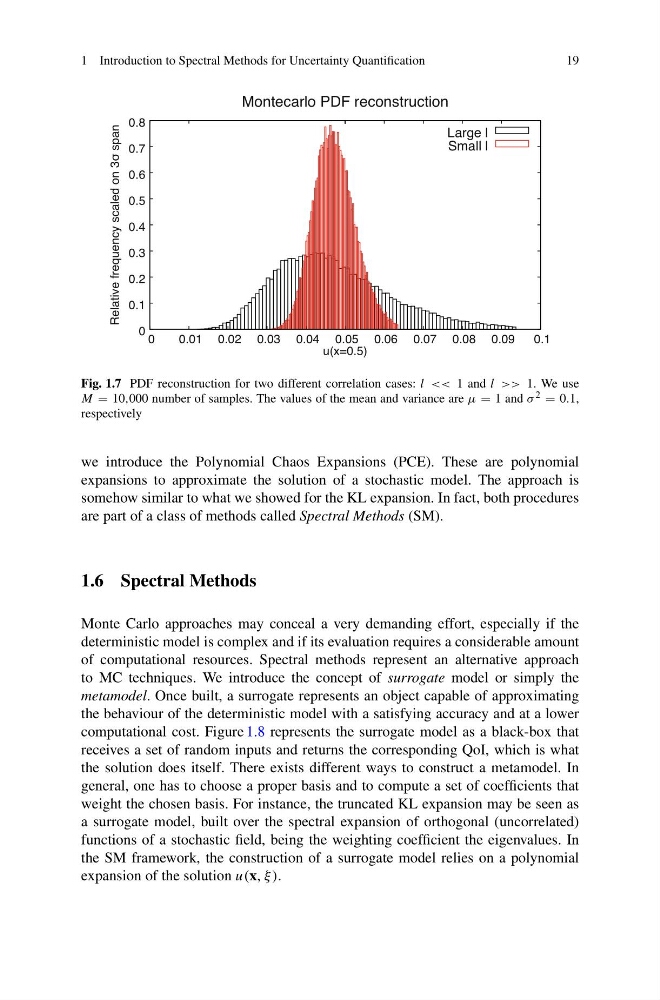
Fig. 1.7 PDF reconstruction for two different correlation cases: l << 1 and l >> 1. We use
M = 10,000 number of samples. The values of the mean and variance are μ = 1 and σ 2 = 0.1,
respectively
we introduce the Polynomial Chaos Expansions (PCE). These are polynomial
expansions to approximate the solution of a stochastic model. The approach is
somehow similar to what we showed for the KL expansion. In fact, both procedures
are part of a class of methods called Spectral Methods (SM).
1.6 Spectral Methods
Monte Carlo approaches may conceal a very demanding effort, especially if the
deterministic model is complex and if its evaluation requires a considerable amount
of computational resources. Spectral methods represent an alternative approach
to MC techniques. We introduce the concept of surrogate model or simply the
metamodel. Once built, a surrogate represents an object capable of approximating
the behaviour of the deterministic model with a satisfying accuracy and at a lower
computational cost. Figure 1.8 represents the surrogate model as a black-box that
receives a set of random inputs and returns the corresponding QoI, which is what
the solution does itself. There exists different ways to construct a metamodel. In
general, one has to choose a proper basis and to compute a set of coefficients that
weight the chosen basis. For instance, the truncated KL expansion may be seen as
a surrogate model, built over the spectral expansion of orthogonal (uncorrelated)
functions of a stochastic field, being the weighting coefficient the eigenvalues. In
the SM framework, the construction of a surrogate model relies on a polynomial
expansion of the solution u(x, ξ).
19
0
0.1
0.2
0.3
0.4
0.5
0.6
0.7
0.8
0
0.01 0.02 0.03 0.04 0.05 0.06 0.07 0.08 0.09
0.1
Relative frequency scaled on 3σ span
u(x=0.5)
Montecarlo PDF reconstruction
Large l
Small l
Fig. 1.7 PDF reconstruction for two different correlation cases: l << 1 and l >> 1. We use
M = 10,000 number of samples. The values of the mean and variance are μ = 1 and σ 2 = 0.1,
respectively
we introduce the Polynomial Chaos Expansions (PCE). These are polynomial
expansions to approximate the solution of a stochastic model. The approach is
somehow similar to what we showed for the KL expansion. In fact, both procedures
are part of a class of methods called Spectral Methods (SM).
1.6 Spectral Methods
Monte Carlo approaches may conceal a very demanding effort, especially if the
deterministic model is complex and if its evaluation requires a considerable amount
of computational resources. Spectral methods represent an alternative approach
to MC techniques. We introduce the concept of surrogate model or simply the
metamodel. Once built, a surrogate represents an object capable of approximating
the behaviour of the deterministic model with a satisfying accuracy and at a lower
computational cost. Figure 1.8 represents the surrogate model as a black-box that
receives a set of random inputs and returns the corresponding QoI, which is what
the solution does itself. There exists different ways to construct a metamodel. In
general, one has to choose a proper basis and to compute a set of coefficients that
weight the chosen basis. For instance, the truncated KL expansion may be seen as
a surrogate model, built over the spectral expansion of orthogonal (uncorrelated)
functions of a stochastic field, being the weighting coefficient the eigenvalues. In
the SM framework, the construction of a surrogate model relies on a polynomial
expansion of the solution u(x, ξ).