

18
J. F. Reis et al.
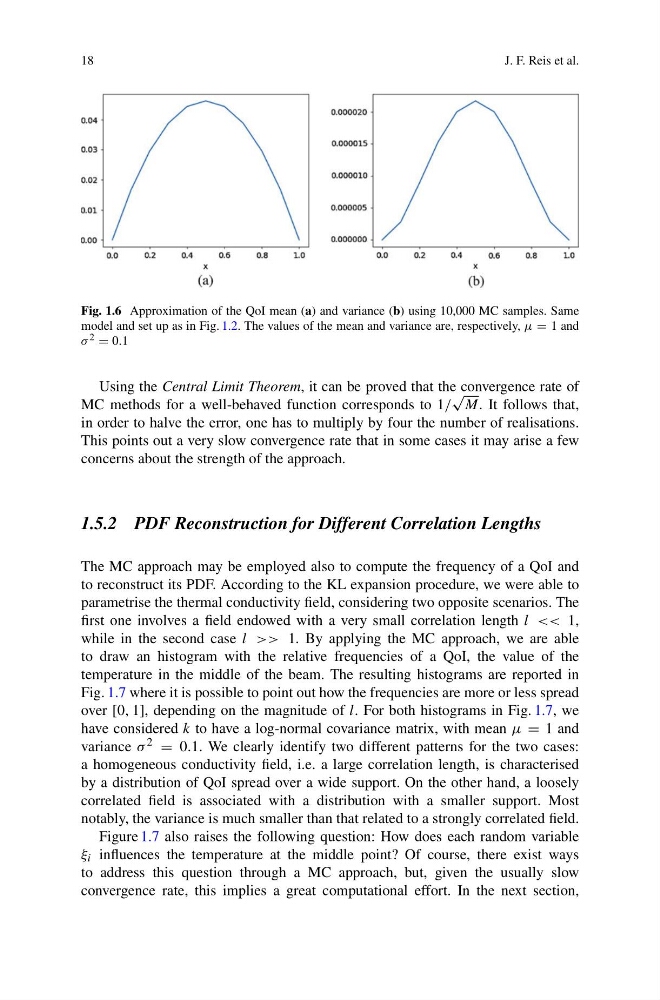
Fig. 1.6 Approximation of the QoI mean (a) and variance (b) using 10,000 MC samples. Same
model and set up as in Fig. 1.2. The values of the mean and variance are, respectively, μ = 1 and
σ 2 = 0.1
Using the Central Limit Theorem, it can be proved that the convergence rate of
MC methods for a well-behaved function corresponds to 1/
√
M. It follows that,
in order to halve the error, one has to multiply by four the number of realisations.
This points out a very slow convergence rate that in some cases it may arise a few
concerns about the strength of the approach.
1.5.2 PDF Reconstruction for Different Correlation Lengths
The MC approach may be employed also to compute the frequency of a QoI and
to reconstruct its PDF. According to the KL expansion procedure, we were able to
parametrise the thermal conductivity field, considering two opposite scenarios. The
first one involves a field endowed with a very small correlation length l << 1,
while in the second case l >> 1. By applying the MC approach, we are able
to draw an histogram with the relative frequencies of a QoI, the value of the
temperature in the middle of the beam. The resulting histograms are reported in
Fig. 1.7 where it is possible to point out how the frequencies are more or less spread
over [0, 1], depending on the magnitude of l. For both histograms in Fig. 1.7, we
have considered k to have a log-normal covariance matrix, with mean μ = 1 and
variance σ 2 = 0.1. We clearly identify two different patterns for the two cases:
a homogeneous conductivity field, i.e. a large correlation length, is characterised
by a distribution of QoI spread over a wide support. On the other hand, a loosely
correlated field is associated with a distribution with a smaller support. Most
notably, the variance is much smaller than that related to a strongly correlated field.
Figure 1.7 also raises the following question: How does each random variable
ξ i influences the temperature at the middle point? Of course, there exist ways
to address this question through a MC approach, but, given the usually slow
convergence rate, this implies a great computational effort. In the next section,
J. F. Reis et al.
Fig. 1.6 Approximation of the QoI mean (a) and variance (b) using 10,000 MC samples. Same
model and set up as in Fig. 1.2. The values of the mean and variance are, respectively, μ = 1 and
σ 2 = 0.1
Using the Central Limit Theorem, it can be proved that the convergence rate of
MC methods for a well-behaved function corresponds to 1/
√
M. It follows that,
in order to halve the error, one has to multiply by four the number of realisations.
This points out a very slow convergence rate that in some cases it may arise a few
concerns about the strength of the approach.
1.5.2 PDF Reconstruction for Different Correlation Lengths
The MC approach may be employed also to compute the frequency of a QoI and
to reconstruct its PDF. According to the KL expansion procedure, we were able to
parametrise the thermal conductivity field, considering two opposite scenarios. The
first one involves a field endowed with a very small correlation length l << 1,
while in the second case l >> 1. By applying the MC approach, we are able
to draw an histogram with the relative frequencies of a QoI, the value of the
temperature in the middle of the beam. The resulting histograms are reported in
Fig. 1.7 where it is possible to point out how the frequencies are more or less spread
over [0, 1], depending on the magnitude of l. For both histograms in Fig. 1.7, we
have considered k to have a log-normal covariance matrix, with mean μ = 1 and
variance σ 2 = 0.1. We clearly identify two different patterns for the two cases:
a homogeneous conductivity field, i.e. a large correlation length, is characterised
by a distribution of QoI spread over a wide support. On the other hand, a loosely
correlated field is associated with a distribution with a smaller support. Most
notably, the variance is much smaller than that related to a strongly correlated field.
Figure 1.7 also raises the following question: How does each random variable
ξ i influences the temperature at the middle point? Of course, there exist ways
to address this question through a MC approach, but, given the usually slow
convergence rate, this implies a great computational effort. In the next section,