

43 A Feasibility Study of a Japanese Power …
659
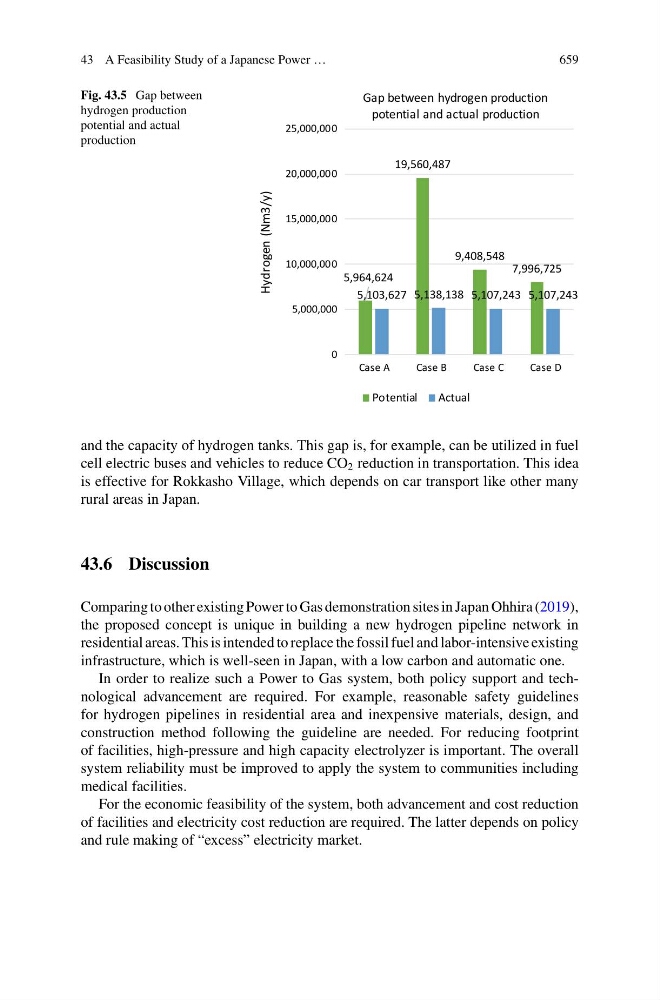
Fig. 43.5 Gap between
hydrogen production
potential and actual
production
5,964,624
19,560,487
9,408,548
7,996,725
5,103,627 5,138,138 5,107,243 5,107,243
0
5,000,000
10,000,000
15,000,000
20,000,000
25,000,000
Case A
Case B
Case C
Case D
Hydrogen (Nm3/y)
Gap between hydrogen production
potential and actual production
Potential
Actual
and the capacity of hydrogen tanks. This gap is, for example, can be utilized in fuel
cell electric buses and vehicles to reduce CO 2 reduction in transportation. This idea
is effective for Rokkasho Village, which depends on car transport like other many
rural areas in Japan.
43.6 Discussion
Comparing to other existing Power to Gas demonstration sites in Japan Ohhira (2019),
the proposed concept is unique in building a new hydrogen pipeline network in
residential areas. This is intended to replace the fossil fuel and labor-intensive existing
infrastructure, which is well-seen in Japan, with a low carbon and automatic one.
In order to realize such a Power to Gas system, both policy support and technological advancement are required. For example, reasonable safety guidelines
for hydrogen pipelines in residential area and inexpensive materials, design, and
construction method following the guideline are needed. For reducing footprint
of facilities, high-pressure and high capacity electrolyzer is important. The overall
system reliability must be improved to apply the system to communities including
medical facilities.
For the economic feasibility of the system, both advancement and cost reduction
of facilities and electricity cost reduction are required. The latter depends on policy
and rule making of “excess” electricity market.