

43 A Feasibility Study of a Japanese Power …
657
Compared to the current hydrogen cost level, case A, C, and D are cheaper than
the hydrogen retail price, 100 JPY/Nm
3 for fuel cell vehicle. Depending on the
additional transport and compression cost, hydrogen in case A, C, and D can be
domestic transport fuel. Compared to the Japanese national target, hydrogen costs
in this study is higher than the 2030s imported hydrogen cost target, 30 JPY/Nm
3 .
However, this target does not include domestic distribution cost.
43.5.3 CO 2 Emission Reduction
In this system, 5,033,466 Nm3 of hydrogen is consumed every year. This amount
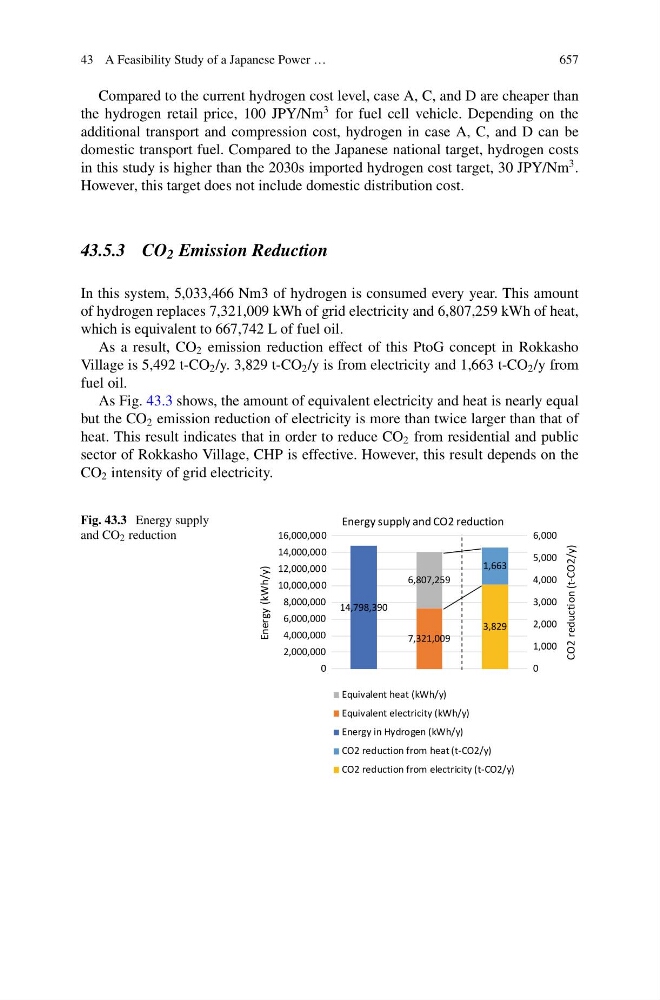
of hydrogen replaces 7,321,009 kWh of grid electricity and 6,807,259 kWh of heat,
which is equivalent to 667,742 L of fuel oil.
As a result, CO 2 emission reduction effect of this PtoG concept in Rokkasho
Village is 5,492 t-CO 2 /y. 3,829 t-CO 2 /y is from electricity and 1,663 t-CO 2 /y from
fuel oil.
As Fig. 43.3 shows, the amount of equivalent electricity and heat is nearly equal
but the CO 2 emission reduction of electricity is more than twice larger than that of
heat. This result indicates that in order to reduce CO 2 from residential and public
sector of Rokkasho Village, CHP is effective. However, this result depends on the
CO 2 intensity of grid electricity.
Fig. 43.3 Energy supply
and CO 2 reduction
14,798,390
7,321,009
6,807,259
3,829
1,663
0
1,000
2,000
3,000
4,000
5,000
6,000
0
2,000,000
4,000,000
6,000,000
8,000,000
10,000,000
12,000,000
14,000,000
16,000,000
CO2 reduction (t-CO2/y)
Energy (kWh/y)
Energy supply and CO2 reduction
Equivalent heat (kWh/y)
Equivalent electricity (kWh/y)
Energy in Hydrogen (kWh/y)
CO2 reduction from heat (t-CO2/y)
CO2 reduction from electricity (t-CO2/y)