

612
M. Huda et al.
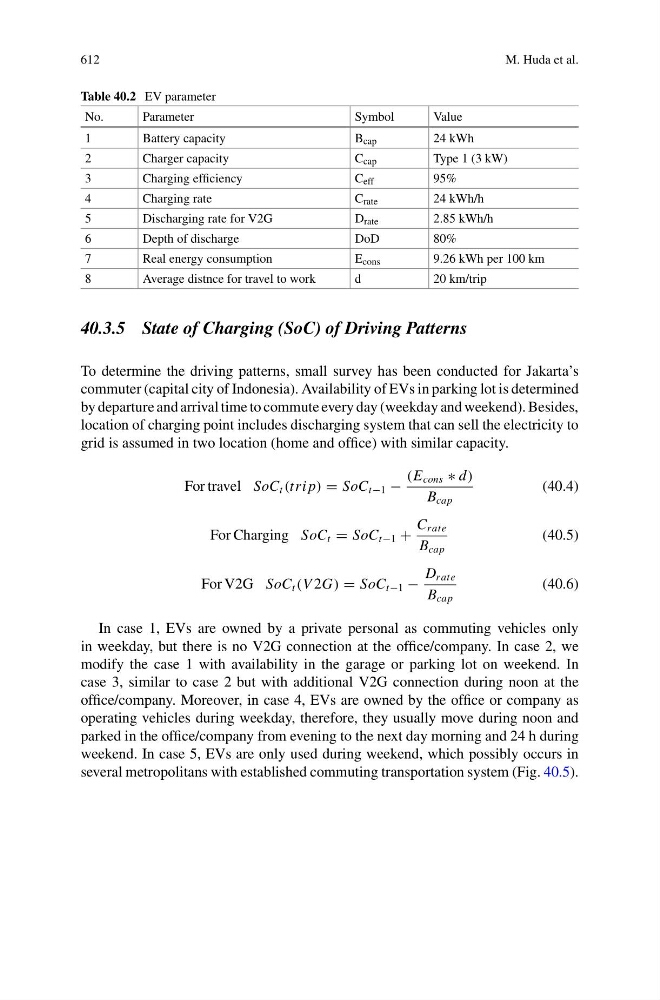
Table 40.2 EV parameter
No.
Parameter
Symbol
Value
1
Battery capacity
B cap
24 kWh
2
Charger capacity
C cap
Type 1 (3 kW)
3
Charging efficiency
C eff
95%
4
Charging rate
C rate
24 kWh/h
5
Discharging rate for V2G
D rate
2.85 kWh/h
6
Depth of discharge
DoD
80%
7
Real energy consumption
E cons
9.26 kWh per 100 km
8
Average distnce for travel to work
d
20 km/trip
40.3.5 State of Charging (SoC) of Driving Patterns
To determine the driving patterns, small survey has been conducted for Jakarta’s
commuter (capital city of Indonesia). Availability of EVs in parking lot is determined
by departure and arrival time to commute every day (weekday and weekend). Besides,
location of charging point includes discharging system that can sell the electricity to
grid is assumed in two location (home and office) with similar capacity.
For travel SoC t (tri p) = SoC t−1 −
(E cons ∗ d)
B cap
(40.4)
For Charging SoC t = SoC t−1 +
C rate
B cap
(40.5)
For V2G SoC t (V 2G) = SoC t−1 −
D rate
B cap
(40.6)
In case 1, EVs are owned by a private personal as commuting vehicles only
in weekday, but there is no V2G connection at the office/company. In case 2, we
modify the case 1 with availability in the garage or parking lot on weekend. In
case 3, similar to case 2 but with additional V2G connection during noon at the
office/company. Moreover, in case 4, EVs are owned by the office or company as
operating vehicles during weekday, therefore, they usually move during noon and
parked in the office/company from evening to the next day morning and 24 h during
weekend. In case 5, EVs are only used during weekend, which possibly occurs in
several metropolitans with established commuting transportation system (Fig. 40.5).