

504
Y. Yoshida et al.
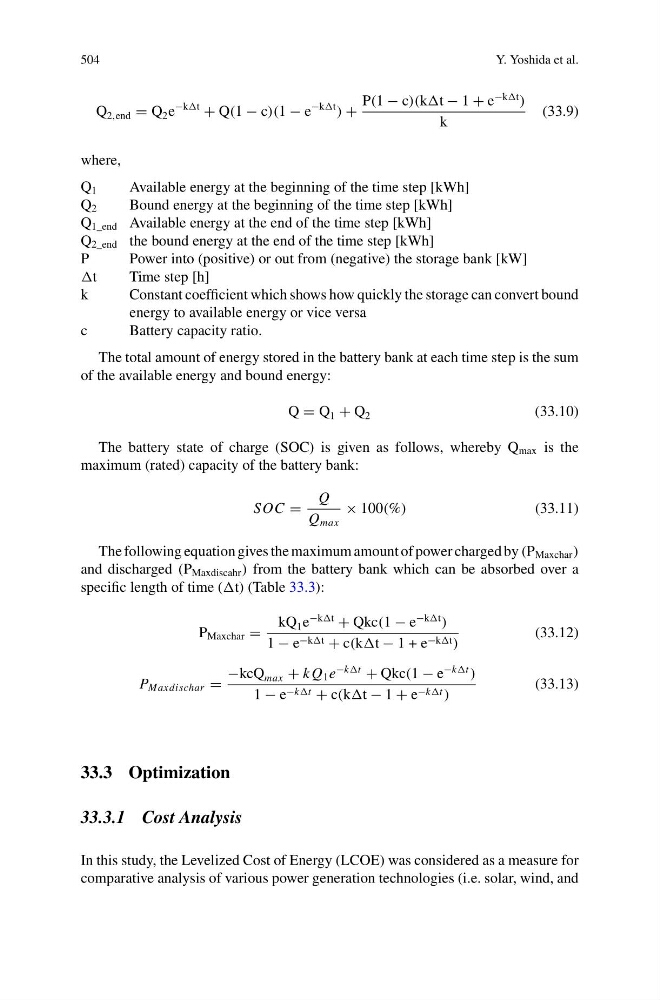
Q 2,end = Q 2 e
−kt
+ Q(1 − c)(1 − e
−kt
) +
P(1 − c)(kt − 1 + e
−kt
)
k
(33.9)
where,
Q 1
Available energy at the beginning of the time step [kWh]
Q 2
Bound energy at the beginning of the time step [kWh]
Q 1_end Available energy at the end of the time step [kWh]
Q 2_end the bound energy at the end of the time step [kWh]
P
Power into (positive) or out from (negative) the storage bank [kW]
t
Time step [h]
k
Constant coefficient which shows how quickly the storage can convert bound
energy to available energy or vice versa
c
Battery capacity ratio.
The total amount of energy stored in the battery bank at each time step is the sum
of the available energy and bound energy:
Q = Q 1 + Q 2
(33.10)
The battery state of charge (SOC) is given as follows, whereby Q max is the
maximum (rated) capacity of the battery bank:
SOC =
Q
Q max
× 100(%)
(33.11)
The following equation gives the maximum amount of power charged by (P Maxchar )
and discharged (P Maxdiscahr ) from the battery bank which can be absorbed over a
specific length of time (t) (Table 33.3):
P Maxchar =
kQ 1 e
−kt
+ Qkc(1 − e
−kt
)
1 − e −kt + c(kt − 1 + e −kt )
(33.12)
P Maxdischar =
−kcQ max + k Q 1 e
−kt
+ Qkc(1 − e
−kt
)
1 − e −kt + c(kt − 1 + e −kt )
(33.13)
33.3 Optimization
33.3.1 Cost Analysis
In this study, the Levelized Cost of Energy (LCOE) was considered as a measure for
comparative analysis of various power generation technologies (i.e. solar, wind, and
Y. Yoshida et al.
Q 2,end = Q 2 e
−kt
+ Q(1 − c)(1 − e
−kt
) +
P(1 − c)(kt − 1 + e
−kt
)
k
(33.9)
where,
Q 1
Available energy at the beginning of the time step [kWh]
Q 2
Bound energy at the beginning of the time step [kWh]
Q 1_end Available energy at the end of the time step [kWh]
Q 2_end the bound energy at the end of the time step [kWh]
P
Power into (positive) or out from (negative) the storage bank [kW]
t
Time step [h]
k
Constant coefficient which shows how quickly the storage can convert bound
energy to available energy or vice versa
c
Battery capacity ratio.
The total amount of energy stored in the battery bank at each time step is the sum
of the available energy and bound energy:
Q = Q 1 + Q 2
(33.10)
The battery state of charge (SOC) is given as follows, whereby Q max is the
maximum (rated) capacity of the battery bank:
SOC =
Q
Q max
× 100(%)
(33.11)
The following equation gives the maximum amount of power charged by (P Maxchar )
and discharged (P Maxdiscahr ) from the battery bank which can be absorbed over a
specific length of time (t) (Table 33.3):
P Maxchar =
kQ 1 e
−kt
+ Qkc(1 − e
−kt
)
1 − e −kt + c(kt − 1 + e −kt )
(33.12)
P Maxdischar =
−kcQ max + k Q 1 e
−kt
+ Qkc(1 − e
−kt
)
1 − e −kt + c(kt − 1 + e −kt )
(33.13)
33.3 Optimization
33.3.1 Cost Analysis
In this study, the Levelized Cost of Energy (LCOE) was considered as a measure for
comparative analysis of various power generation technologies (i.e. solar, wind, and