

33 Optimal Design and Operation of a Residential Hybrid Microgrid …
503
α
Solar absorptance of the PV array [%]
GT Incident solar radiation incident on the PV array [kW/m
2 ]
η C Electrical conversion efficiency of the PV array [%]
U L Overal heat transfer coefficient of the PV [kW/m
2 °C]
T C PV cell temperature [°C]
T a Ambient temperature [°C]
33.2.3 Diesel Generation
The fuel consumption of diesel generator is calculated as follows (Jamshidi and
Askarzadeh 2019):
Cons G = B G · P N_G + A G · P G
(33.6)
where,
Cons G Fuel consumption of diesel generator [L/h]
P N_G Nominal power of diesel generator [kW]
P G
Power output of diesel generator [kW]
A G
0.2461 [L/kWh] and BG:0.081451 [L/kWh].
The thermal efficiency of the diesel generator is estimated by using the following
equation:
η G =
P G
Cons G
(33.7)
33.2.4 Battery Modeling
In this investigation, the Kinetic Battery Model was used to determine the amount
of energy that can be charged by or discharged from the storage bank in each time
step. The Kinetic Battery model explains the behavior of a lead acid battery based
on the operation of two storage tank. The first tank contains “available energy”, or
the amount of chemical energy which is available and can be converted into DC
electricity. The second tank represents “bound energy,” or energy that is chemically
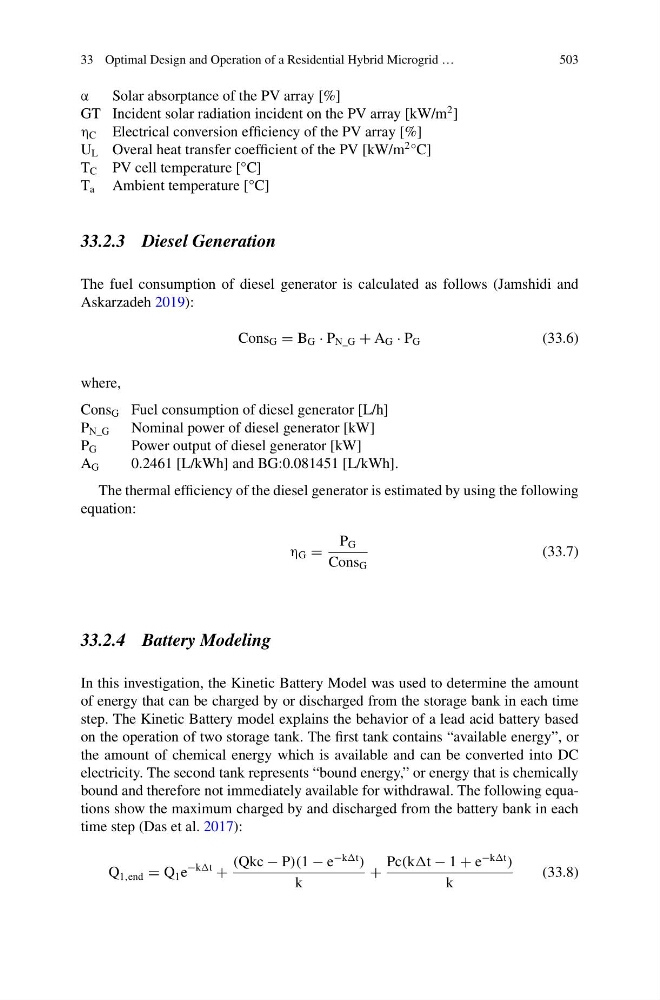
bound and therefore not immediately available for withdrawal. The following equations show the maximum charged by and discharged from the battery bank in each
time step (Das et al. 2017):
Q 1,end = Q 1 e
−kt
+
(Qkc − P)(1 − e
−kt
)
k
+
Pc(kt − 1 + e
−kt
)
k
(33.8)
503
α
Solar absorptance of the PV array [%]
GT Incident solar radiation incident on the PV array [kW/m
2 ]
η C Electrical conversion efficiency of the PV array [%]
U L Overal heat transfer coefficient of the PV [kW/m
2 °C]
T C PV cell temperature [°C]
T a Ambient temperature [°C]
33.2.3 Diesel Generation
The fuel consumption of diesel generator is calculated as follows (Jamshidi and
Askarzadeh 2019):
Cons G = B G · P N_G + A G · P G
(33.6)
where,
Cons G Fuel consumption of diesel generator [L/h]
P N_G Nominal power of diesel generator [kW]
P G
Power output of diesel generator [kW]
A G
0.2461 [L/kWh] and BG:0.081451 [L/kWh].
The thermal efficiency of the diesel generator is estimated by using the following
equation:
η G =
P G
Cons G
(33.7)
33.2.4 Battery Modeling
In this investigation, the Kinetic Battery Model was used to determine the amount
of energy that can be charged by or discharged from the storage bank in each time
step. The Kinetic Battery model explains the behavior of a lead acid battery based
on the operation of two storage tank. The first tank contains “available energy”, or
the amount of chemical energy which is available and can be converted into DC
electricity. The second tank represents “bound energy,” or energy that is chemically
bound and therefore not immediately available for withdrawal. The following equations show the maximum charged by and discharged from the battery bank in each
time step (Das et al. 2017):
Q 1,end = Q 1 e
−kt
+
(Qkc − P)(1 − e
−kt
)
k
+
Pc(kt − 1 + e
−kt
)
k
(33.8)