

502
Y. Yoshida et al.
33.2.2 PV Power Generation
The amount of power output form the PV array is expressed by the following equation
(HOMER 2019):
P pv = G pv f pv
I T
I T, STC
[1 + α p (T C− T C, STC )]
(33.4)
where,
G pv
Rated capacity of the PV array power, under standard test conditions [kW]
f pv
PV derating factor [%]
I T
Solar radiation incident on the PV array [kW/m
2 ]
I T,STC Incident radiation at standard test conditions [kW/m
2 ]
α p
Temperature coefficient of power [%/°C]
T C
PV cell temperature [°C]
T C,STC PV cell temperature under standard test conditions [25 °C].
PV cell temperature is the same as the ambient temperature at night, but it can
increase during sunny days. Following equation represents the energy balance of the
PV array. The input data used in this study for the simulation of the power out of a
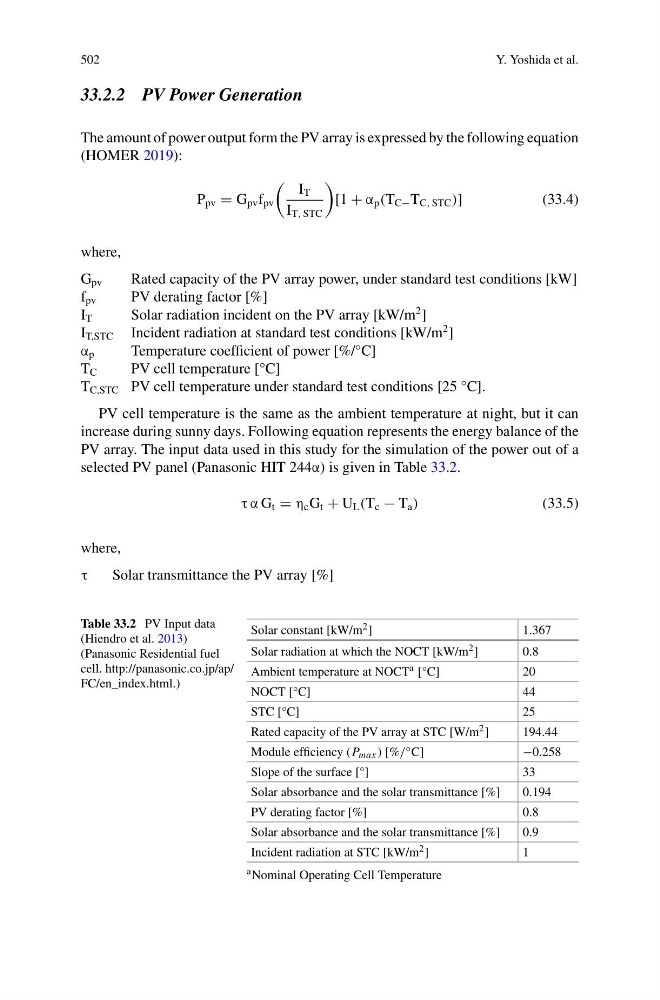
selected PV panel (Panasonic HIT 244α) is given in Table 33.2.
τ α G t = η c G t + U L (T c − T a )
(33.5)
where,
τ
Solar transmittance the PV array [%]
Table 33.2 PV Input data
(Hiendro et al. 2013)
(Panasonic Residential fuel
cell. http://panasonic.co.jp/ap/
FC/en_index.html.)
Solar constant [kW/m 2 ]
1.367
Solar radiation at which the NOCT [kW/m 2 ]
0.8
Ambient temperature at NOCT a [°C]
20
NOCT [°C]
44
STC [°C]
25
Rated capacity of the PV array at STC [W/m 2 ]
194.44
Module efficiency (P max ) [%/ ◦ C]
−0.258
Slope of the surface [°]
33
Solar absorbance and the solar transmittance [%]
0.194
PV derating factor [%]
0.8
Solar absorbance and the solar transmittance [%]
0.9
Incident radiation at STC [kW/m 2 ]
1
a Nominal Operating Cell Temperature
Y. Yoshida et al.
33.2.2 PV Power Generation
The amount of power output form the PV array is expressed by the following equation
(HOMER 2019):
P pv = G pv f pv
I T
I T, STC
[1 + α p (T C− T C, STC )]
(33.4)
where,
G pv
Rated capacity of the PV array power, under standard test conditions [kW]
f pv
PV derating factor [%]
I T
Solar radiation incident on the PV array [kW/m
2 ]
I T,STC Incident radiation at standard test conditions [kW/m
2 ]
α p
Temperature coefficient of power [%/°C]
T C
PV cell temperature [°C]
T C,STC PV cell temperature under standard test conditions [25 °C].
PV cell temperature is the same as the ambient temperature at night, but it can
increase during sunny days. Following equation represents the energy balance of the
PV array. The input data used in this study for the simulation of the power out of a
selected PV panel (Panasonic HIT 244α) is given in Table 33.2.
τ α G t = η c G t + U L (T c − T a )
(33.5)
where,
τ
Solar transmittance the PV array [%]
Table 33.2 PV Input data
(Hiendro et al. 2013)
(Panasonic Residential fuel
cell. http://panasonic.co.jp/ap/
FC/en_index.html.)
Solar constant [kW/m 2 ]
1.367
Solar radiation at which the NOCT [kW/m 2 ]
0.8
Ambient temperature at NOCT a [°C]
20
NOCT [°C]
44
STC [°C]
25
Rated capacity of the PV array at STC [W/m 2 ]
194.44
Module efficiency (P max ) [%/ ◦ C]
−0.258
Slope of the surface [°]
33
Solar absorbance and the solar transmittance [%]
0.194
PV derating factor [%]
0.8
Solar absorbance and the solar transmittance [%]
0.9
Incident radiation at STC [kW/m 2 ]
1
a Nominal Operating Cell Temperature