

33 Optimal Design and Operation of a Residential Hybrid Microgrid …
505
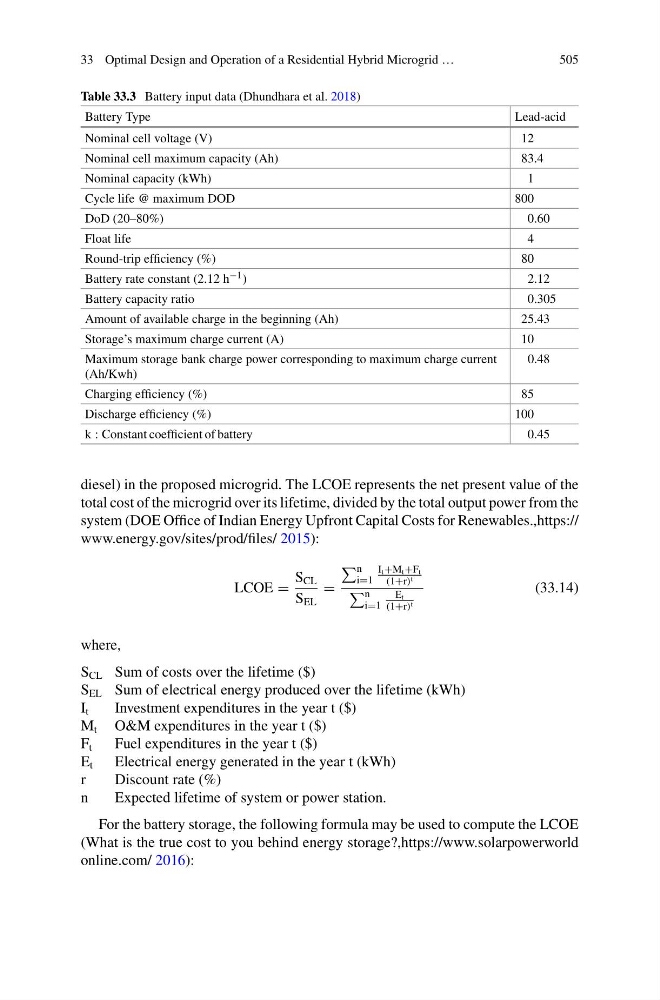
Table 33.3 Battery input data (Dhundhara et al. 2018)
Battery Type
Lead-acid
Nominal cell voltage (V)
12
Nominal cell maximum capacity (Ah)
83.4
Nominal capacity (kWh)
1
Cycle life @ maximum DOD
800
DoD (20–80%)
0.60
Float life
4
Round-trip efficiency (%)
80
Battery rate constant (2.12 h −1 )
2.12
Battery capacity ratio
0.305
Amount of available charge in the beginning (Ah)
25.43
Storage’s maximum charge current (A)
10
Maximum storage bank charge power corresponding to maximum charge current
(Ah/Kwh)
0.48
Charging efficiency (%)
85
Discharge efficiency (%)
100
k : Constant coefficient of battery
0.45
diesel) in the proposed microgrid. The LCOE represents the net present value of the
total cost of the microgrid over its lifetime, divided by the total output power from the
system (DOE Office of Indian Energy Upfront Capital Costs for Renewables.,https://
www.energy.gov/sites/prod/files/ 2015):
LCOE =
S CL
S EL
=
n
i=1
I t +M t +F t
(1+r) t
n
i=1
E t
(1+r) t
(33.14)
where,
S CL Sum of costs over the lifetime ($)
S EL Sum of electrical energy produced over the lifetime (kWh)
I t
Investment expenditures in the year t ($)
M t O&M expenditures in the year t ($)
F t
Fuel expenditures in the year t ($)
E t Electrical energy generated in the year t (kWh)
r
Discount rate (%)
n
Expected lifetime of system or power station.
For the battery storage, the following formula may be used to compute the LCOE
(What is the true cost to you behind energy storage?,https://www.solarpowerworld
online.com/ 2016):
505
Table 33.3 Battery input data (Dhundhara et al. 2018)
Battery Type
Lead-acid
Nominal cell voltage (V)
12
Nominal cell maximum capacity (Ah)
83.4
Nominal capacity (kWh)
1
Cycle life @ maximum DOD
800
DoD (20–80%)
0.60
Float life
4
Round-trip efficiency (%)
80
Battery rate constant (2.12 h −1 )
2.12
Battery capacity ratio
0.305
Amount of available charge in the beginning (Ah)
25.43
Storage’s maximum charge current (A)
10
Maximum storage bank charge power corresponding to maximum charge current
(Ah/Kwh)
0.48
Charging efficiency (%)
85
Discharge efficiency (%)
100
k : Constant coefficient of battery
0.45
diesel) in the proposed microgrid. The LCOE represents the net present value of the
total cost of the microgrid over its lifetime, divided by the total output power from the
system (DOE Office of Indian Energy Upfront Capital Costs for Renewables.,https://
www.energy.gov/sites/prod/files/ 2015):
LCOE =
S CL
S EL
=
n
i=1
I t +M t +F t
(1+r) t
n
i=1
E t
(1+r) t
(33.14)
where,
S CL Sum of costs over the lifetime ($)
S EL Sum of electrical energy produced over the lifetime (kWh)
I t
Investment expenditures in the year t ($)
M t O&M expenditures in the year t ($)
F t
Fuel expenditures in the year t ($)
E t Electrical energy generated in the year t (kWh)
r
Discount rate (%)
n
Expected lifetime of system or power station.
For the battery storage, the following formula may be used to compute the LCOE
(What is the true cost to you behind energy storage?,https://www.solarpowerworld
online.com/ 2016):