

488
N. Takatsu and H. Farzaneh
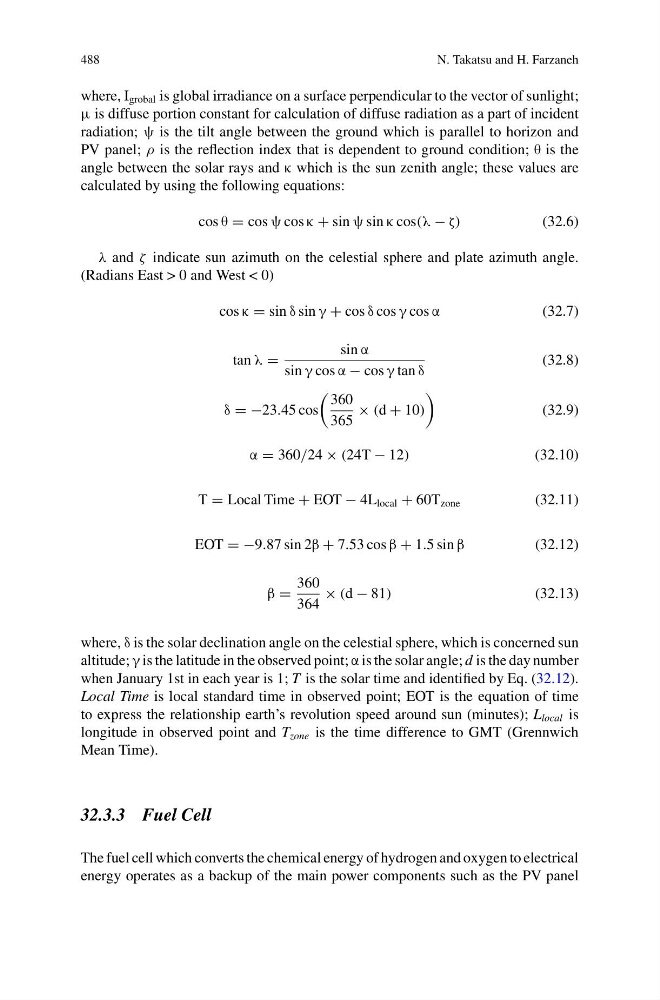
where, I grobal is global irradiance on a surface perpendicular to the vector of sunlight;
μ is diffuse portion constant for calculation of diffuse radiation as a part of incident
radiation; ψ is the tilt angle between the ground which is parallel to horizon and
PV panel; ρ is the reflection index that is dependent to ground condition; θ is the
angle between the solar rays and κ which is the sun zenith angle; these values are
calculated by using the following equations:
cos θ = cos ψ cos κ + sin ψ sin κ cos(λ − ζ)
(32.6)
λ and ζ indicate sun azimuth on the celestial sphere and plate azimuth angle.
(Radians East > 0 and West < 0)
cos κ = sin δ sin γ + cos δ cos γ cos α
(32.7)
tan λ =
sin α
sin γ cos α − cos γ tan δ
(32.8)
δ = −23.45 cos
360
365
× (d + 10)
(32.9)
α = 360/24 × (24T − 12)
(32.10)
T = Local Time + EOT − 4L local + 60T zone
(32.11)
EOT = −9.87 sin 2β + 7.53 cos β + 1.5 sin β
(32.12)
β =
360
364
× (d − 81)
(32.13)
where, δ is the solar declination angle on the celestial sphere, which is concerned sun
altitude; γ is the latitude in the observed point; α is the solar angle; d is the day number
when January 1st in each year is 1; T is the solar time and identified by Eq. (32.12).
Local Time is local standard time in observed point; EOT is the equation of time
to express the relationship earth’s revolution speed around sun (minutes); L local is
longitude in observed point and T zone is the time difference to GMT (Grennwich
Mean Time).
32.3.3 Fuel Cell
The fuel cell which converts the chemical energy of hydrogen and oxygen to electrical
energy operates as a backup of the main power components such as the PV panel
N. Takatsu and H. Farzaneh
where, I grobal is global irradiance on a surface perpendicular to the vector of sunlight;
μ is diffuse portion constant for calculation of diffuse radiation as a part of incident
radiation; ψ is the tilt angle between the ground which is parallel to horizon and
PV panel; ρ is the reflection index that is dependent to ground condition; θ is the
angle between the solar rays and κ which is the sun zenith angle; these values are
calculated by using the following equations:
cos θ = cos ψ cos κ + sin ψ sin κ cos(λ − ζ)
(32.6)
λ and ζ indicate sun azimuth on the celestial sphere and plate azimuth angle.
(Radians East > 0 and West < 0)
cos κ = sin δ sin γ + cos δ cos γ cos α
(32.7)
tan λ =
sin α
sin γ cos α − cos γ tan δ
(32.8)
δ = −23.45 cos
360
365
× (d + 10)
(32.9)
α = 360/24 × (24T − 12)
(32.10)
T = Local Time + EOT − 4L local + 60T zone
(32.11)
EOT = −9.87 sin 2β + 7.53 cos β + 1.5 sin β
(32.12)
β =
360
364
× (d − 81)
(32.13)
where, δ is the solar declination angle on the celestial sphere, which is concerned sun
altitude; γ is the latitude in the observed point; α is the solar angle; d is the day number
when January 1st in each year is 1; T is the solar time and identified by Eq. (32.12).
Local Time is local standard time in observed point; EOT is the equation of time
to express the relationship earth’s revolution speed around sun (minutes); L local is
longitude in observed point and T zone is the time difference to GMT (Grennwich
Mean Time).
32.3.3 Fuel Cell
The fuel cell which converts the chemical energy of hydrogen and oxygen to electrical
energy operates as a backup of the main power components such as the PV panel