

32 Techno-Economic Analysis of a Hybrid Solar-Hydrogen-Biomass …
487
where, P rate . is the rated power of wind turbine; V (t) is the wind velocity in each
time step; V r is the rated wind velocity and V c and V o are the cut-in velocity and
cut-out velocity of the wind turbine.
Wind velocity V (t) is dependent to the height of hub of the wind turbine, it can
be expressed following Eq. (32.2) (Hiendro 2013):
V(t) = V ref (t)
H
H ref
α
(32.2)
where, V ref (t) is the wind velocity measured at the reference height H ref , and the
coefficient α is dependent to roughness of surface, ambient temperature and season.
Here, the value of α is assumed to be 0.14 (Hiendro 2013).
32.3.2 PV Module
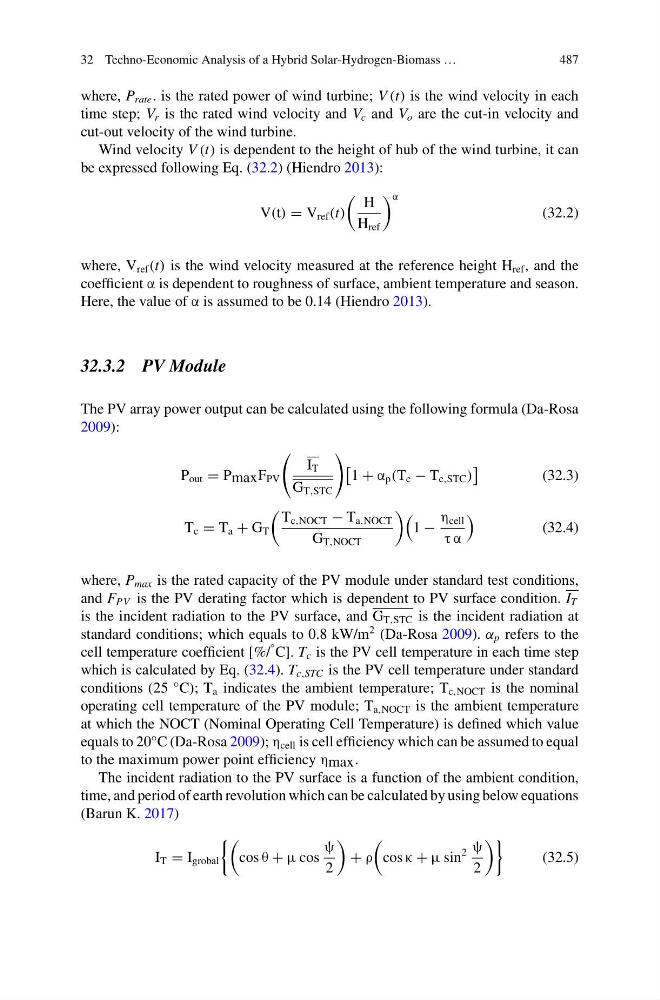
The PV array power output can be calculated using the following formula (Da-Rosa
2009):
P out = P max F PV
I T
G T,STC
1 + α p (T c − T c,STC )
(32.3)
T c = T a + G T
T c,NOCT − T a,NOCT
G T,NOCT
1 −
η cell
τ α
(32.4)
where, P max is the rated capacity of the PV module under standard test conditions,
and F PV is the PV derating factor which is dependent to PV surface condition. I T
is the incident radiation to the PV surface, and G T,STC is the incident radiation at
standard conditions; which equals to 0.8 kW/m
2 (Da-Rosa 2009). α p refers to the
cell temperature coefficient [%/
° C]. T c is the PV cell temperature in each time step
which is calculated by Eq. (32.4). T c,STC is the PV cell temperature under standard
conditions (25 °C); T a indicates the ambient temperature; T c,NOCT is the nominal
operating cell temperature of the PV module; T a,NOCT is the ambient temperature
at which the NOCT (Nominal Operating Cell Temperature) is defined which value
equals to 20°C (Da-Rosa 2009); η cell is cell efficiency which can be assumed to equal
to the maximum power point efficiency η max .
The incident radiation to the PV surface is a function of the ambient condition,
time, and period of earth revolution which can be calculated by using below equations
(Barun K. 2017)
I T = I grobal
cos θ + μ cos
ψ
2
+ ρ
cos κ + μ sin
2 ψ
2
(32.5)
487
where, P rate . is the rated power of wind turbine; V (t) is the wind velocity in each
time step; V r is the rated wind velocity and V c and V o are the cut-in velocity and
cut-out velocity of the wind turbine.
Wind velocity V (t) is dependent to the height of hub of the wind turbine, it can
be expressed following Eq. (32.2) (Hiendro 2013):
V(t) = V ref (t)
H
H ref
α
(32.2)
where, V ref (t) is the wind velocity measured at the reference height H ref , and the
coefficient α is dependent to roughness of surface, ambient temperature and season.
Here, the value of α is assumed to be 0.14 (Hiendro 2013).
32.3.2 PV Module
The PV array power output can be calculated using the following formula (Da-Rosa
2009):
P out = P max F PV
I T
G T,STC
1 + α p (T c − T c,STC )
(32.3)
T c = T a + G T
T c,NOCT − T a,NOCT
G T,NOCT
1 −
η cell
τ α
(32.4)
where, P max is the rated capacity of the PV module under standard test conditions,
and F PV is the PV derating factor which is dependent to PV surface condition. I T
is the incident radiation to the PV surface, and G T,STC is the incident radiation at
standard conditions; which equals to 0.8 kW/m
2 (Da-Rosa 2009). α p refers to the
cell temperature coefficient [%/
° C]. T c is the PV cell temperature in each time step
which is calculated by Eq. (32.4). T c,STC is the PV cell temperature under standard
conditions (25 °C); T a indicates the ambient temperature; T c,NOCT is the nominal
operating cell temperature of the PV module; T a,NOCT is the ambient temperature
at which the NOCT (Nominal Operating Cell Temperature) is defined which value
equals to 20°C (Da-Rosa 2009); η cell is cell efficiency which can be assumed to equal
to the maximum power point efficiency η max .
The incident radiation to the PV surface is a function of the ambient condition,
time, and period of earth revolution which can be calculated by using below equations
(Barun K. 2017)
I T = I grobal
cos θ + μ cos
ψ
2
+ ρ
cos κ + μ sin
2 ψ
2
(32.5)