

32 Techno-Economic Analysis of a Hybrid Solar-Hydrogen-Biomass …
485
electricity. The Hydrogen provided from two sources feed the fuel cell: (1) a water
electrolyzer and (2) a SCWG which generates hydrogen from biomass gasification
via hydrothermal conversion route (Pichtel 2001). The SCWG uses water as the
gasifying agent at its supercritical condition to decompose the organic biomass such
as kitchen waste and organic biomass to hydrogen, carbon dioxide, carbon monoxide,
and methane gas, allowing to achieve very high volumetric hydrogen ratio.
32.2 Case Study
The case study considered in this paper is a residential area located in a subject district
in Shinchi-machi of Fukushima-Prefecture, Japan. This district belongs to the Tohoku
region, which the Great East Japan Earthquake occurred there (Shinchi-machi and
Official Homepage 2019). A small thermal powerplant provides the electricity load
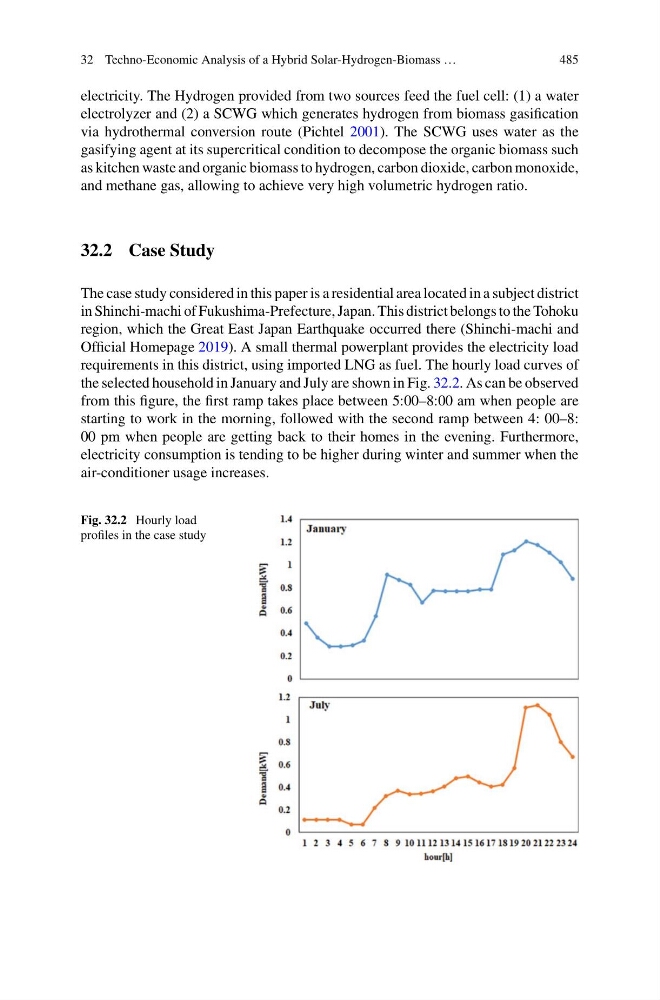
requirements in this district, using imported LNG as fuel. The hourly load curves of
the selected household in January and July are shown in Fig. 32.2. As can be observed
from this figure, the first ramp takes place between 5:00–8:00 am when people are
starting to work in the morning, followed with the second ramp between 4: 00–8:
00 pm when people are getting back to their homes in the evening. Furthermore,
electricity consumption is tending to be higher during winter and summer when the
air-conditioner usage increases.
Fig. 32.2 Hourly load
profiles in the case study
485
electricity. The Hydrogen provided from two sources feed the fuel cell: (1) a water
electrolyzer and (2) a SCWG which generates hydrogen from biomass gasification
via hydrothermal conversion route (Pichtel 2001). The SCWG uses water as the
gasifying agent at its supercritical condition to decompose the organic biomass such
as kitchen waste and organic biomass to hydrogen, carbon dioxide, carbon monoxide,
and methane gas, allowing to achieve very high volumetric hydrogen ratio.
32.2 Case Study
The case study considered in this paper is a residential area located in a subject district
in Shinchi-machi of Fukushima-Prefecture, Japan. This district belongs to the Tohoku
region, which the Great East Japan Earthquake occurred there (Shinchi-machi and
Official Homepage 2019). A small thermal powerplant provides the electricity load
requirements in this district, using imported LNG as fuel. The hourly load curves of
the selected household in January and July are shown in Fig. 32.2. As can be observed
from this figure, the first ramp takes place between 5:00–8:00 am when people are
starting to work in the morning, followed with the second ramp between 4: 00–8:
00 pm when people are getting back to their homes in the evening. Furthermore,
electricity consumption is tending to be higher during winter and summer when the
air-conditioner usage increases.
Fig. 32.2 Hourly load
profiles in the case study