

484
N. Takatsu and H. Farzaneh
Fossil fuels currently account for 83.7% of the total energy consumption in Japan,
which approaches the level of the oil shock in 1973 (Agency for Natural Resources
and Energy, Japan 2016). To tackle this challenge, the government of Japan needs to
develop and utilize renewable energy sources to increase its energy self-sufficiency
rate and reduce the environmental impacts of the increased use of fossil fuels.
Since the renewable energies are from the natural environment, they are all weather
dependent, which makes them vulnerable in developing a stable power system. The
hybridization of variable renewables can allow for smooth, durable, and reliable
output to power grids to improve the safety, reliability, and stability of dispatched
power, which is cheaper than investing in single renewable technologies. Therefore,
Hybrid Renewable Energy System (HRES) can be considered as one possible solution which can combine two or more renewable energy sources to produce power
continuously, without interruption. Furthermore, when the HRES is connected to a
storage system like battery or hydrogen storage, the excess energy generated by the
renewable energies such as solar or wind can be stored and then utilized during the
period when there is no sunshine and wind and electricity is not being generated.
Therefore, compared to a single renewable technology, the HRES works more efficiently in all operating conditions. There have been reports on HRES using various
components so far (Takatsu and Farzaneh, 2020; Shaqour et al., 2020; Yoshida and
Farzaneh, 2020; Rodolfo Dufo-Lopez 2008; Guinot 2014; Amer 2013; Sawle 2017).
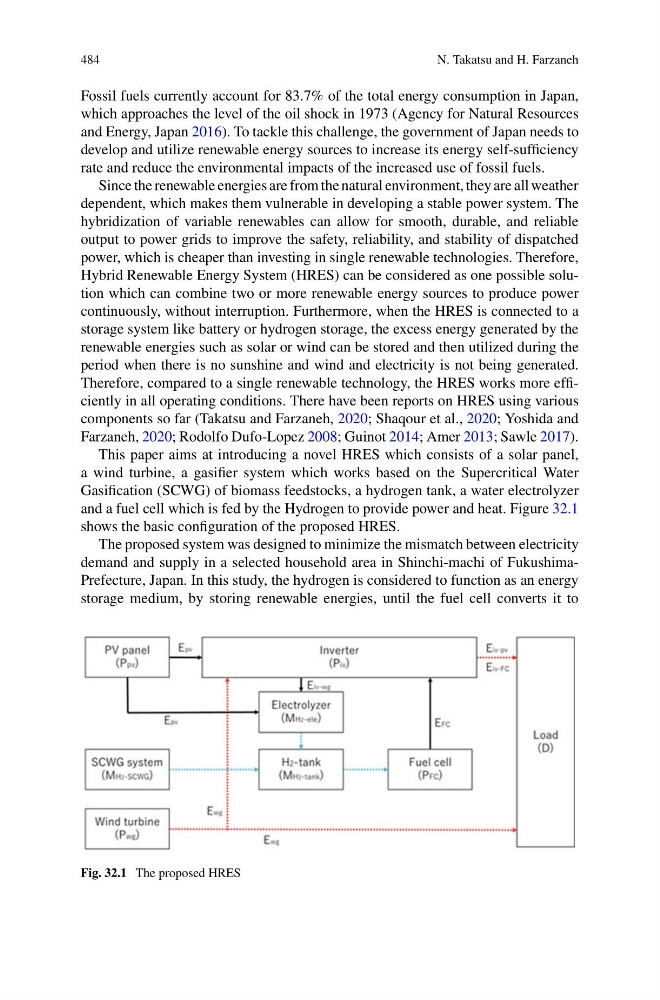
This paper aims at introducing a novel HRES which consists of a solar panel,
a wind turbine, a gasifier system which works based on the Supercritical Water
Gasification (SCWG) of biomass feedstocks, a hydrogen tank, a water electrolyzer
and a fuel cell which is fed by the Hydrogen to provide power and heat. Figure 32.1
shows the basic configuration of the proposed HRES.
The proposed system was designed to minimize the mismatch between electricity
demand and supply in a selected household area in Shinchi-machi of FukushimaPrefecture, Japan. In this study, the hydrogen is considered to function as an energy
storage medium, by storing renewable energies, until the fuel cell converts it to
Fig. 32.1 The proposed HRES
N. Takatsu and H. Farzaneh
Fossil fuels currently account for 83.7% of the total energy consumption in Japan,
which approaches the level of the oil shock in 1973 (Agency for Natural Resources
and Energy, Japan 2016). To tackle this challenge, the government of Japan needs to
develop and utilize renewable energy sources to increase its energy self-sufficiency
rate and reduce the environmental impacts of the increased use of fossil fuels.
Since the renewable energies are from the natural environment, they are all weather
dependent, which makes them vulnerable in developing a stable power system. The
hybridization of variable renewables can allow for smooth, durable, and reliable
output to power grids to improve the safety, reliability, and stability of dispatched
power, which is cheaper than investing in single renewable technologies. Therefore,
Hybrid Renewable Energy System (HRES) can be considered as one possible solution which can combine two or more renewable energy sources to produce power
continuously, without interruption. Furthermore, when the HRES is connected to a
storage system like battery or hydrogen storage, the excess energy generated by the
renewable energies such as solar or wind can be stored and then utilized during the
period when there is no sunshine and wind and electricity is not being generated.
Therefore, compared to a single renewable technology, the HRES works more efficiently in all operating conditions. There have been reports on HRES using various
components so far (Takatsu and Farzaneh, 2020; Shaqour et al., 2020; Yoshida and
Farzaneh, 2020; Rodolfo Dufo-Lopez 2008; Guinot 2014; Amer 2013; Sawle 2017).
This paper aims at introducing a novel HRES which consists of a solar panel,
a wind turbine, a gasifier system which works based on the Supercritical Water
Gasification (SCWG) of biomass feedstocks, a hydrogen tank, a water electrolyzer
and a fuel cell which is fed by the Hydrogen to provide power and heat. Figure 32.1
shows the basic configuration of the proposed HRES.
The proposed system was designed to minimize the mismatch between electricity
demand and supply in a selected household area in Shinchi-machi of FukushimaPrefecture, Japan. In this study, the hydrogen is considered to function as an energy
storage medium, by storing renewable energies, until the fuel cell converts it to
Fig. 32.1 The proposed HRES