

31 Development of a Method for Measuring Resource Efficiency …
475
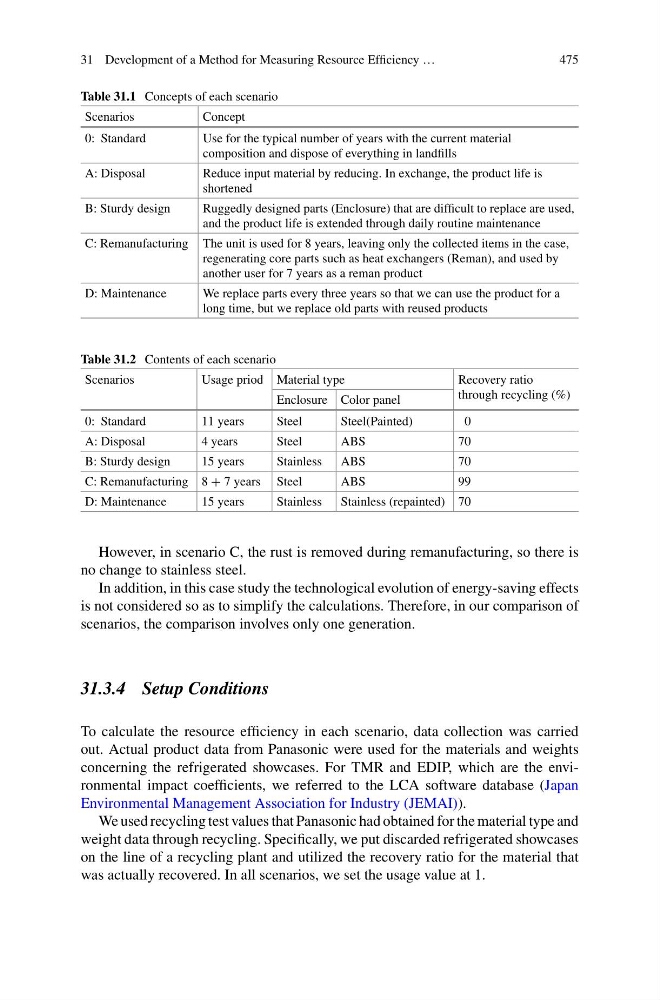
Table 31.1 Concepts of each scenario
Scenarios
Concept
0: Standard
Use for the typical number of years with the current material
composition and dispose of everything in landfills
A: Disposal
Reduce input material by reducing. In exchange, the product life is
shortened
B: Sturdy design
Ruggedly designed parts (Enclosure) that are difficult to replace are used,
and the product life is extended through daily routine maintenance
C: Remanufacturing The unit is used for 8 years, leaving only the collected items in the case,
regenerating core parts such as heat exchangers (Reman), and used by
another user for 7 years as a reman product
D: Maintenance
We replace parts every three years so that we can use the product for a
long time, but we replace old parts with reused products
Table 31.2 Contents of each scenario
Scenarios
Usage priod Material type
Recovery ratio
through recycling (%)
Enclosure Color panel
0: Standard
11 years
Steel
Steel(Painted)
0
A: Disposal
4 years
Steel
ABS
70
B: Sturdy design
15 years
Stainless ABS
70
C: Remanufacturing 8 + 7 years Steel
ABS
99
D: Maintenance
15 years
Stainless Stainless (repainted) 70
However, in scenario C, the rust is removed during remanufacturing, so there is
no change to stainless steel.
In addition, in this case study the technological evolution of energy-saving effects
is not considered so as to simplify the calculations. Therefore, in our comparison of
scenarios, the comparison involves only one generation.
31.3.4 Setup Conditions
To calculate the resource efficiency in each scenario, data collection was carried
out. Actual product data from Panasonic were used for the materials and weights
concerning the refrigerated showcases. For TMR and EDIP, which are the environmental impact coefficients, we referred to the LCA software database (Japan
Environmental Management Association for Industry (JEMAI)).
We used recycling test values that Panasonic had obtained for the material type and
weight data through recycling. Specifically, we put discarded refrigerated showcases
on the line of a recycling plant and utilized the recovery ratio for the material that
was actually recovered. In all scenarios, we set the usage value at 1.
475
Table 31.1 Concepts of each scenario
Scenarios
Concept
0: Standard
Use for the typical number of years with the current material
composition and dispose of everything in landfills
A: Disposal
Reduce input material by reducing. In exchange, the product life is
shortened
B: Sturdy design
Ruggedly designed parts (Enclosure) that are difficult to replace are used,
and the product life is extended through daily routine maintenance
C: Remanufacturing The unit is used for 8 years, leaving only the collected items in the case,
regenerating core parts such as heat exchangers (Reman), and used by
another user for 7 years as a reman product
D: Maintenance
We replace parts every three years so that we can use the product for a
long time, but we replace old parts with reused products
Table 31.2 Contents of each scenario
Scenarios
Usage priod Material type
Recovery ratio
through recycling (%)
Enclosure Color panel
0: Standard
11 years
Steel
Steel(Painted)
0
A: Disposal
4 years
Steel
ABS
70
B: Sturdy design
15 years
Stainless ABS
70
C: Remanufacturing 8 + 7 years Steel
ABS
99
D: Maintenance
15 years
Stainless Stainless (repainted) 70
However, in scenario C, the rust is removed during remanufacturing, so there is
no change to stainless steel.
In addition, in this case study the technological evolution of energy-saving effects
is not considered so as to simplify the calculations. Therefore, in our comparison of
scenarios, the comparison involves only one generation.
31.3.4 Setup Conditions
To calculate the resource efficiency in each scenario, data collection was carried
out. Actual product data from Panasonic were used for the materials and weights
concerning the refrigerated showcases. For TMR and EDIP, which are the environmental impact coefficients, we referred to the LCA software database (Japan
Environmental Management Association for Industry (JEMAI)).
We used recycling test values that Panasonic had obtained for the material type and
weight data through recycling. Specifically, we put discarded refrigerated showcases
on the line of a recycling plant and utilized the recovery ratio for the material that
was actually recovered. In all scenarios, we set the usage value at 1.