

474
G. Miyake et al.
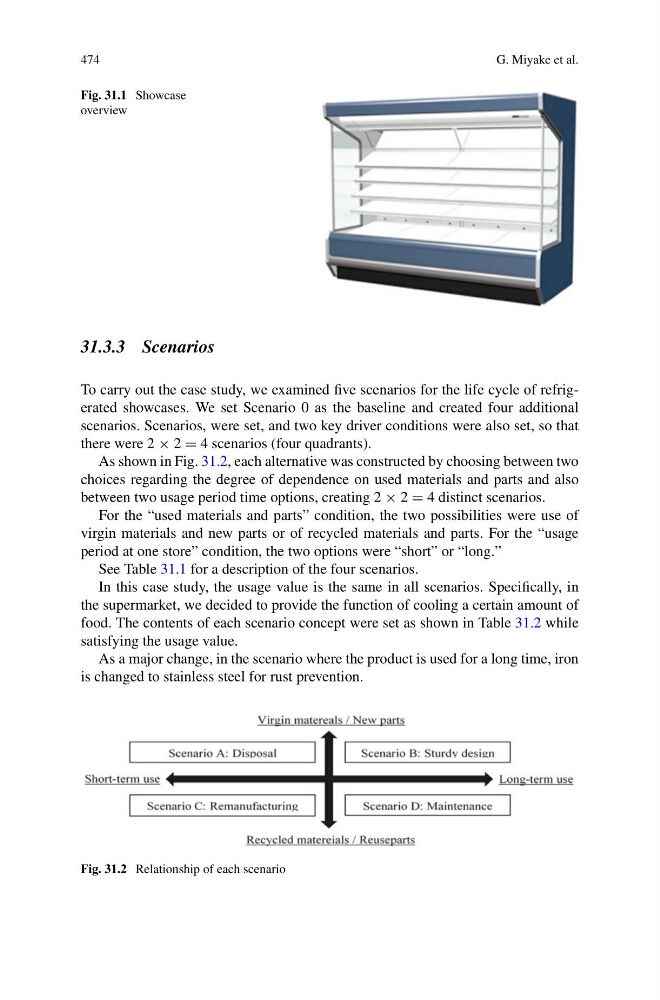
Fig. 31.1 Showcase
overview
31.3.3 Scenarios
To carry out the case study, we examined five scenarios for the life cycle of refrigerated showcases. We set Scenario 0 as the baseline and created four additional
scenarios. Scenarios, were set, and two key driver conditions were also set, so that
there were 2 × 2 = 4 scenarios (four quadrants).
As shown in Fig. 31.2, each alternative was constructed by choosing between two
choices regarding the degree of dependence on used materials and parts and also
between two usage period time options, creating 2 × 2 = 4 distinct scenarios.
For the “used materials and parts” condition, the two possibilities were use of
virgin materials and new parts or of recycled materials and parts. For the “usage
period at one store” condition, the two options were “short” or “long.”
See Table 31.1 for a description of the four scenarios.
In this case study, the usage value is the same in all scenarios. Specifically, in
the supermarket, we decided to provide the function of cooling a certain amount of
food. The contents of each scenario concept were set as shown in Table 31.2 while
satisfying the usage value.
As a major change, in the scenario where the product is used for a long time, iron
is changed to stainless steel for rust prevention.
Fig. 31.2 Relationship of each scenario
G. Miyake et al.
Fig. 31.1 Showcase
overview
31.3.3 Scenarios
To carry out the case study, we examined five scenarios for the life cycle of refrigerated showcases. We set Scenario 0 as the baseline and created four additional
scenarios. Scenarios, were set, and two key driver conditions were also set, so that
there were 2 × 2 = 4 scenarios (four quadrants).
As shown in Fig. 31.2, each alternative was constructed by choosing between two
choices regarding the degree of dependence on used materials and parts and also
between two usage period time options, creating 2 × 2 = 4 distinct scenarios.
For the “used materials and parts” condition, the two possibilities were use of
virgin materials and new parts or of recycled materials and parts. For the “usage
period at one store” condition, the two options were “short” or “long.”
See Table 31.1 for a description of the four scenarios.
In this case study, the usage value is the same in all scenarios. Specifically, in
the supermarket, we decided to provide the function of cooling a certain amount of
food. The contents of each scenario concept were set as shown in Table 31.2 while
satisfying the usage value.
As a major change, in the scenario where the product is used for a long time, iron
is changed to stainless steel for rust prevention.
Fig. 31.2 Relationship of each scenario