

460
X. Chen et al.
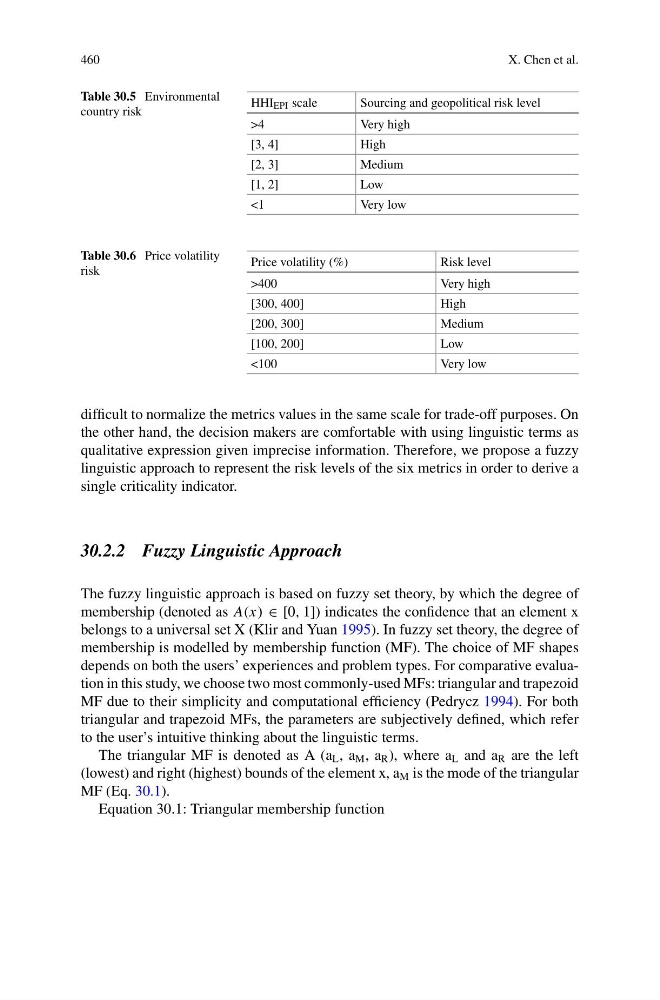
Table 30.5 Environmental
country risk
HHI EPI scale
Sourcing and geopolitical risk level
>4
Very high
[3, 4]
High
[2, 3]
Medium
[1, 2]
Low
<1
Very low
Table 30.6 Price volatility
risk
Price volatility (%)
Risk level
>400
Very high
[300, 400]
High
[200, 300]
Medium
[100, 200]
Low
<100
Very low
difficult to normalize the metrics values in the same scale for trade-off purposes. On
the other hand, the decision makers are comfortable with using linguistic terms as
qualitative expression given imprecise information. Therefore, we propose a fuzzy
linguistic approach to represent the risk levels of the six metrics in order to derive a
single criticality indicator.
30.2.2 Fuzzy Linguistic Approach
The fuzzy linguistic approach is based on fuzzy set theory, by which the degree of
membership (denoted as A(x) ∈ [0, 1]) indicates the confidence that an element x
belongs to a universal set X (Klir and Yuan 1995). In fuzzy set theory, the degree of
membership is modelled by membership function (MF). The choice of MF shapes
depends on both the users’ experiences and problem types. For comparative evaluation in this study, we choose two most commonly-used MFs: triangular and trapezoid
MF due to their simplicity and computational efficiency (Pedrycz 1994). For both
triangular and trapezoid MFs, the parameters are subjectively defined, which refer
to the user’s intuitive thinking about the linguistic terms.
The triangular MF is denoted as A (a L , a M , a R ), where a L and a R are the left
(lowest) and right (highest) bounds of the element x, a M is the mode of the triangular
MF (Eq. 30.1).
Equation 30.1: Triangular membership function
X. Chen et al.
Table 30.5 Environmental
country risk
HHI EPI scale
Sourcing and geopolitical risk level
>4
Very high
[3, 4]
High
[2, 3]
Medium
[1, 2]
Low
<1
Very low
Table 30.6 Price volatility
risk
Price volatility (%)
Risk level
>400
Very high
[300, 400]
High
[200, 300]
Medium
[100, 200]
Low
<100
Very low
difficult to normalize the metrics values in the same scale for trade-off purposes. On
the other hand, the decision makers are comfortable with using linguistic terms as
qualitative expression given imprecise information. Therefore, we propose a fuzzy
linguistic approach to represent the risk levels of the six metrics in order to derive a
single criticality indicator.
30.2.2 Fuzzy Linguistic Approach
The fuzzy linguistic approach is based on fuzzy set theory, by which the degree of
membership (denoted as A(x) ∈ [0, 1]) indicates the confidence that an element x
belongs to a universal set X (Klir and Yuan 1995). In fuzzy set theory, the degree of
membership is modelled by membership function (MF). The choice of MF shapes
depends on both the users’ experiences and problem types. For comparative evaluation in this study, we choose two most commonly-used MFs: triangular and trapezoid
MF due to their simplicity and computational efficiency (Pedrycz 1994). For both
triangular and trapezoid MFs, the parameters are subjectively defined, which refer
to the user’s intuitive thinking about the linguistic terms.
The triangular MF is denoted as A (a L , a M , a R ), where a L and a R are the left
(lowest) and right (highest) bounds of the element x, a M is the mode of the triangular
MF (Eq. 30.1).
Equation 30.1: Triangular membership function