

30 Material Criticality Assessment for Business Purposes …
459
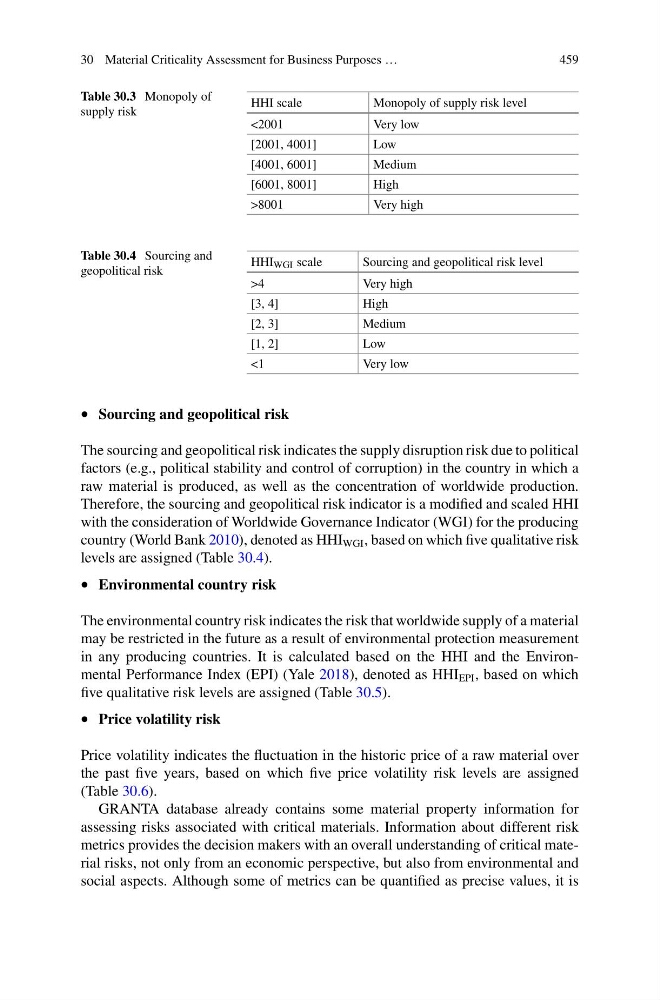
Table 30.3 Monopoly of
supply risk
HHI scale
Monopoly of supply risk level
<2001
Very low
[2001, 4001]
Low
[4001, 6001]
Medium
[6001, 8001]
High
>8001
Very high
Table 30.4 Sourcing and
geopolitical risk
HHI WGI scale
Sourcing and geopolitical risk level
>4
Very high
[3, 4]
High
[2, 3]
Medium
[1, 2]
Low
<1
Very low
• Sourcing and geopolitical risk
The sourcing and geopolitical risk indicates the supply disruption risk due to political
factors (e.g., political stability and control of corruption) in the country in which a
raw material is produced, as well as the concentration of worldwide production.
Therefore, the sourcing and geopolitical risk indicator is a modified and scaled HHI
with the consideration of Worldwide Governance Indicator (WGI) for the producing
country (World Bank 2010), denoted as HHI WGI , based on which five qualitative risk
levels are assigned (Table 30.4).
• Environmental country risk
The environmental country risk indicates the risk that worldwide supply of a material
may be restricted in the future as a result of environmental protection measurement
in any producing countries. It is calculated based on the HHI and the Environmental Performance Index (EPI) (Yale 2018), denoted as HHI EPI , based on which
five qualitative risk levels are assigned (Table 30.5).
• Price volatility risk
Price volatility indicates the fluctuation in the historic price of a raw material over
the past five years, based on which five price volatility risk levels are assigned
(Table 30.6).
GRANTA database already contains some material property information for
assessing risks associated with critical materials. Information about different risk
metrics provides the decision makers with an overall understanding of critical material risks, not only from an economic perspective, but also from environmental and
social aspects. Although some of metrics can be quantified as precise values, it is
459
Table 30.3 Monopoly of
supply risk
HHI scale
Monopoly of supply risk level
<2001
Very low
[2001, 4001]
Low
[4001, 6001]
Medium
[6001, 8001]
High
>8001
Very high
Table 30.4 Sourcing and
geopolitical risk
HHI WGI scale
Sourcing and geopolitical risk level
>4
Very high
[3, 4]
High
[2, 3]
Medium
[1, 2]
Low
<1
Very low
• Sourcing and geopolitical risk
The sourcing and geopolitical risk indicates the supply disruption risk due to political
factors (e.g., political stability and control of corruption) in the country in which a
raw material is produced, as well as the concentration of worldwide production.
Therefore, the sourcing and geopolitical risk indicator is a modified and scaled HHI
with the consideration of Worldwide Governance Indicator (WGI) for the producing
country (World Bank 2010), denoted as HHI WGI , based on which five qualitative risk
levels are assigned (Table 30.4).
• Environmental country risk
The environmental country risk indicates the risk that worldwide supply of a material
may be restricted in the future as a result of environmental protection measurement
in any producing countries. It is calculated based on the HHI and the Environmental Performance Index (EPI) (Yale 2018), denoted as HHI EPI , based on which
five qualitative risk levels are assigned (Table 30.5).
• Price volatility risk
Price volatility indicates the fluctuation in the historic price of a raw material over
the past five years, based on which five price volatility risk levels are assigned
(Table 30.6).
GRANTA database already contains some material property information for
assessing risks associated with critical materials. Information about different risk
metrics provides the decision makers with an overall understanding of critical material risks, not only from an economic perspective, but also from environmental and
social aspects. Although some of metrics can be quantified as precise values, it is