

458
X. Chen et al.
Table 30.1 Abundance risk
level
Abundance in the Earth’s crust (ppm) Abundance risk level
<0.01
Very high
[0.01, 1]
High
[1, 100]
Medium
[100, 10,000]
Low
>10,000
Very low
• Abundance risk
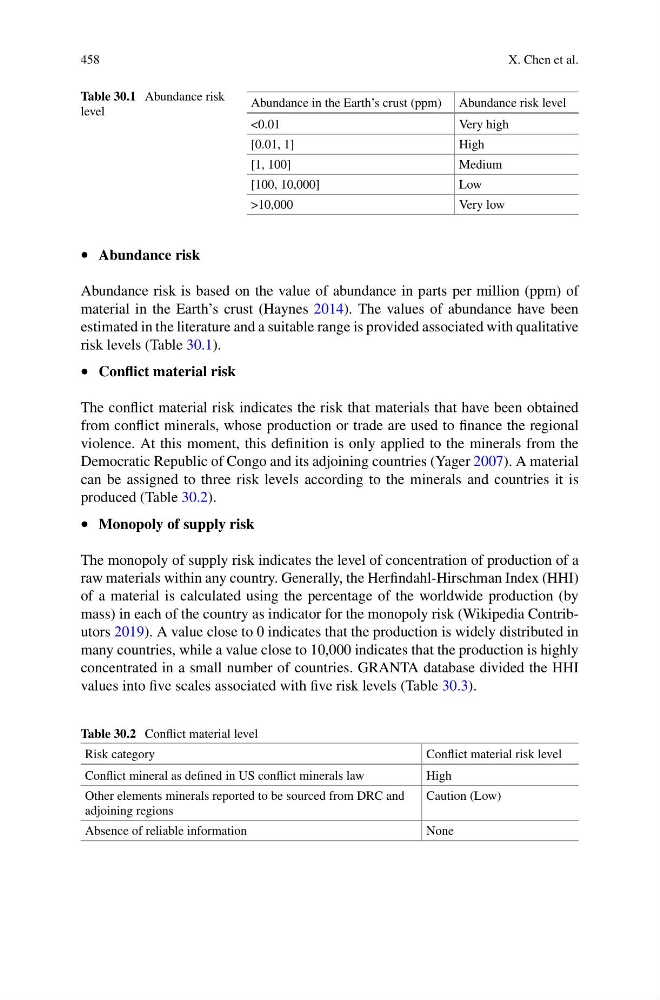
Abundance risk is based on the value of abundance in parts per million (ppm) of
material in the Earth’s crust (Haynes 2014). The values of abundance have been
estimated in the literature and a suitable range is provided associated with qualitative
risk levels (Table 30.1).
• Conflict material risk
The conflict material risk indicates the risk that materials that have been obtained
from conflict minerals, whose production or trade are used to finance the regional
violence. At this moment, this definition is only applied to the minerals from the
Democratic Republic of Congo and its adjoining countries (Yager 2007). A material
can be assigned to three risk levels according to the minerals and countries it is
produced (Table 30.2).
• Monopoly of supply risk
The monopoly of supply risk indicates the level of concentration of production of a
raw materials within any country. Generally, the Herfindahl-Hirschman Index (HHI)
of a material is calculated using the percentage of the worldwide production (by
mass) in each of the country as indicator for the monopoly risk (Wikipedia Contributors 2019). A value close to 0 indicates that the production is widely distributed in
many countries, while a value close to 10,000 indicates that the production is highly
concentrated in a small number of countries. GRANTA database divided the HHI
values into five scales associated with five risk levels (Table 30.3).
Table 30.2 Conflict material level
Risk category
Conflict material risk level
Conflict mineral as defined in US conflict minerals law
High
Other elements minerals reported to be sourced from DRC and
adjoining regions
Caution (Low)
Absence of reliable information
None
X. Chen et al.
Table 30.1 Abundance risk
level
Abundance in the Earth’s crust (ppm) Abundance risk level
<0.01
Very high
[0.01, 1]
High
[1, 100]
Medium
[100, 10,000]
Low
>10,000
Very low
• Abundance risk
Abundance risk is based on the value of abundance in parts per million (ppm) of
material in the Earth’s crust (Haynes 2014). The values of abundance have been
estimated in the literature and a suitable range is provided associated with qualitative
risk levels (Table 30.1).
• Conflict material risk
The conflict material risk indicates the risk that materials that have been obtained
from conflict minerals, whose production or trade are used to finance the regional
violence. At this moment, this definition is only applied to the minerals from the
Democratic Republic of Congo and its adjoining countries (Yager 2007). A material
can be assigned to three risk levels according to the minerals and countries it is
produced (Table 30.2).
• Monopoly of supply risk
The monopoly of supply risk indicates the level of concentration of production of a
raw materials within any country. Generally, the Herfindahl-Hirschman Index (HHI)
of a material is calculated using the percentage of the worldwide production (by
mass) in each of the country as indicator for the monopoly risk (Wikipedia Contributors 2019). A value close to 0 indicates that the production is widely distributed in
many countries, while a value close to 10,000 indicates that the production is highly
concentrated in a small number of countries. GRANTA database divided the HHI
values into five scales associated with five risk levels (Table 30.3).
Table 30.2 Conflict material level
Risk category
Conflict material risk level
Conflict mineral as defined in US conflict minerals law
High
Other elements minerals reported to be sourced from DRC and
adjoining regions
Caution (Low)
Absence of reliable information
None