

30 Material Criticality Assessment for Business Purposes …
461
A(a L , a M , a R ) =
⎧
⎪ ⎨
⎪ ⎩
x−a L
a M −a L
for a L ≤ x ≤ a M
0
otherwise
a R −x
a R −a M
for a M ≤ x ≤ a R
⎫
⎪ ⎬
⎪ ⎭
in which 0 ≤ a L ≤ a M ≤ a R
(30.1)
The trapezoid MF is denoted as A (a L , a LM , a RM , a R ), where a L and a R are the left
(lowest) and right (highest) bounds of the element x, a LM and a M is the range of the
mode of the trapezoid MF (Eq. 30.2).
Equation 30.2: Trapezoid membership function
A(a L , a LM , a RM , a R ) =
⎧
⎪ ⎪ ⎪ ⎪ ⎪ ⎪ ⎪ ⎪ ⎪ ⎨
⎪ ⎪ ⎪ ⎪ ⎪ ⎪ ⎪ ⎪ ⎪ ⎩
x − a L M
a L M − a L
f or a L ≤ xa L M
1 f or a L M ≤ x ≤ a RM
a R − x
a R − a RM
f or a RM ≤ x a R
0
Otherwise
⎫
⎪ ⎪ ⎪ ⎪ ⎪ ⎪ ⎪ ⎪ ⎪ ⎬
⎪ ⎪ ⎪ ⎪ ⎪ ⎪ ⎪ ⎪ ⎪ ⎭
in which 0 ≤ a L ≤ a L M ≤ a RM ≤ a R
(30.2)
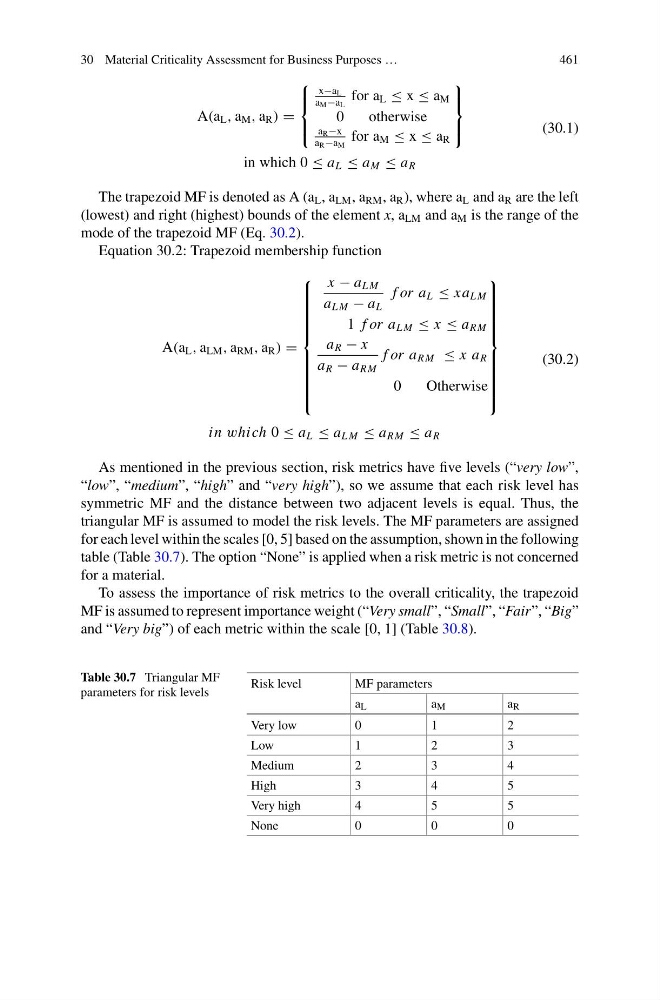
As mentioned in the previous section, risk metrics have five levels (“very low”,
“low”, “medium”, “high” and “very high”), so we assume that each risk level has
symmetric MF and the distance between two adjacent levels is equal. Thus, the
triangular MF is assumed to model the risk levels. The MF parameters are assigned
for each level within the scales [0, 5] based on the assumption, shown in the following
table (Table 30.7). The option “None” is applied when a risk metric is not concerned
for a material.
To assess the importance of risk metrics to the overall criticality, the trapezoid
MF is assumed to represent importance weight (“Very small”, “Small”, “Fair”, “Big”
and “Very big”) of each metric within the scale [0, 1] (Table 30.8).
Table 30.7 Triangular MF
parameters for risk levels
Risk level
MF parameters
a L
a M
a R
Very low
0
1
2
Low
1
2
3
Medium
2
3
4
High
3
4
5
Very high
4
5
5
None
0
0
0
461
A(a L , a M , a R ) =
⎧
⎪ ⎨
⎪ ⎩
x−a L
a M −a L
for a L ≤ x ≤ a M
0
otherwise
a R −x
a R −a M
for a M ≤ x ≤ a R
⎫
⎪ ⎬
⎪ ⎭
in which 0 ≤ a L ≤ a M ≤ a R
(30.1)
The trapezoid MF is denoted as A (a L , a LM , a RM , a R ), where a L and a R are the left
(lowest) and right (highest) bounds of the element x, a LM and a M is the range of the
mode of the trapezoid MF (Eq. 30.2).
Equation 30.2: Trapezoid membership function
A(a L , a LM , a RM , a R ) =
⎧
⎪ ⎪ ⎪ ⎪ ⎪ ⎪ ⎪ ⎪ ⎪ ⎨
⎪ ⎪ ⎪ ⎪ ⎪ ⎪ ⎪ ⎪ ⎪ ⎩
x − a L M
a L M − a L
f or a L ≤ xa L M
1 f or a L M ≤ x ≤ a RM
a R − x
a R − a RM
f or a RM ≤ x a R
0
Otherwise
⎫
⎪ ⎪ ⎪ ⎪ ⎪ ⎪ ⎪ ⎪ ⎪ ⎬
⎪ ⎪ ⎪ ⎪ ⎪ ⎪ ⎪ ⎪ ⎪ ⎭
in which 0 ≤ a L ≤ a L M ≤ a RM ≤ a R
(30.2)
As mentioned in the previous section, risk metrics have five levels (“very low”,
“low”, “medium”, “high” and “very high”), so we assume that each risk level has
symmetric MF and the distance between two adjacent levels is equal. Thus, the
triangular MF is assumed to model the risk levels. The MF parameters are assigned
for each level within the scales [0, 5] based on the assumption, shown in the following
table (Table 30.7). The option “None” is applied when a risk metric is not concerned
for a material.
To assess the importance of risk metrics to the overall criticality, the trapezoid
MF is assumed to represent importance weight (“Very small”, “Small”, “Fair”, “Big”
and “Very big”) of each metric within the scale [0, 1] (Table 30.8).
Table 30.7 Triangular MF
parameters for risk levels
Risk level
MF parameters
a L
a M
a R
Very low
0
1
2
Low
1
2
3
Medium
2
3
4
High
3
4
5
Very high
4
5
5
None
0
0
0