

28 Techno-Economic Assessment on Waste from Palm Oil Mill …
433
CAP Capacity of the plant
CAP
Capacity of the reference plant.
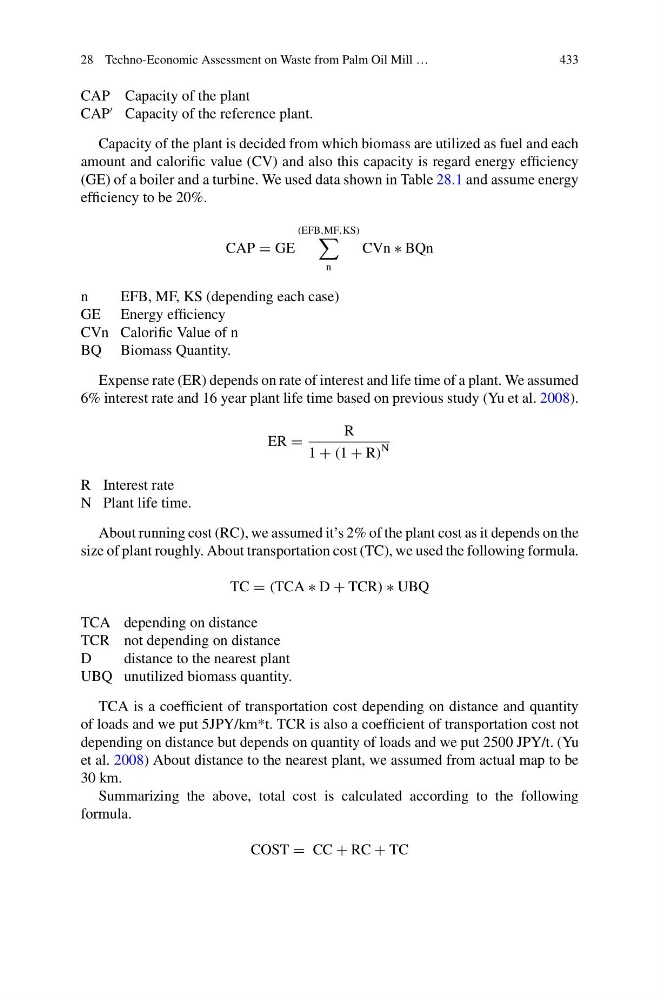
Capacity of the plant is decided from which biomass are utilized as fuel and each
amount and calorific value (CV) and also this capacity is regard energy efficiency
(GE) of a boiler and a turbine. We used data shown in Table 28.1 and assume energy
efficiency to be 20%.
CAP = GE
(EFB,MF,KS)
n
CVn ∗ BQn
n
EFB, MF, KS (depending each case)
GE Energy efficiency
CVn Calorific Value of n
BQ Biomass Quantity.
Expense rate (ER) depends on rate of interest and life time of a plant. We assumed
6% interest rate and 16 year plant life time based on previous study (Yu et al. 2008).
ER =
R
1 + (1 + R)
N
R Interest rate
N Plant life time.
About running cost (RC), we assumed it’s 2% of the plant cost as it depends on the
size of plant roughly. About transportation cost (TC), we used the following formula.
TC = (TCA ∗ D + TCR) ∗ UBQ
TCA depending on distance
TCR not depending on distance
D
distance to the nearest plant
UBQ unutilized biomass quantity.
TCA is a coefficient of transportation cost depending on distance and quantity
of loads and we put 5JPY/km*t. TCR is also a coefficient of transportation cost not
depending on distance but depends on quantity of loads and we put 2500 JPY/t. (Yu
et al. 2008) About distance to the nearest plant, we assumed from actual map to be
30 km.
Summarizing the above, total cost is calculated according to the following
formula.
COST = CC + RC + TC
433
CAP Capacity of the plant
CAP
Capacity of the reference plant.
Capacity of the plant is decided from which biomass are utilized as fuel and each
amount and calorific value (CV) and also this capacity is regard energy efficiency
(GE) of a boiler and a turbine. We used data shown in Table 28.1 and assume energy
efficiency to be 20%.
CAP = GE
(EFB,MF,KS)
n
CVn ∗ BQn
n
EFB, MF, KS (depending each case)
GE Energy efficiency
CVn Calorific Value of n
BQ Biomass Quantity.
Expense rate (ER) depends on rate of interest and life time of a plant. We assumed
6% interest rate and 16 year plant life time based on previous study (Yu et al. 2008).
ER =
R
1 + (1 + R)
N
R Interest rate
N Plant life time.
About running cost (RC), we assumed it’s 2% of the plant cost as it depends on the
size of plant roughly. About transportation cost (TC), we used the following formula.
TC = (TCA ∗ D + TCR) ∗ UBQ
TCA depending on distance
TCR not depending on distance
D
distance to the nearest plant
UBQ unutilized biomass quantity.
TCA is a coefficient of transportation cost depending on distance and quantity
of loads and we put 5JPY/km*t. TCR is also a coefficient of transportation cost not
depending on distance but depends on quantity of loads and we put 2500 JPY/t. (Yu
et al. 2008) About distance to the nearest plant, we assumed from actual map to be
30 km.
Summarizing the above, total cost is calculated according to the following
formula.
COST = CC + RC + TC