

422
T. Hishinuma et al.
Japan 2018). The GHG emissions associated with the use of agricultural machinery,
the indirect emissions, were calculated based on the operating hours and economic
life of machinery.
27.3 Results and Discussion
The range of GHG emissions from the results of LCA of the entire scenarios were
3283–5343 kg-CO 2 e/ha. These values were similar to the reported GHG emissions,
namely 2270 kg-CO 2 e/ha (Hokazono et al. 2012) and 5870 kg-CO 2 e/ha (Kurosawa et al. 2007) estimated using the LCA method. Basically, the values from the
LCA reflected emissions from consumed materials, hence the similarity between our
results and the reported values are considered to support the discussions based on
the outputs from our scenario analysis.
27.3.1 Comparing the Environmental Impacts Between
Organic Fertilizer and Conventional Scenarios
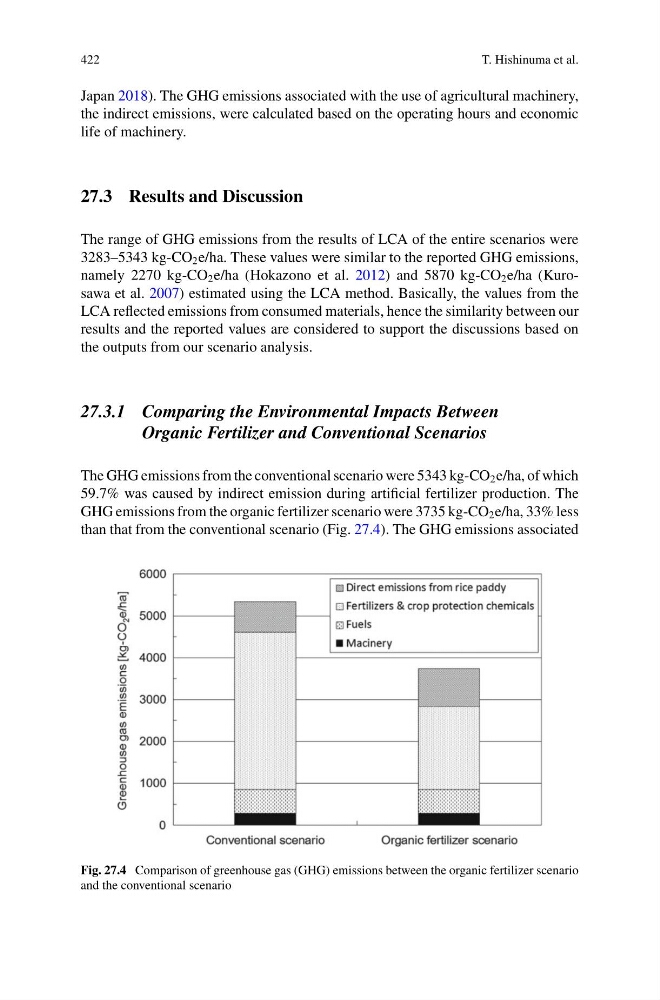
The GHG emissions from the conventional scenario were 5343 kg-CO 2 e/ha, of which
59.7% was caused by indirect emission during artificial fertilizer production. The
GHG emissions from the organic fertilizer scenario were 3735 kg-CO 2 e/ha, 33% less
than that from the conventional scenario (Fig. 27.4). The GHG emissions associated
Fig. 27.4 Comparison of greenhouse gas (GHG) emissions between the organic fertilizer scenario
and the conventional scenario
T. Hishinuma et al.
Japan 2018). The GHG emissions associated with the use of agricultural machinery,
the indirect emissions, were calculated based on the operating hours and economic
life of machinery.
27.3 Results and Discussion
The range of GHG emissions from the results of LCA of the entire scenarios were
3283–5343 kg-CO 2 e/ha. These values were similar to the reported GHG emissions,
namely 2270 kg-CO 2 e/ha (Hokazono et al. 2012) and 5870 kg-CO 2 e/ha (Kurosawa et al. 2007) estimated using the LCA method. Basically, the values from the
LCA reflected emissions from consumed materials, hence the similarity between our
results and the reported values are considered to support the discussions based on
the outputs from our scenario analysis.
27.3.1 Comparing the Environmental Impacts Between
Organic Fertilizer and Conventional Scenarios
The GHG emissions from the conventional scenario were 5343 kg-CO 2 e/ha, of which
59.7% was caused by indirect emission during artificial fertilizer production. The
GHG emissions from the organic fertilizer scenario were 3735 kg-CO 2 e/ha, 33% less
than that from the conventional scenario (Fig. 27.4). The GHG emissions associated
Fig. 27.4 Comparison of greenhouse gas (GHG) emissions between the organic fertilizer scenario
and the conventional scenario