

26 Ecological Cost-Benefit Analysis of a Sensor-Based Parking …
411
Table 26.6 “Park&Joy” emission saving potential Munich
Value
Unit
Number of sensors
1,052
pcs
Parking lots
8,897
pcs
Max. CO 2 emission savings (100% market share)
4,846,492
kgCO 2 eq/a
Max. NO x emission savings (100% market share)
4,520
kgNO x /a
Emission costs
16,165
kgCO 2 eq/a
Amortization
0.33
%
26.4.3 Influencing Factors
By evaluating the emission saving results, the identification of major influencing
factors is necessary to provide a sensitivity analysis of the cost-benefit model. Based
on the Hamburg scenario, with 11,000 parking lots and a four-year lifetime span of
servers and sensors, four of the following factors show the different influence on the
emission savings of “Park&Joy”.
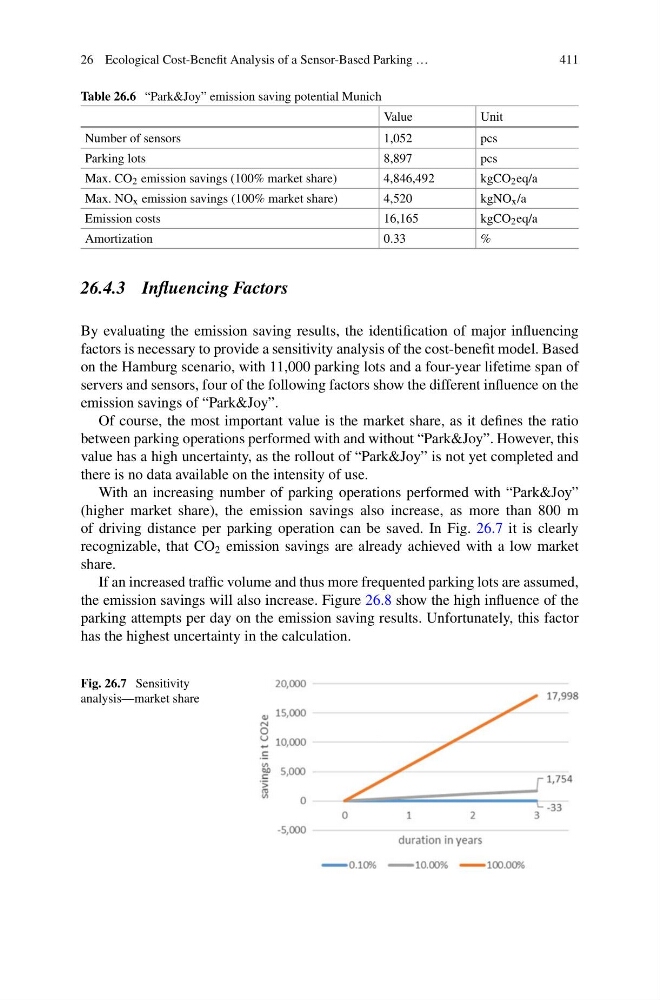
Of course, the most important value is the market share, as it defines the ratio
between parking operations performed with and without “Park&Joy”. However, this
value has a high uncertainty, as the rollout of “Park&Joy” is not yet completed and
there is no data available on the intensity of use.
With an increasing number of parking operations performed with “Park&Joy”
(higher market share), the emission savings also increase, as more than 800 m
of driving distance per parking operation can be saved. In Fig. 26.7 it is clearly
recognizable, that CO 2 emission savings are already achieved with a low market
share.
If an increased traffic volume and thus more frequented parking lots are assumed,
the emission savings will also increase. Figure 26.8 show the high influence of the
parking attempts per day on the emission saving results. Unfortunately, this factor
has the highest uncertainty in the calculation.
Fig. 26.7 Sensitivity
analysis—market share
411
Table 26.6 “Park&Joy” emission saving potential Munich
Value
Unit
Number of sensors
1,052
pcs
Parking lots
8,897
pcs
Max. CO 2 emission savings (100% market share)
4,846,492
kgCO 2 eq/a
Max. NO x emission savings (100% market share)
4,520
kgNO x /a
Emission costs
16,165
kgCO 2 eq/a
Amortization
0.33
%
26.4.3 Influencing Factors
By evaluating the emission saving results, the identification of major influencing
factors is necessary to provide a sensitivity analysis of the cost-benefit model. Based
on the Hamburg scenario, with 11,000 parking lots and a four-year lifetime span of
servers and sensors, four of the following factors show the different influence on the
emission savings of “Park&Joy”.
Of course, the most important value is the market share, as it defines the ratio
between parking operations performed with and without “Park&Joy”. However, this
value has a high uncertainty, as the rollout of “Park&Joy” is not yet completed and
there is no data available on the intensity of use.
With an increasing number of parking operations performed with “Park&Joy”
(higher market share), the emission savings also increase, as more than 800 m
of driving distance per parking operation can be saved. In Fig. 26.7 it is clearly
recognizable, that CO 2 emission savings are already achieved with a low market
share.
If an increased traffic volume and thus more frequented parking lots are assumed,
the emission savings will also increase. Figure 26.8 show the high influence of the
parking attempts per day on the emission saving results. Unfortunately, this factor
has the highest uncertainty in the calculation.
Fig. 26.7 Sensitivity
analysis—market share