

22 Adopting Life Cycle Assessment for Various Greenhouse …
355
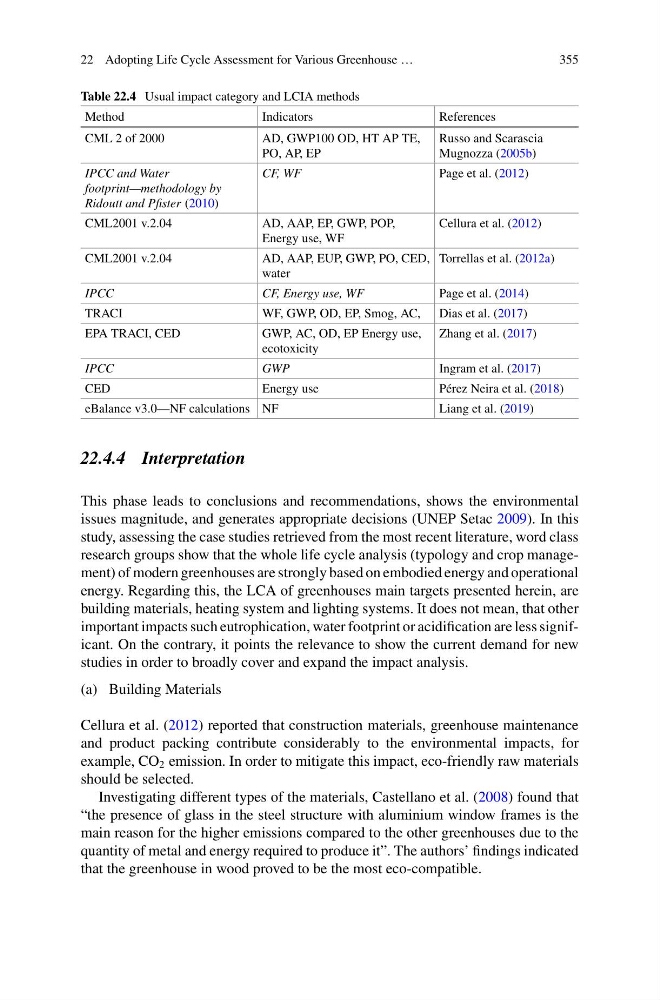
Table 22.4 Usual impact category and LCIA methods
Method
Indicators
References
CML 2 of 2000
AD, GWP100 OD, HT AP TE,
PO, AP, EP
Russo and Scarascia
Mugnozza (2005b)
IPCC and Water
footprint—methodology by
Ridoutt and Pfister (2010)
CF, WF
Page et al. (2012)
CML2001 v.2.04
AD, AAP, EP, GWP, POP,
Energy use, WF
Cellura et al. (2012)
CML2001 v.2.04
AD, AAP, EUP, GWP, PO, CED,
water
Torrellas et al. (2012a)
IPCC
CF, Energy use, WF
Page et al. (2014)
TRACI
WF, GWP, OD, EP, Smog, AC, Dias et al. (2017)
EPA TRACI, CED
GWP, AC, OD, EP Energy use,
ecotoxicity
Zhang et al. (2017)
IPCC
GWP
Ingram et al. (2017)
CED
Energy use
Pérez Neira et al. (2018)
eBalance v3.0—NF calculations NF
Liang et al. (2019)
22.4.4 Interpretation
This phase leads to conclusions and recommendations, shows the environmental
issues magnitude, and generates appropriate decisions (UNEP Setac 2009). In this
study, assessing the case studies retrieved from the most recent literature, word class
research groups show that the whole life cycle analysis (typology and crop management) of modern greenhouses are strongly based on embodied energy and operational
energy. Regarding this, the LCA of greenhouses main targets presented herein, are
building materials, heating system and lighting systems. It does not mean, that other
important impacts such eutrophication, water footprint or acidification are less significant. On the contrary, it points the relevance to show the current demand for new
studies in order to broadly cover and expand the impact analysis.
(a) Building Materials
Cellura et al. (2012) reported that construction materials, greenhouse maintenance
and product packing contribute considerably to the environmental impacts, for
example, CO 2 emission. In order to mitigate this impact, eco-friendly raw materials
should be selected.
Investigating different types of the materials, Castellano et al. (2008) found that
“the presence of glass in the steel structure with aluminium window frames is the
main reason for the higher emissions compared to the other greenhouses due to the
quantity of metal and energy required to produce it”. The authors’ findings indicated
that the greenhouse in wood proved to be the most eco-compatible.
355
Table 22.4 Usual impact category and LCIA methods
Method
Indicators
References
CML 2 of 2000
AD, GWP100 OD, HT AP TE,
PO, AP, EP
Russo and Scarascia
Mugnozza (2005b)
IPCC and Water
footprint—methodology by
Ridoutt and Pfister (2010)
CF, WF
Page et al. (2012)
CML2001 v.2.04
AD, AAP, EP, GWP, POP,
Energy use, WF
Cellura et al. (2012)
CML2001 v.2.04
AD, AAP, EUP, GWP, PO, CED,
water
Torrellas et al. (2012a)
IPCC
CF, Energy use, WF
Page et al. (2014)
TRACI
WF, GWP, OD, EP, Smog, AC, Dias et al. (2017)
EPA TRACI, CED
GWP, AC, OD, EP Energy use,
ecotoxicity
Zhang et al. (2017)
IPCC
GWP
Ingram et al. (2017)
CED
Energy use
Pérez Neira et al. (2018)
eBalance v3.0—NF calculations NF
Liang et al. (2019)
22.4.4 Interpretation
This phase leads to conclusions and recommendations, shows the environmental
issues magnitude, and generates appropriate decisions (UNEP Setac 2009). In this
study, assessing the case studies retrieved from the most recent literature, word class
research groups show that the whole life cycle analysis (typology and crop management) of modern greenhouses are strongly based on embodied energy and operational
energy. Regarding this, the LCA of greenhouses main targets presented herein, are
building materials, heating system and lighting systems. It does not mean, that other
important impacts such eutrophication, water footprint or acidification are less significant. On the contrary, it points the relevance to show the current demand for new
studies in order to broadly cover and expand the impact analysis.
(a) Building Materials
Cellura et al. (2012) reported that construction materials, greenhouse maintenance
and product packing contribute considerably to the environmental impacts, for
example, CO 2 emission. In order to mitigate this impact, eco-friendly raw materials
should be selected.
Investigating different types of the materials, Castellano et al. (2008) found that
“the presence of glass in the steel structure with aluminium window frames is the
main reason for the higher emissions compared to the other greenhouses due to the
quantity of metal and energy required to produce it”. The authors’ findings indicated
that the greenhouse in wood proved to be the most eco-compatible.