

354
A. Evangelista et al.
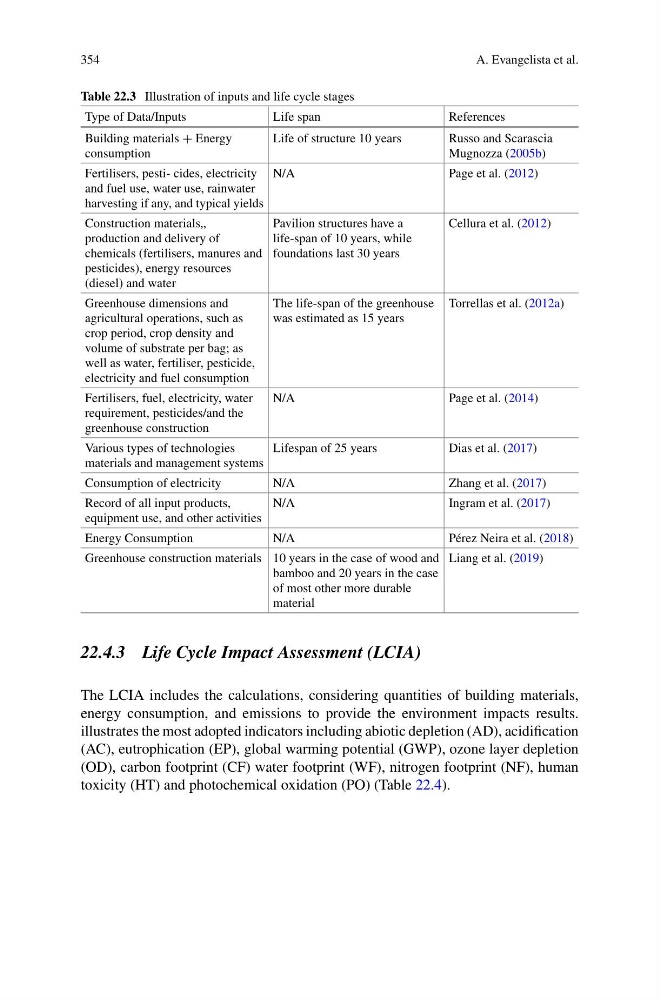
Table 22.3 Illustration of inputs and life cycle stages
Type of Data/Inputs
Life span
References
Building materials + Energy
consumption
Life of structure 10 years
Russo and Scarascia
Mugnozza (2005b)
Fertilisers, pesti- cides, electricity
and fuel use, water use, rainwater
harvesting if any, and typical yields
N/A
Page et al. (2012)
Construction materials„
production and delivery of
chemicals (fertilisers, manures and
pesticides), energy resources
(diesel) and water
Pavilion structures have a
life-span of 10 years, while
foundations last 30 years
Cellura et al. (2012)
Greenhouse dimensions and
agricultural operations, such as
crop period, crop density and
volume of substrate per bag; as
well as water, fertiliser, pesticide,
electricity and fuel consumption
The life-span of the greenhouse
was estimated as 15 years
Torrellas et al. (2012a)
Fertilisers, fuel, electricity, water
requirement, pesticides/and the
greenhouse construction
N/A
Page et al. (2014)
Various types of technologies
materials and management systems
Lifespan of 25 years
Dias et al. (2017)
Consumption of electricity
N/A
Zhang et al. (2017)
Record of all input products,
equipment use, and other activities
N/A
Ingram et al. (2017)
Energy Consumption
N/A
Pérez Neira et al. (2018)
Greenhouse construction materials 10 years in the case of wood and
bamboo and 20 years in the case
of most other more durable
material
Liang et al. (2019)
22.4.3 Life Cycle Impact Assessment (LCIA)
The LCIA includes the calculations, considering quantities of building materials,
energy consumption, and emissions to provide the environment impacts results.
illustrates the most adopted indicators including abiotic depletion (AD), acidification
(AC), eutrophication (EP), global warming potential (GWP), ozone layer depletion
(OD), carbon footprint (CF) water footprint (WF), nitrogen footprint (NF), human
toxicity (HT) and photochemical oxidation (PO) (Table 22.4).
A. Evangelista et al.
Table 22.3 Illustration of inputs and life cycle stages
Type of Data/Inputs
Life span
References
Building materials + Energy
consumption
Life of structure 10 years
Russo and Scarascia
Mugnozza (2005b)
Fertilisers, pesti- cides, electricity
and fuel use, water use, rainwater
harvesting if any, and typical yields
N/A
Page et al. (2012)
Construction materials„
production and delivery of
chemicals (fertilisers, manures and
pesticides), energy resources
(diesel) and water
Pavilion structures have a
life-span of 10 years, while
foundations last 30 years
Cellura et al. (2012)
Greenhouse dimensions and
agricultural operations, such as
crop period, crop density and
volume of substrate per bag; as
well as water, fertiliser, pesticide,
electricity and fuel consumption
The life-span of the greenhouse
was estimated as 15 years
Torrellas et al. (2012a)
Fertilisers, fuel, electricity, water
requirement, pesticides/and the
greenhouse construction
N/A
Page et al. (2014)
Various types of technologies
materials and management systems
Lifespan of 25 years
Dias et al. (2017)
Consumption of electricity
N/A
Zhang et al. (2017)
Record of all input products,
equipment use, and other activities
N/A
Ingram et al. (2017)
Energy Consumption
N/A
Pérez Neira et al. (2018)
Greenhouse construction materials 10 years in the case of wood and
bamboo and 20 years in the case
of most other more durable
material
Liang et al. (2019)
22.4.3 Life Cycle Impact Assessment (LCIA)
The LCIA includes the calculations, considering quantities of building materials,
energy consumption, and emissions to provide the environment impacts results.
illustrates the most adopted indicators including abiotic depletion (AD), acidification
(AC), eutrophication (EP), global warming potential (GWP), ozone layer depletion
(OD), carbon footprint (CF) water footprint (WF), nitrogen footprint (NF), human
toxicity (HT) and photochemical oxidation (PO) (Table 22.4).