

20 Consideration of Communication Methods with the Next …
323
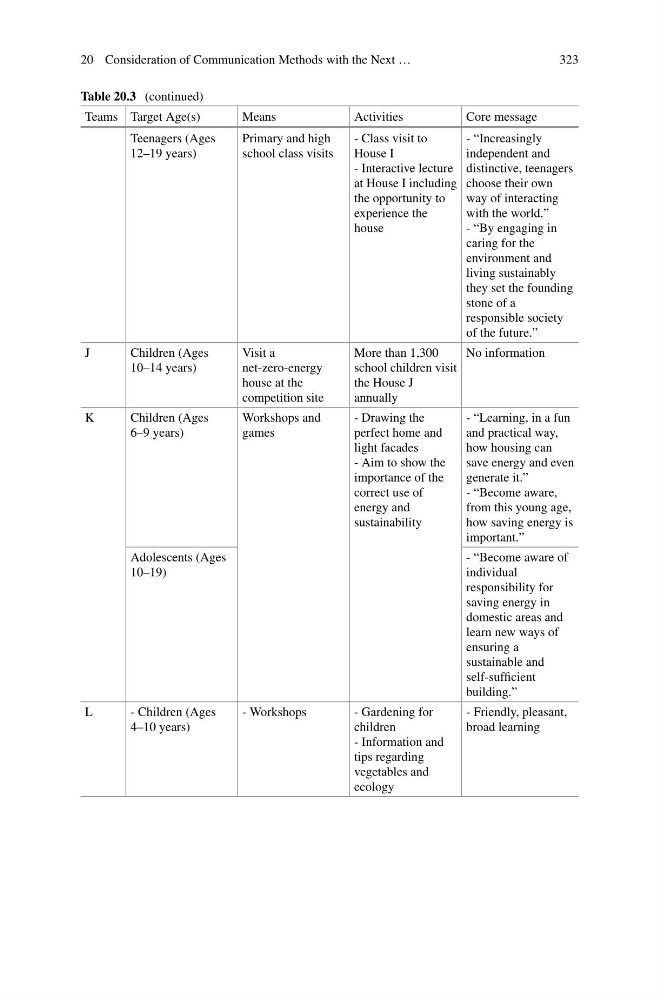
Table 20.3 (continued)
Teams Target Age(s)
Means
Activities
Core message
Teenagers (Ages
12–19 years)
Primary and high
school class visits
- Class visit to
House I
- Interactive lecture
at House I including
the opportunity to
experience the
house
- “Increasingly
independent and
distinctive, teenagers
choose their own
way of interacting
with the world.”
- “By engaging in
caring for the
environment and
living sustainably
they set the founding
stone of a
responsible society
of the future.”
J
Children (Ages
10–14 years)
Visit a
net-zero-energy
house at the
competition site
More than 1,300
school children visit
the House J
annually
No information
K
Children (Ages
6–9 years)
Workshops and
games
- Drawing the
perfect home and
light facades
- Aim to show the
importance of the
correct use of
energy and
sustainability
- “Learning, in a fun
and practical way,
how housing can
save energy and even
generate it.”
- “Become aware,
from this young age,
how saving energy is
important.”
Adolescents (Ages
10–19)
- “Become aware of
individual
responsibility for
saving energy in
domestic areas and
learn new ways of
ensuring a
sustainable and
self-sufficient
building.”
L
- Children (Ages
4–10 years)
- Workshops
- Gardening for
children
- Information and
tips regarding
vegetables and
ecology
- Friendly, pleasant,
broad learning
323
Table 20.3 (continued)
Teams Target Age(s)
Means
Activities
Core message
Teenagers (Ages
12–19 years)
Primary and high
school class visits
- Class visit to
House I
- Interactive lecture
at House I including
the opportunity to
experience the
house
- “Increasingly
independent and
distinctive, teenagers
choose their own
way of interacting
with the world.”
- “By engaging in
caring for the
environment and
living sustainably
they set the founding
stone of a
responsible society
of the future.”
J
Children (Ages
10–14 years)
Visit a
net-zero-energy
house at the
competition site
More than 1,300
school children visit
the House J
annually
No information
K
Children (Ages
6–9 years)
Workshops and
games
- Drawing the
perfect home and
light facades
- Aim to show the
importance of the
correct use of
energy and
sustainability
- “Learning, in a fun
and practical way,
how housing can
save energy and even
generate it.”
- “Become aware,
from this young age,
how saving energy is
important.”
Adolescents (Ages
10–19)
- “Become aware of
individual
responsibility for
saving energy in
domestic areas and
learn new ways of
ensuring a
sustainable and
self-sufficient
building.”
L
- Children (Ages
4–10 years)
- Workshops
- Gardening for
children
- Information and
tips regarding
vegetables and
ecology
- Friendly, pleasant,
broad learning