

324
S. Tajima et al.
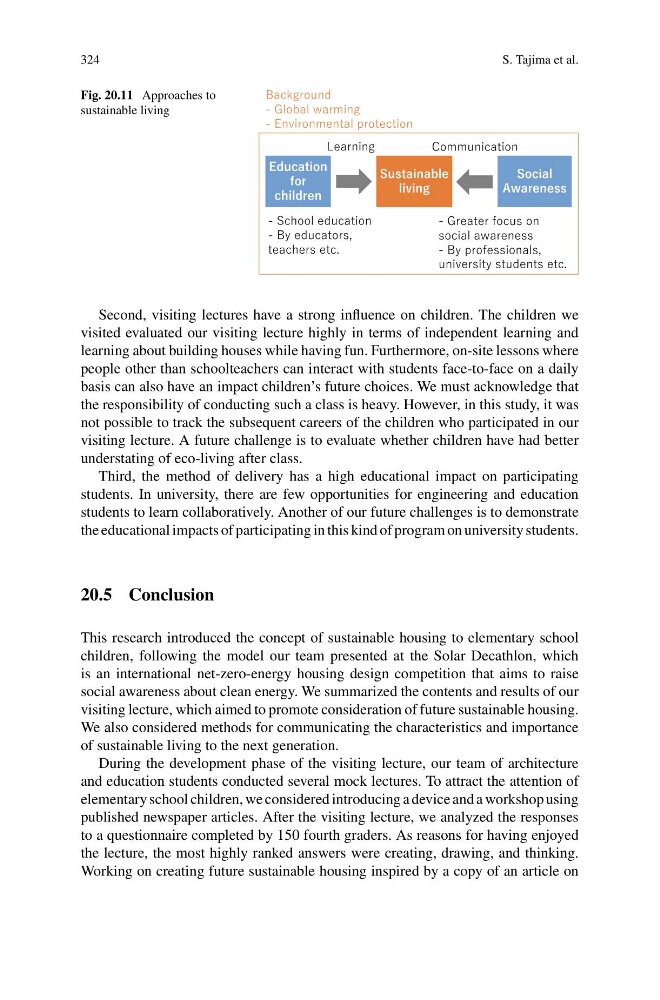
Fig. 20.11 Approaches to
sustainable living
Second, visiting lectures have a strong influence on children. The children we
visited evaluated our visiting lecture highly in terms of independent learning and
learning about building houses while having fun. Furthermore, on-site lessons where
people other than schoolteachers can interact with students face-to-face on a daily
basis can also have an impact children’s future choices. We must acknowledge that
the responsibility of conducting such a class is heavy. However, in this study, it was
not possible to track the subsequent careers of the children who participated in our
visiting lecture. A future challenge is to evaluate whether children have had better
understating of eco-living after class.
Third, the method of delivery has a high educational impact on participating
students. In university, there are few opportunities for engineering and education
students to learn collaboratively. Another of our future challenges is to demonstrate
the educational impacts of participating in this kind of program on university students.
20.5 Conclusion
This research introduced the concept of sustainable housing to elementary school
children, following the model our team presented at the Solar Decathlon, which
is an international net-zero-energy housing design competition that aims to raise
social awareness about clean energy. We summarized the contents and results of our
visiting lecture, which aimed to promote consideration of future sustainable housing.
We also considered methods for communicating the characteristics and importance
of sustainable living to the next generation.
During the development phase of the visiting lecture, our team of architecture
and education students conducted several mock lectures. To attract the attention of
elementary school children, we considered introducing a device and a workshop using
published newspaper articles. After the visiting lecture, we analyzed the responses
to a questionnaire completed by 150 fourth graders. As reasons for having enjoyed
the lecture, the most highly ranked answers were creating, drawing, and thinking.
Working on creating future sustainable housing inspired by a copy of an article on
S. Tajima et al.
Fig. 20.11 Approaches to
sustainable living
Second, visiting lectures have a strong influence on children. The children we
visited evaluated our visiting lecture highly in terms of independent learning and
learning about building houses while having fun. Furthermore, on-site lessons where
people other than schoolteachers can interact with students face-to-face on a daily
basis can also have an impact children’s future choices. We must acknowledge that
the responsibility of conducting such a class is heavy. However, in this study, it was
not possible to track the subsequent careers of the children who participated in our
visiting lecture. A future challenge is to evaluate whether children have had better
understating of eco-living after class.
Third, the method of delivery has a high educational impact on participating
students. In university, there are few opportunities for engineering and education
students to learn collaboratively. Another of our future challenges is to demonstrate
the educational impacts of participating in this kind of program on university students.
20.5 Conclusion
This research introduced the concept of sustainable housing to elementary school
children, following the model our team presented at the Solar Decathlon, which
is an international net-zero-energy housing design competition that aims to raise
social awareness about clean energy. We summarized the contents and results of our
visiting lecture, which aimed to promote consideration of future sustainable housing.
We also considered methods for communicating the characteristics and importance
of sustainable living to the next generation.
During the development phase of the visiting lecture, our team of architecture
and education students conducted several mock lectures. To attract the attention of
elementary school children, we considered introducing a device and a workshop using
published newspaper articles. After the visiting lecture, we analyzed the responses
to a questionnaire completed by 150 fourth graders. As reasons for having enjoyed
the lecture, the most highly ranked answers were creating, drawing, and thinking.
Working on creating future sustainable housing inspired by a copy of an article on