

20 Consideration of Communication Methods with the Next …
321
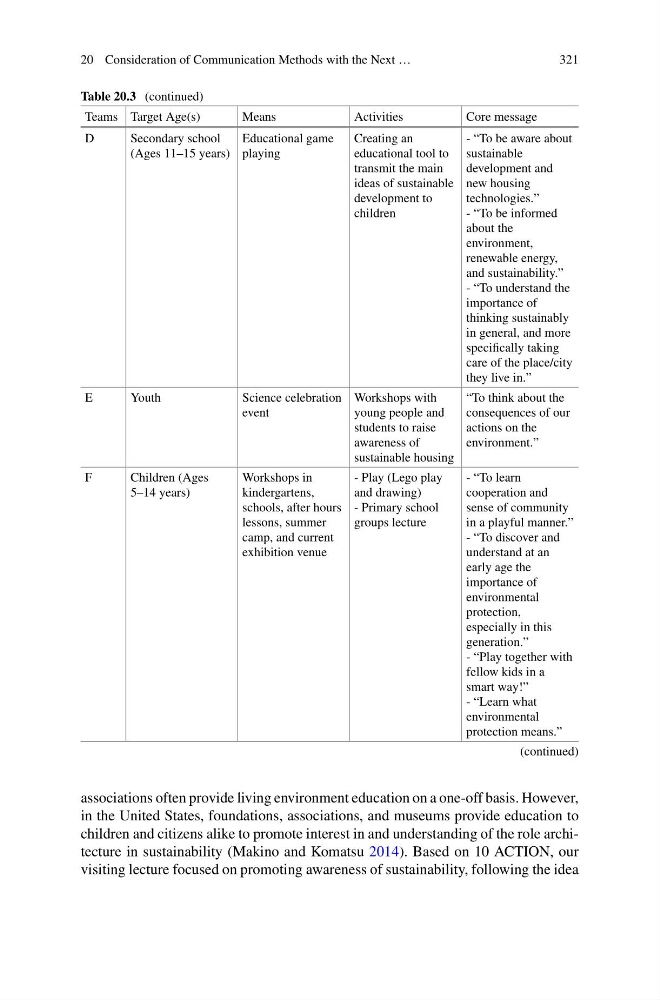
Table 20.3 (continued)
Teams Target Age(s)
Means
Activities
Core message
D
Secondary school
(Ages 11–15 years)
Educational game
playing
Creating an
educational tool to
transmit the main
ideas of sustainable
development to
children
- “To be aware about
sustainable
development and
new housing
technologies.”
- “To be informed
about the
environment,
renewable energy,
and sustainability.”
- “To understand the
importance of
thinking sustainably
in general, and more
specifically taking
care of the place/city
they live in.”
E
Youth
Science celebration
event
Workshops with
young people and
students to raise
awareness of
sustainable housing
“To think about the
consequences of our
actions on the
environment.”
F
Children (Ages
5–14 years)
Workshops in
kindergartens,
schools, after hours
lessons, summer
camp, and current
exhibition venue
- Play (Lego play
and drawing)
- Primary school
groups lecture
- “To learn
cooperation and
sense of community
in a playful manner.”
- “To discover and
understand at an
early age the
importance of
environmental
protection,
especially in this
generation.”
- “Play together with
fellow kids in a
smart way!”
- “Learn what
environmental
protection means.”
(continued)
associations often provide living environment education on a one-off basis. However,
in the United States, foundations, associations, and museums provide education to
children and citizens alike to promote interest in and understanding of the role architecture in sustainability (Makino and Komatsu 2014). Based on 10 ACTION, our
visiting lecture focused on promoting awareness of sustainability, following the idea
321
Table 20.3 (continued)
Teams Target Age(s)
Means
Activities
Core message
D
Secondary school
(Ages 11–15 years)
Educational game
playing
Creating an
educational tool to
transmit the main
ideas of sustainable
development to
children
- “To be aware about
sustainable
development and
new housing
technologies.”
- “To be informed
about the
environment,
renewable energy,
and sustainability.”
- “To understand the
importance of
thinking sustainably
in general, and more
specifically taking
care of the place/city
they live in.”
E
Youth
Science celebration
event
Workshops with
young people and
students to raise
awareness of
sustainable housing
“To think about the
consequences of our
actions on the
environment.”
F
Children (Ages
5–14 years)
Workshops in
kindergartens,
schools, after hours
lessons, summer
camp, and current
exhibition venue
- Play (Lego play
and drawing)
- Primary school
groups lecture
- “To learn
cooperation and
sense of community
in a playful manner.”
- “To discover and
understand at an
early age the
importance of
environmental
protection,
especially in this
generation.”
- “Play together with
fellow kids in a
smart way!”
- “Learn what
environmental
protection means.”
(continued)
associations often provide living environment education on a one-off basis. However,
in the United States, foundations, associations, and museums provide education to
children and citizens alike to promote interest in and understanding of the role architecture in sustainability (Makino and Komatsu 2014). Based on 10 ACTION, our
visiting lecture focused on promoting awareness of sustainability, following the idea