

280
Z. Liang et al.
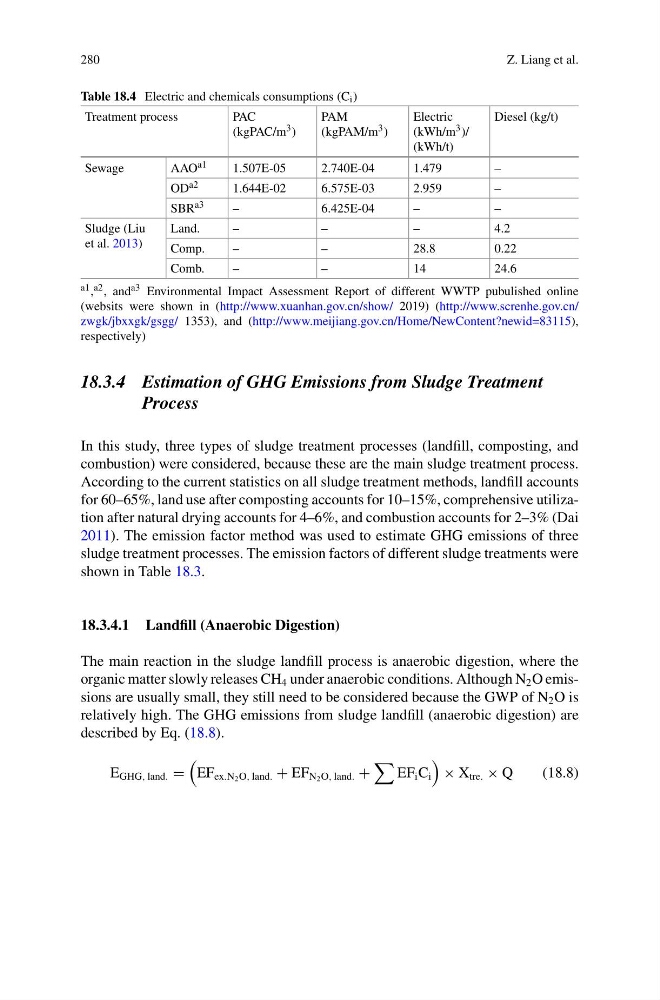
Table 18.4 Electric and chemicals consumptions (C i )
Treatment process
PAC
(kgPAC/m 3 )
PAM
(kgPAM/m 3 )
Electric
(kWh/m 3 )/
(kWh/t)
Diesel (kg/t)
Sewage
AAO a1
1.507E-05
2.740E-04
1.479
–
OD a2
1.644E-02
6.575E-03
2.959
–
SBR a3
–
6.425E-04
–
–
Sludge (Liu
et al. 2013)
Land.
–
–
–
4.2
Comp.
–
–
28.8
0.22
Comb.
–
–
14
24.6
a1 , a2 , and a3 Environmental Impact Assessment Report of different WWTP pubulished online
(websits were shown in (http://www.xuanhan.gov.cn/show/ 2019) (http://www.screnhe.gov.cn/
zwgk/jbxxgk/gsgg/ 1353), and (http://www.meijiang.gov.cn/Home/NewContent?newid=83115),
respectively)
18.3.4 Estimation of GHG Emissions from Sludge Treatment
Process
In this study, three types of sludge treatment processes (landfill, composting, and
combustion) were considered, because these are the main sludge treatment process.
According to the current statistics on all sludge treatment methods, landfill accounts
for 60–65%, land use after composting accounts for 10–15%, comprehensive utilization after natural drying accounts for 4–6%, and combustion accounts for 2–3% (Dai
2011). The emission factor method was used to estimate GHG emissions of three
sludge treatment processes. The emission factors of different sludge treatments were
shown in Table 18.3.
18.3.4.1 Landfill (Anaerobic Digestion)
The main reaction in the sludge landfill process is anaerobic digestion, where the
organic matter slowly releases CH 4 under anaerobic conditions. Although N 2 O emissions are usually small, they still need to be considered because the GWP of N 2 O is
relatively high. The GHG emissions from sludge landfill (anaerobic digestion) are
described by Eq. (18.8).
E GHG, land. =
EF ex.N 2 O, land. + EF N 2 O, land. +
EF i C i
× X tre. × Q
(18.8)
Z. Liang et al.
Table 18.4 Electric and chemicals consumptions (C i )
Treatment process
PAC
(kgPAC/m 3 )
PAM
(kgPAM/m 3 )
Electric
(kWh/m 3 )/
(kWh/t)
Diesel (kg/t)
Sewage
AAO a1
1.507E-05
2.740E-04
1.479
–
OD a2
1.644E-02
6.575E-03
2.959
–
SBR a3
–
6.425E-04
–
–
Sludge (Liu
et al. 2013)
Land.
–
–
–
4.2
Comp.
–
–
28.8
0.22
Comb.
–
–
14
24.6
a1 , a2 , and a3 Environmental Impact Assessment Report of different WWTP pubulished online
(websits were shown in (http://www.xuanhan.gov.cn/show/ 2019) (http://www.screnhe.gov.cn/
zwgk/jbxxgk/gsgg/ 1353), and (http://www.meijiang.gov.cn/Home/NewContent?newid=83115),
respectively)
18.3.4 Estimation of GHG Emissions from Sludge Treatment
Process
In this study, three types of sludge treatment processes (landfill, composting, and
combustion) were considered, because these are the main sludge treatment process.
According to the current statistics on all sludge treatment methods, landfill accounts
for 60–65%, land use after composting accounts for 10–15%, comprehensive utilization after natural drying accounts for 4–6%, and combustion accounts for 2–3% (Dai
2011). The emission factor method was used to estimate GHG emissions of three
sludge treatment processes. The emission factors of different sludge treatments were
shown in Table 18.3.
18.3.4.1 Landfill (Anaerobic Digestion)
The main reaction in the sludge landfill process is anaerobic digestion, where the
organic matter slowly releases CH 4 under anaerobic conditions. Although N 2 O emissions are usually small, they still need to be considered because the GWP of N 2 O is
relatively high. The GHG emissions from sludge landfill (anaerobic digestion) are
described by Eq. (18.8).
E GHG, land. =
EF ex.N 2 O, land. + EF N 2 O, land. +
EF i C i
× X tre. × Q
(18.8)