

18 Study on the Quantitative Evaluation of Greenhouse Gas (GHG) …
281
18.3.4.2 Composting (Aerobic Digestion)
The main reaction in the sludge composting process is aerobic digestion, where the
organic matter, which is oxidized, releases CO 2 under aerobic conditions. N 2 O emissions were also considered in this study. The GHG emissions from sludge composting
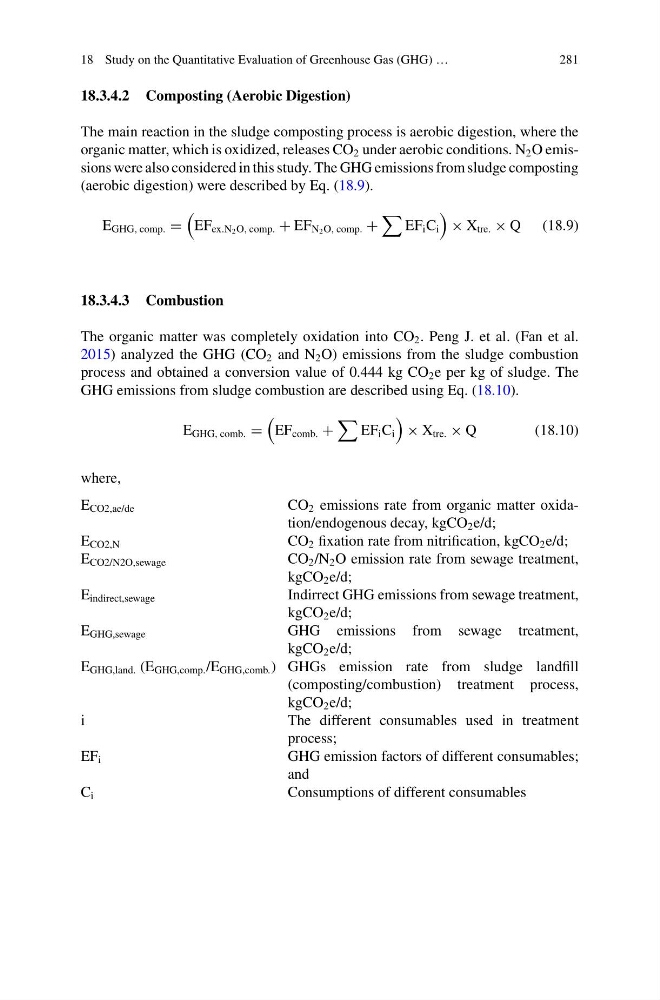
(aerobic digestion) were described by Eq. (18.9).
E GHG, comp. =
EF ex.N 2 O, comp. + EF N 2 O, comp. +
EF i C i
× X tre. × Q (18.9)
18.3.4.3 Combustion
The organic matter was completely oxidation into CO 2 . Peng J. et al. (Fan et al.
2015) analyzed the GHG (CO 2 and N 2 O) emissions from the sludge combustion
process and obtained a conversion value of 0.444 kg CO 2 e per kg of sludge. The
GHG emissions from sludge combustion are described using Eq. (18.10).
E GHG, comb. =
EF comb. +
EF i C i
× X tre. × Q
(18.10)
where,
E CO2,ae/de
CO 2 emissions rate from organic matter oxidation/endogenous decay, kgCO 2 e/d;
E CO2,N
CO 2 fixation rate from nitrification, kgCO 2 e/d;
E CO2/N2O,sewage
CO 2 /N 2 O emission rate from sewage treatment,
kgCO 2 e/d;
E indirect,sewage
Indirrect GHG emissions from sewage treatment,
kgCO 2 e/d;
E GHG,sewage
GHG emissions from sewage treatment,
kgCO 2 e/d;
E GHG,land. (E GHG,comp. /E GHG,comb. ) GHGs emission rate from sludge landfill
(composting/combustion) treatment process,
kgCO 2 e/d;
i
The different consumables used in treatment
process;
EF i
GHG emission factors of different consumables;
and
C i
Consumptions of different consumables
281
18.3.4.2 Composting (Aerobic Digestion)
The main reaction in the sludge composting process is aerobic digestion, where the
organic matter, which is oxidized, releases CO 2 under aerobic conditions. N 2 O emissions were also considered in this study. The GHG emissions from sludge composting
(aerobic digestion) were described by Eq. (18.9).
E GHG, comp. =
EF ex.N 2 O, comp. + EF N 2 O, comp. +
EF i C i
× X tre. × Q (18.9)
18.3.4.3 Combustion
The organic matter was completely oxidation into CO 2 . Peng J. et al. (Fan et al.
2015) analyzed the GHG (CO 2 and N 2 O) emissions from the sludge combustion
process and obtained a conversion value of 0.444 kg CO 2 e per kg of sludge. The
GHG emissions from sludge combustion are described using Eq. (18.10).
E GHG, comb. =
EF comb. +
EF i C i
× X tre. × Q
(18.10)
where,
E CO2,ae/de
CO 2 emissions rate from organic matter oxidation/endogenous decay, kgCO 2 e/d;
E CO2,N
CO 2 fixation rate from nitrification, kgCO 2 e/d;
E CO2/N2O,sewage
CO 2 /N 2 O emission rate from sewage treatment,
kgCO 2 e/d;
E indirect,sewage
Indirrect GHG emissions from sewage treatment,
kgCO 2 e/d;
E GHG,sewage
GHG emissions from sewage treatment,
kgCO 2 e/d;
E GHG,land. (E GHG,comp. /E GHG,comb. ) GHGs emission rate from sludge landfill
(composting/combustion) treatment process,
kgCO 2 e/d;
i
The different consumables used in treatment
process;
EF i
GHG emission factors of different consumables;
and
C i
Consumptions of different consumables