

248
S. Kosai and E. Yamasue
of peripheral cities, significant differences of spatial transport energy intensity are
hardly observed regardless of the scale of areas.
The modal split highly affects these trends. The modal split of automobile is
much greater in peripheral cities than in central cities, while the modal split of walk,
bicycle is much greater in central cities than in peripheral cities. Additionally, the
higher modal split of electric train can be seen in the greater scale of areas. The
electric trains in central cities in most of major metropolitan areas contributes to
20% of modal split, but in Sapporo, Sendai and Fukuoka in the five sub-metropolitan
areas contributes to approximately 10% and the rest cities only less than 5%.
To generalize, the three major metropolitan areas have a wide range of STEI gap
between central and peripheral cities. In this area, the further the peripheral cities are
away from the central city, the greater the STEI gap is, which indicates that the spatial
transport energy intensity in the peripheral city would decrease with distance from
the central city. Meanwhile, the sub-metropolitan areas and regional urban areas with
the higher spatial transport energy intensity (e.g. Hiroshima, Sendai, Kanazawa and
Matsue) have a smaller range of STEI gap even in the middle distance. This would
be because the automobile-oriented transport society has been already developed
in both central and peripheral cities. In fact, the most cities other than the major
metropolitan areas reach 60% of automobile modal split.
Finally, the relations between central and peripheral cities from the perspectives
of spatial transport energy intensity and city scale is analyzed. Additionally, a hierarchical cluster analysis was conducted to determine which combinations of central
and peripheral cities are clustered together from the perspectives of city scale and
the gap of spatial transport energy intensity. The cluster analysis was executed on a
basis of square Euclidian distance and Ward’s method (Ward 1963). Elbow method
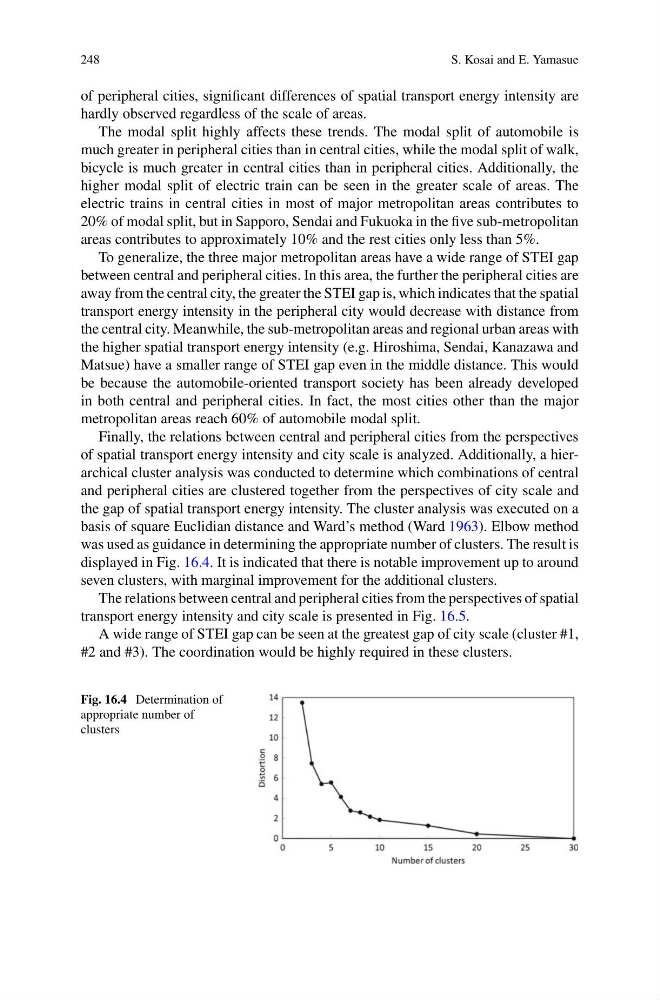
was used as guidance in determining the appropriate number of clusters. The result is
displayed in Fig. 16.4. It is indicated that there is notable improvement up to around
seven clusters, with marginal improvement for the additional clusters.
The relations between central and peripheral cities from the perspectives of spatial
transport energy intensity and city scale is presented in Fig. 16.5.
A wide range of STEI gap can be seen at the greatest gap of city scale (cluster #1,
#2 and #3). The coordination would be highly required in these clusters.
Fig. 16.4 Determination of
appropriate number of
clusters
S. Kosai and E. Yamasue
of peripheral cities, significant differences of spatial transport energy intensity are
hardly observed regardless of the scale of areas.
The modal split highly affects these trends. The modal split of automobile is
much greater in peripheral cities than in central cities, while the modal split of walk,
bicycle is much greater in central cities than in peripheral cities. Additionally, the
higher modal split of electric train can be seen in the greater scale of areas. The
electric trains in central cities in most of major metropolitan areas contributes to
20% of modal split, but in Sapporo, Sendai and Fukuoka in the five sub-metropolitan
areas contributes to approximately 10% and the rest cities only less than 5%.
To generalize, the three major metropolitan areas have a wide range of STEI gap
between central and peripheral cities. In this area, the further the peripheral cities are
away from the central city, the greater the STEI gap is, which indicates that the spatial
transport energy intensity in the peripheral city would decrease with distance from
the central city. Meanwhile, the sub-metropolitan areas and regional urban areas with
the higher spatial transport energy intensity (e.g. Hiroshima, Sendai, Kanazawa and
Matsue) have a smaller range of STEI gap even in the middle distance. This would
be because the automobile-oriented transport society has been already developed
in both central and peripheral cities. In fact, the most cities other than the major
metropolitan areas reach 60% of automobile modal split.
Finally, the relations between central and peripheral cities from the perspectives
of spatial transport energy intensity and city scale is analyzed. Additionally, a hierarchical cluster analysis was conducted to determine which combinations of central
and peripheral cities are clustered together from the perspectives of city scale and
the gap of spatial transport energy intensity. The cluster analysis was executed on a
basis of square Euclidian distance and Ward’s method (Ward 1963). Elbow method
was used as guidance in determining the appropriate number of clusters. The result is
displayed in Fig. 16.4. It is indicated that there is notable improvement up to around
seven clusters, with marginal improvement for the additional clusters.
The relations between central and peripheral cities from the perspectives of spatial
transport energy intensity and city scale is presented in Fig. 16.5.
A wide range of STEI gap can be seen at the greatest gap of city scale (cluster #1,
#2 and #3). The coordination would be highly required in these clusters.
Fig. 16.4 Determination of
appropriate number of
clusters